

Do you know which hammer to use when? With so many types available, it’s easy to feel unsure. This guide clearly explains the key types, functions, and scenarios for each jewelry hammer—helping you choose with confidence and master your craft.
Jewelry Hammer Usage Quick Reference Table
| No. | Hammer Name | Key Features | Main Uses | Effects | Applicable Scenarios (Quick Reference) |
| 1 | Planning Hammer (Planishing) | Highly polished flat surfaces | Flattening, removing rough hammer marks | Smooth, flat surfaces | Final surface finishing |
| 2 | Ball Pein Hammer | One end flat, one end hemispherical | Riveting, metal hardening | Uniform dotted or hardened riveting | Basic texture, riveting processes |
| 3 | Texturing Hammer | Pre-set patterns on the working surface | Quickly add decorative patterns | Special decorative textures | Decorative surface creation |
| 4 | Chasing Hammer | Large impact surface, slender handle | Driving punch for relief/carving | Three-dimensional relief or detailed pattern carving | Complex carving work (Repoussé) |
| 5 | Raising Hammer | Slender rectangular head | Lifting or bending metal into hollow shapes | Forming arcs/hollow bodies | Making vessels or hollow parts |
| 6 | Riveting Hammer | One end flat, one end narrow wedge | Precision riveting, spreading the rivet shaft | Flat and firmly connected parts | Precise multi-layered connections |
| 7 | Cross Peen Hammer | One end flat, the other flat wedge-shaped | Extending, forging, and stretching metal | Metal thinning and shaping | Metal forging and stretching |
| 8 | Box/Bordering Hammer | Sharp or angled square face | Hammer out clean edges or creases | Clearly defined geometric boundaries | Boxes, containers, or sharp-angled pieces |
| 9 | Nylon Mallet | Hard nylon head (non-metallic) | Correcting/hammering without damaging the surface | No trace hammering | Adjusting rings and correcting bends |
| 10 | Rawhide Mallet | Elastic rawhide rolled | Extremely gentle shaping tool | Soft shaping, leaving no marks | Shaping with high surface requirements |
| 11 | Brass/Lead Hammer | Head made of metal softer than steel | Hammering steel punches, protecting the tool head | Prevents tool damage | Precision tool driving and stamping |
1. Planishing Hammer
The Planishing Hammer is arguably the most essential shaping tool for metalworkers.
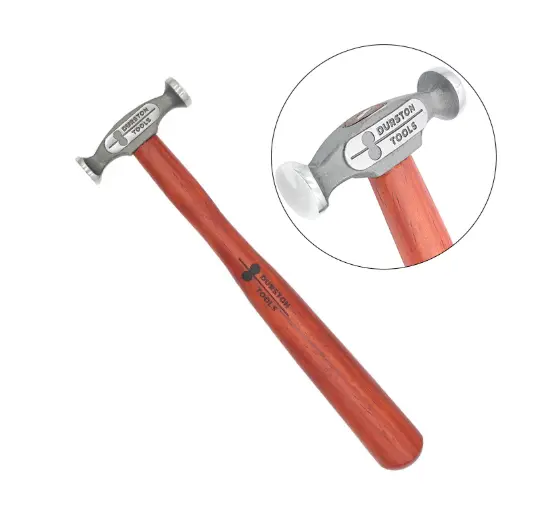
- Features: Usually has a highly polished flat or slightly convex surface. The mirror-smooth surface is crucial to prevent transferring imperfections to the metal.
- Main Uses: Flattening metal surfaces, removing rough hammer marks left by initial shaping, and final smoothing of the surface (planishing). This process also helps to gently harden the metal.
- Applicable Scenarios: Final surface finishing of shaped metal parts, such as earring blanks, flat pendants, or large sheet sections that need a professional polish before buffing.
2. Ball Pein Hammer
A standard workhorse in any metalsmithing kit, the Ball Pein Hammer is versatile and rugged.
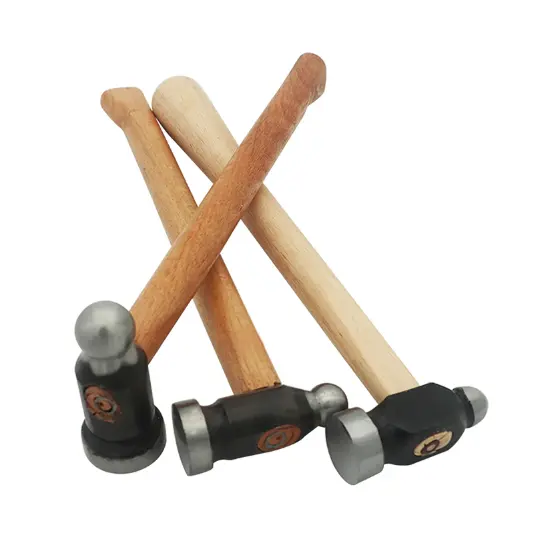
- Features: Flat-headed at one end, hemispherical (ball-shaped) at the other.
- Main Uses: Primarily used for riveting—the flat end starts the rivet, and the round end peens (mushrooms) the metal to secure the joint. It’s also vital for hardening metal after annealing. The round end is excellent for creating a classic, uniform dotted texture.
- Applicable Scenarios: Riveting processes, increasing the structural strength of components, and basic texture creation on ring shanks or bangle bracelets.
3. Texturing Hammer
If you want your piece to stand out, a Texturing Hammer provides immediate decorative impact.
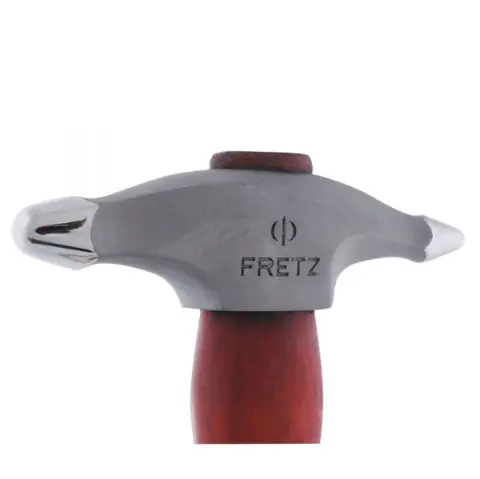
- Features: The working surfaces of the head have pre-set patterns (e.g., striped, checkered, dimpled).
- Main Uses: Quickly and evenly hammer specific decorative textures onto metal surfaces to enhance visual appeal and hide minor surface imperfections.
- Applicable Scenarios: Creating jewelry requiring special surface effects, such as the decorative surfaces for wide bands, cuffs, or pendants.
- Special Note: Interchangeable-head texturing hammers are a variation of this category, often used by beginners, offering a variety of texture options in one tool set.
4. Chasing Hammer
The Chasing Hammer is designed for precision and control in fine-detail work.
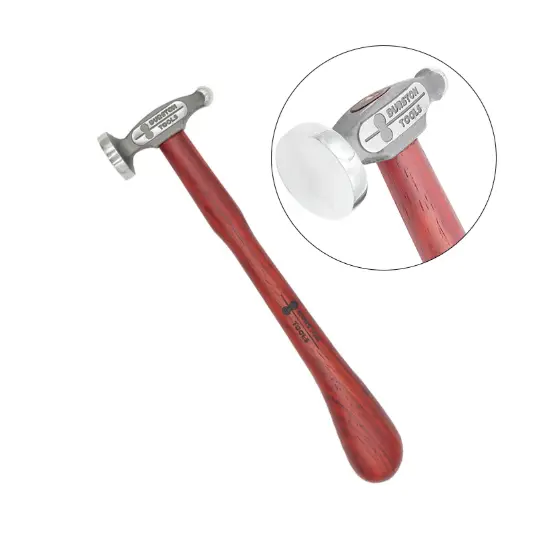
- Features: Compact and lightweight, it features a large, round striking surface and a slender, balancing handle that aids in controlled, repetitive strikes.
- Main Uses: Functions as a driving tool, used with chasing punches for fine work such as relief sculpting (Repoussé) and chasing (Chasing).
- Applicable Scenarios: Creating complex metal reliefs and detailed patterns, often used on bezels or large copper/silver plaques.
5. Raising Hammer
Essential for forming three-dimensional, hollow metal objects.
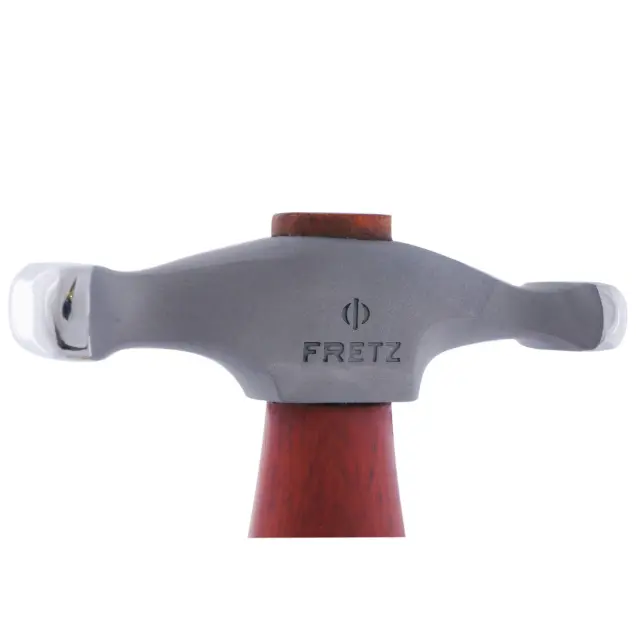
- Features: Long and slender head with two elongated rectangular working surfaces.
- Main Uses: Specifically used for raising or bending metalware—a process that forms hollow shapes (vessels) from flat sheets.
- Applicable Scenarios: Creating hollow jewelry parts or vessels, such as cups, small boxes, or bowl-shaped pendants.
6. Riveting Hammer
This specialized tool ensures that your mechanical connections are clean and secure.
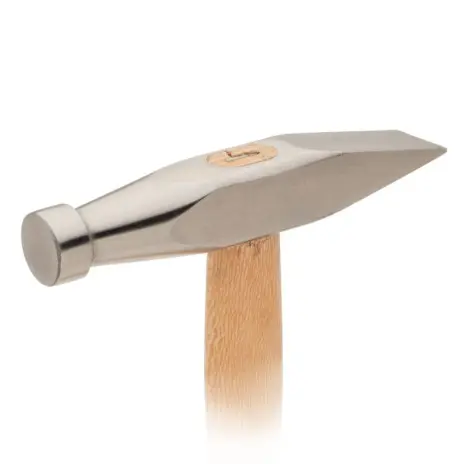
- Features: Small head, flat at one end and narrow wedge-shaped at the other.
- Main Uses: Specifically used for fine riveting; the wedge-shaped end is used to precisely spread the rivet’s axis before the flat end secures it.
- Applicable Scenarios: Jewelry parts requiring precise connections, such as hinges, articulated pieces, or multi-layered structures.
7. Cross Peen Hammer
A classic forging hammer used to manipulate metal thickness and shape.
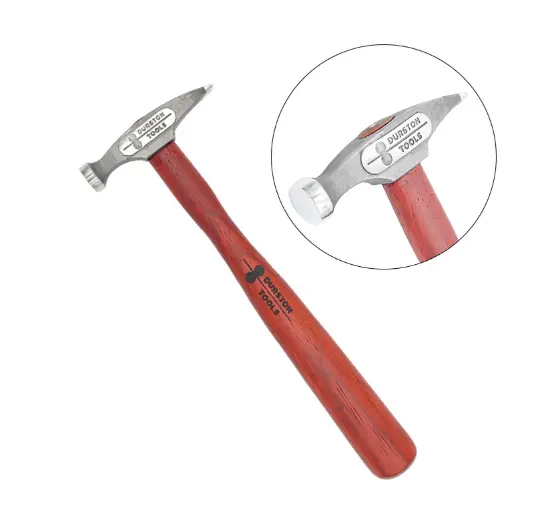
- Features: One end of the head is flat, and the other end is a flat wedge shape.
- Main Uses: Used for forging and stretching metal, efficiently thinning or shaping metal strips by directing the force along the wedge’s axis.
- Applicable Scenarios: Changing the thickness or length of metal, such as forging slender booms or tapering metal ends.
8. Box Hammer/Bordering Hammer
Used when sharp, intentional angles are required.
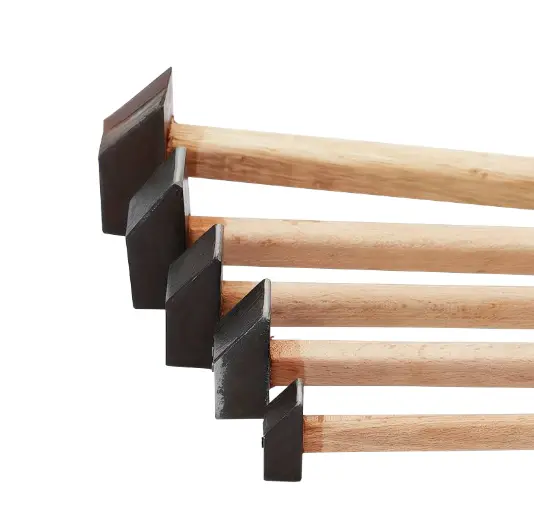
- Features: The head typically has one or two sharp or beveled square/rectangular faces.
- Main Uses: Used to hammer clean edges or creases into metal parts, ideal for creating corners.
- Applicable Scenarios: Creating boxes, containers, or parts requiring sharp angles with defined geometry.
9. Nylon Mallet
The most common soft hammer for general corrections.
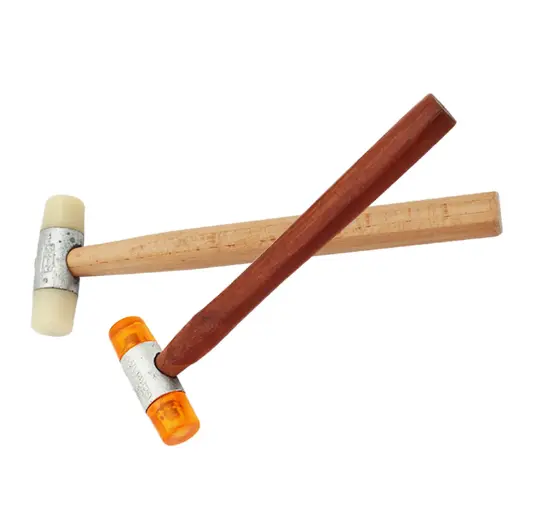
- Features: Made of hard non-metallic materials such as nylon or plastic.
- Main Uses: Hammering and straightening without damaging the metal surface or leaving the strike marks a steel hammer would.
- Suitable Uses: Adjusting ring bands, correcting metal bends, and safely hammering on punches or bracelet core mandrels.
10. Leather/Rawhide Mallet
The ultimate soft touch for delicate work.
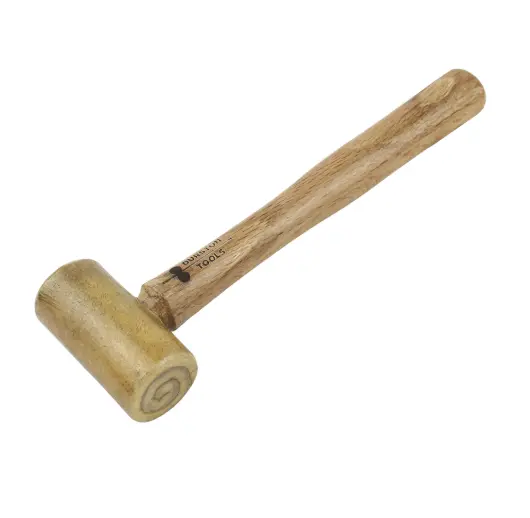
- Features: Made from rolled, flexible rawhide.
- Main Uses: An extremely gentle shaping tool used to softly shape metal sheets into curved surfaces without leaving any marks whatsoever.
- Suitable Uses: Soft shaping work requiring extremely precise surface finishes, such as hammering soft silver or gold leaf, where even nylon is too hard.
11. Brass/Lead Hammer
A crucial tool for protecting your most expensive equipment.
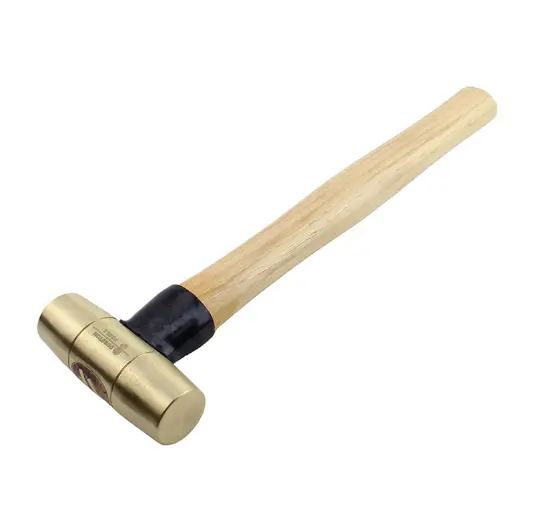
- Features: The hammerhead is made of a metal softer than steel (like brass or lead).
- Main Uses: Used to strike steel tools (such as punches or stamps) to prevent the steel from chipping or mushrooming the tool head. The soft material absorbs the shock.
- Suitable Uses: Precision stamping, driving punches, and fine-tuning the fit of castings.
Conclusion
The vast world of jewelry hammers provides immense creative control, but mastering the craft begins with selecting the right tools. From the heavy-duty Cross Peen Hammer used for forging, to the subtle Rawhide Mallet used for soft shaping, understanding the function of each tool will save you time and greatly improve the quality of your finished pieces.
To help you get started, we have curated a selection of high-quality jewelry hammers and tool kits available on JYBS website. Whether you are a beginner looking for an essential kit or a professional seeking a specialized chasing hammer or a new texturing hammer, you will find durable, expertly crafted tools designed to last a lifetime.
Browse our collection today and bring precision and expertise to your next jewelry project!