

Why Refiners and Recyclers Need a Specific Type of Rolling Mill
- Diagnostic Utility: For precious metal refiners and scrap recyclers, the rolling mill is not just a fabrication tool; it is a critical diagnostic instrument.
- Integrity Testing: When a refiner melts down a batch of scrap jewelry (often contaminated with solders, nickel, or bench sweeps) and pours an ingot, the first step is to test the alloy’s structural integrity.
- Quality Control: The ingot is passed through the rolling mill to check for edge-cracking or brittleness. If it cracks prematurely, the refiner knows the melt is contaminated with lead, tin, or excessive oxides and must be re-refined.
- Industrial Durability: Therefore, a refiner’s mill takes incredible abuse. It is frequently fed rough, unpolished, and sometimes porous cast ingots.
- Material Hardness: It must possess extreme roller hardness (HRC 64+) to survive contact with trace borax glass inclusions.
- Assay Requirements: Furthermore, refiners often need to draw assay wire—thin strips of the refined metal used for chemical testing or XRF scanning.
- V-Groove Calibration: A mill with exceptionally deep and highly calibrated V-grooves is essential for quickly turning a rough pour into a uniform test sample.
Key Technical Specs for Refining Applications
Refining is a harsh environment; your equipment must prioritize absolute durability and high-torque crushing power.
| Specification | Recommended Range | Why It Matters for Refiners |
| Roller Hardness | Minimum HRC 64 – 65 | Rough poured ingots may contain hard spots or flux glass inclusions that will instantly pit softer HRC 60 rollers. |
| Roller Configuration | Heavy Wire Grooves Focus | Refiners primarily need to extrude rough ingots into thick rods or assay wire for chemical testing and lot sampling. |
| Drive / Gear Ratio | 4:1 Precision Gear or Motorized | Required to forcefully break down the porous crystalline structure of freshly cast, unhammered ingots without gear binding. |
Top 3 Rolling Mill Recommendations for Gold/Silver Refiners
Built to withstand the abrasive, high-stress environment of a smelting room:
1. 1.5HP 2 Heads Electric Rolling Mill – JYBS
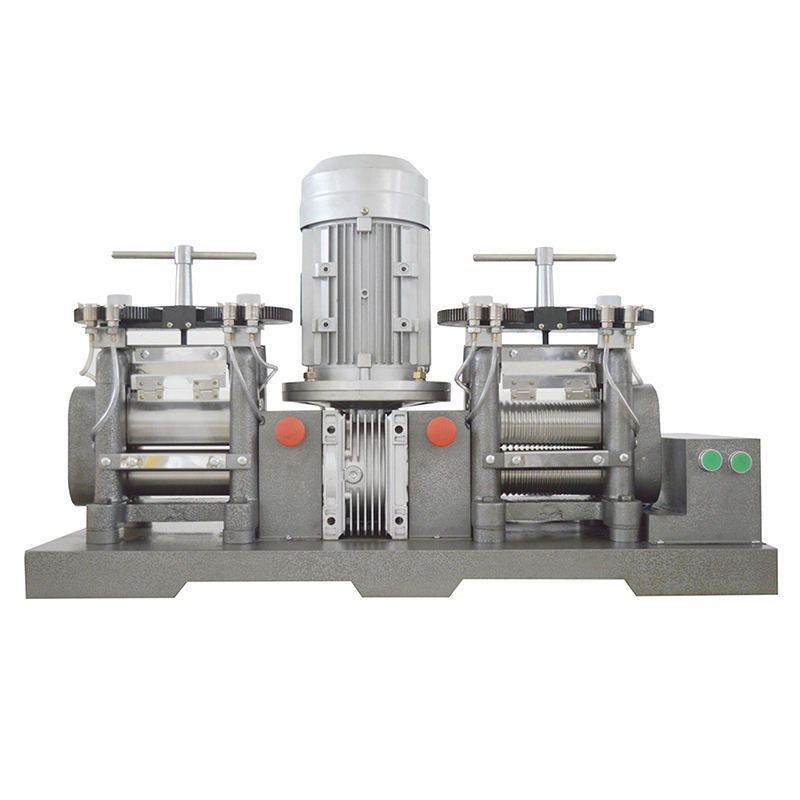
- Specs: Massive 1.5HP (1100W) Motor, 177kg Gross Weight, Dedicated wire drawing head with 24 grooves (1mm to 7mm), AC220V.
- Verdict: The ultimate industrial solution for high-volume smelting rooms. When crushing heavily contaminated scrap pours, manual cranking is inefficient. This 1.5HP dual-head powerhouse provides unyielding motorized torque, while the dedicated 24-groove wire station makes pulling uniform assay samples for XRF scanning incredibly fast.
2. Combination Rolling Mill 130MM(L)65MM(D) – JYBS
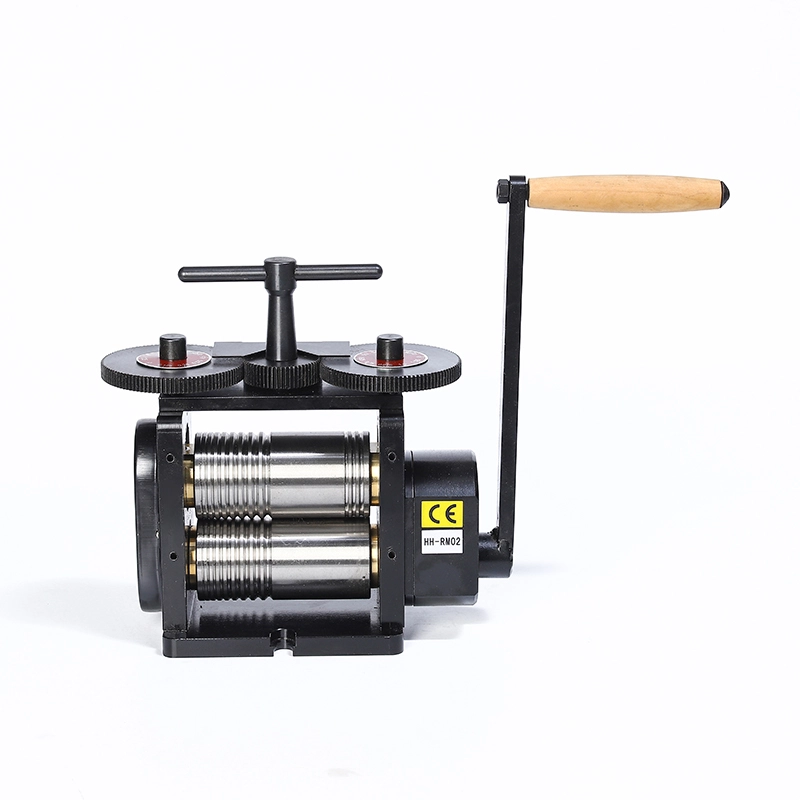
- Specs: 130mm roll width, rollers induction hardened to 65 HRC, 4:1 precision hobbed solid steel gears, one-piece solid steel chassis.
- Verdict: An indestructible manual unit designed for harsh refining testing. The exceptional 65 HRC roller hardness guarantees resistance against pitting from trace borax glass inclusions in dirty scrap pours. Its solid cast-steel body ensures the frame won’t flex or snap when a porous gold bar unexpectedly resists compression.
3. Only Wire Rolling Mill (Combination Focus) – JYBS
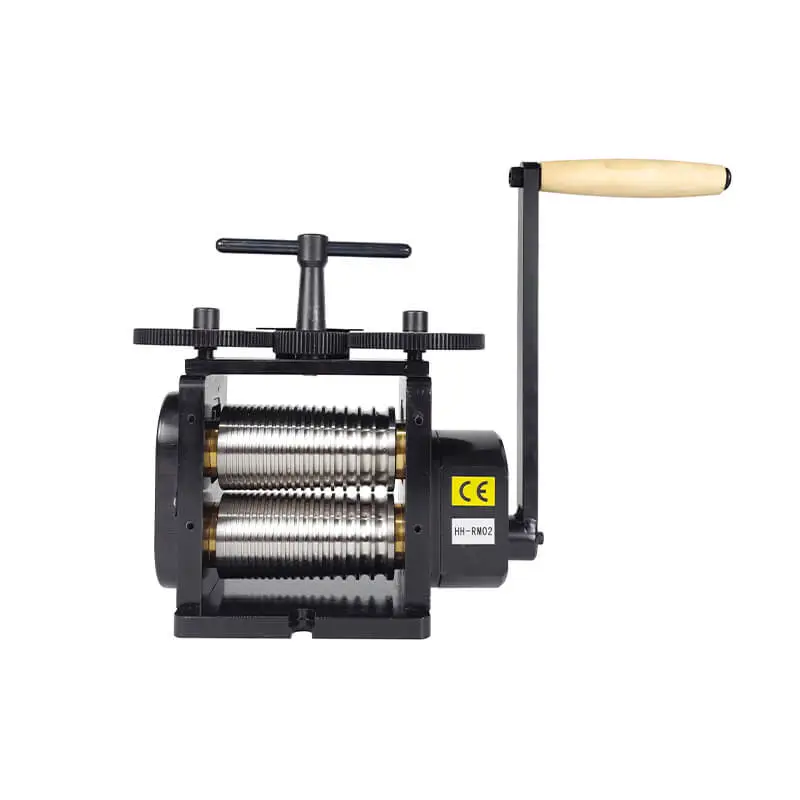
- Specs: 130mm overall width, 65mm roller diameter, specialized multi-groove configuration (square wire down to 1.0mm, half-round to 2.5*1mm), 4:1 Gear Ratio.
- Verdict: The diagnostic workhorse. With oversized 65mm diameter rollers and a heavy focus on wire grooves, this mill is engineered specifically for refiners whose primary daily task is extruding rough scrap castings into thin, precise assay strips for chemical titration and lot testing.
Maintenance Tips for Refining Workshops
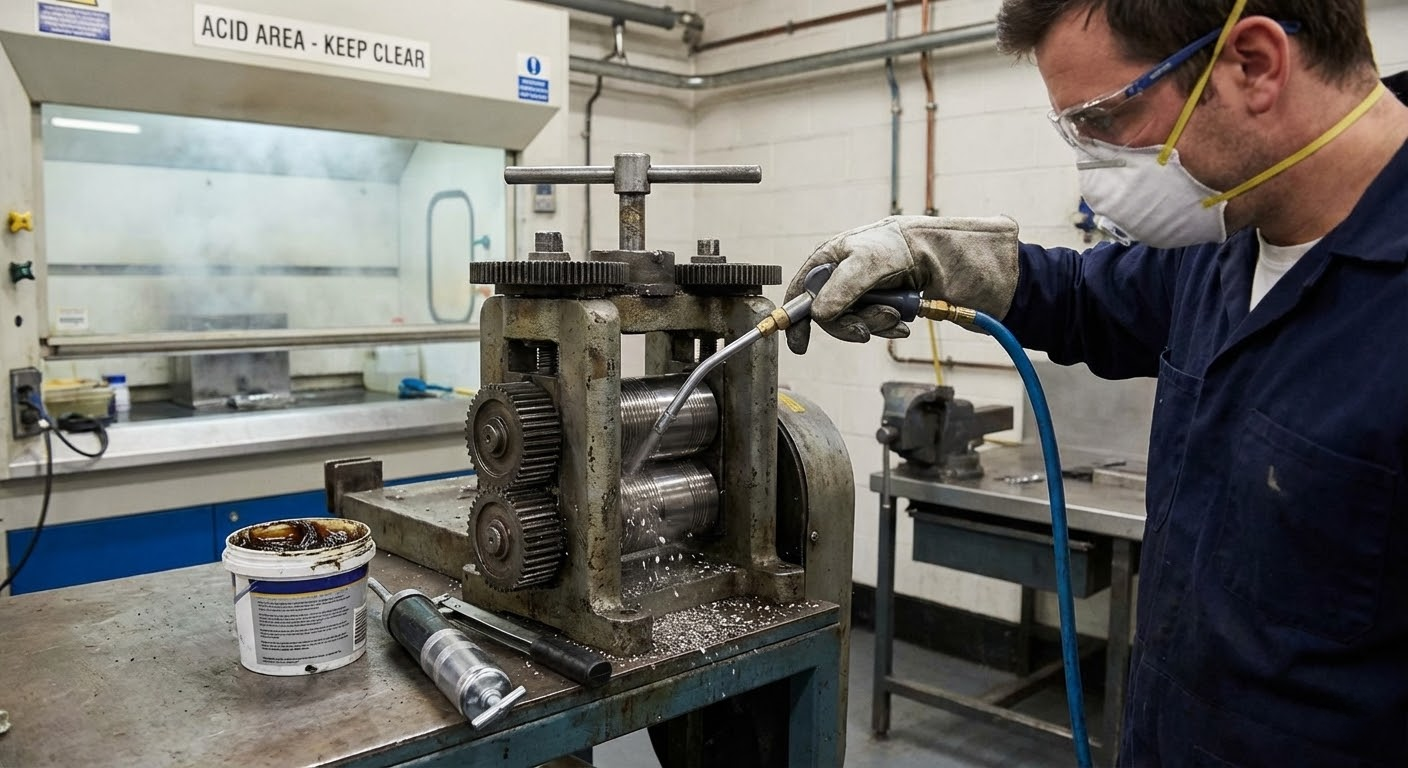
- Environmental Hazards: The smelting room is full of hazards for steel machinery: acid fumes from aqua regia, abrasive flux dust, and extreme heat.
- Protection Requirements: A rolling mill in this environment must be aggressively protected.
- Acid Exposure: Never locate your mill near your acid hood, as hydrochloric and nitric acid fumes will rust the gears within days.
- Debris Management: Because you are rolling rough pours, metal flakes and borax dust will inevitably fall into the lower gear housing.
- Daily Cleaning: Use compressed air to blow out the chassis daily, and coat the rollers in a heavy protective grease (not light oil) at the end of every shift to create a barrier against ambient chemical vapors.
Frequently Asked Questions about Refining Tools
- Q: Why does my newly poured scrap gold ingot crack immediately in the mill?
- A: This is called “hot shortness” or contamination. If the scrap contained any lead or tin (often from cheap solders), it settles in the grain boundaries of the gold, causing it to shatter under the pressure of the rollers.
- Q: Do I need to forge my ingot with a hammer before rolling?
- A: Yes, it is highly recommended. Lightly forging the freshly poured ingot on an anvil with a heavy hammer compresses the external porosity and prevents the edges from tearing when it hits the rolling mill.
- Q: Can the mill help me identify if silver has fire scale?
- A: Yes. If you roll an ingot of sterling silver and notice a dark, shadowy mottling stretching across the surface as it gets thinner, you are exposing subsurface cupric oxide (fire scale) that formed during an improper melt.
- Q: Why is my ingot slipping and not going through the rollers?
- A: The ingot is too thick for the gap, or the edges are too square. You must taper or bevel the leading edge of the ingot with a hammer or file so the rollers can “bite” into the metal.
- Q: Is it safe to roll an ingot while it is still hot?
- A: Absolutely not. Rolling hot metal will instantly ruin the temper of your hardened steel rollers, reducing them from HRC 64 back to soft steel, ruining the mill permanently.
Ready to upgrade your Refining setup?
Get a Quick Quote. Our team will provide a detailed quote sheet within 3 hours.