

High upfront machinery costs make jewelry industry startups financially risky. Buying the wrong tools can permanently crush your cash flow before your first production run. Instead of generic recommendations, this guide provides a practical, modular procurement checklist tailored to your specific business scale and budget.
1. Step 1: Define Your Business Model First
Your equipment configuration must follow your commercial workflow. Categorizing your jewelry startup protects your working capital. It prevents unnecessary equipment redundancy.
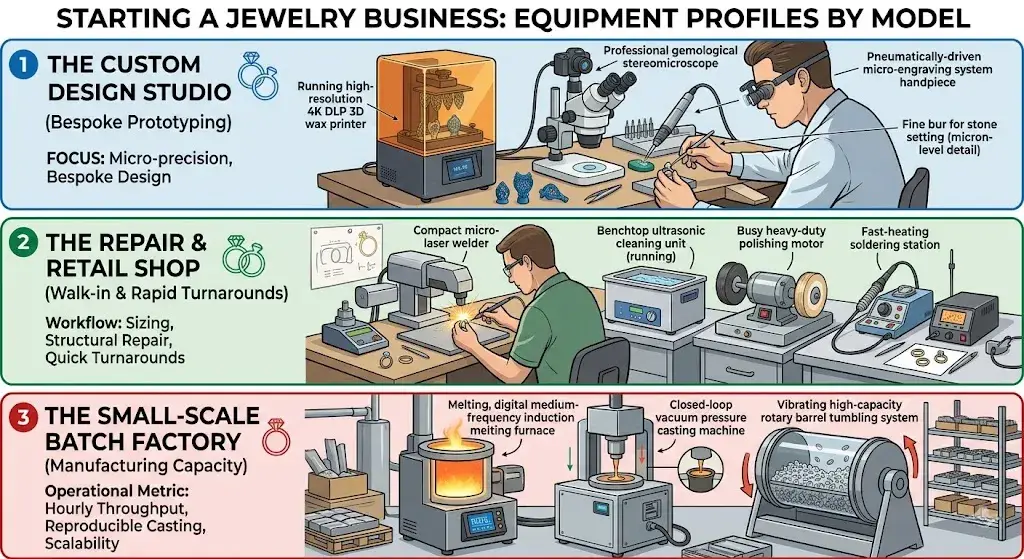
The Custom Design Studio
This model prioritizes bespoke prototyping and high-end stone setting. The workbench footprint centers on high-resolution 4K DLP or LCD 3D wax printers. It requires professional gemological stereomicroscopes and specialized pneumatic micro-engraving systems. Here, your investment capital is concentrated entirely on micron-level optical precision rather than raw material processing volume.
The Repair & Retail Shop
This configuration requires rapid commercial turnarounds, structural resizing, and immediate customer walk-in service. The daily workflow centers on heavy-duty polishing motors, compact micro-laser welders, and benchtop ultrasonic cleaning units. You need versatile, fast-heating soldering stations that allow you to resize a standard 14K gold ring shank within fifteen minutes.
The Small-Scale Batch Factory
Here, your operational metric shifts completely to hourly throughput, manufacturing capacity, and reproducible casting yield rates. This intensive industrial setup demands heavy-duty medium-frequency induction melting furnaces, closed-loop vacuum pressure casting machinery, and high-capacity centrifugal or rotary barrel tumbling systems.
2. The Core Equipment Checklist: From Melting to Finishing
To source precision tools effectively, you must analyze the physics of each jewelry manufacturing step. Let’s break down the technical specifications required to maintain structural quality.
Module A: Melting & Casting (The Foundation)
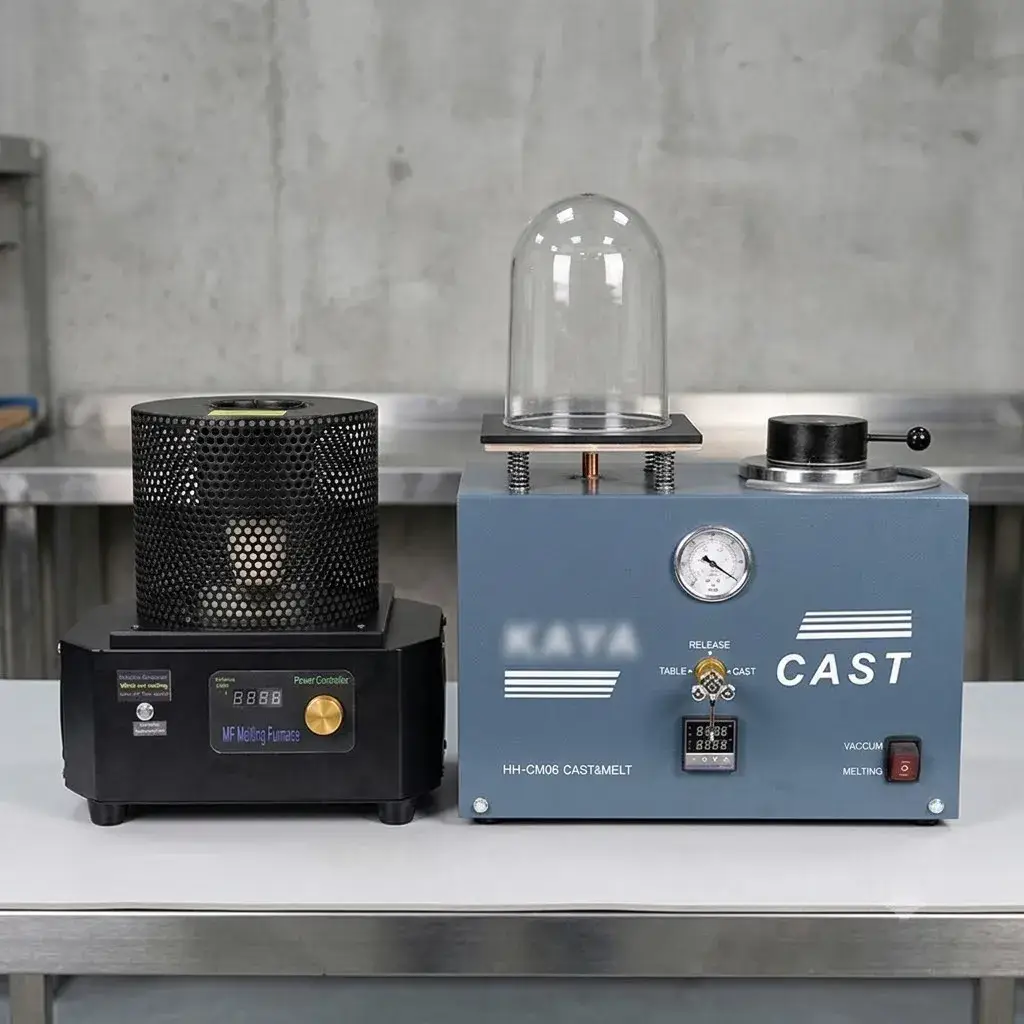
- Key Equipment: Digital medium-frequency induction melting furnace, split-system vacuum pressure casting machine.
- Technical Highlights: Thermal management is critical. Your induction furnace must utilize advanced digital PID temperature controllers. This prevents thermal overshoot. Overheating causes the severe volatilization and oxidation of delicate alloying elements like copper in sterling silver, or palladium in white gold. For the actual casting phase, a dual-zone vacuum chamber is non-negotiable. The upper chamber uses positive pressure (1.5 to 2.0 bar of inert argon gas) to push molten metal down. Simultaneously, the lower chamber pulls a deep vacuum (below -0.09 MPa). This combined pressure differential forces the liquid alloy into the absolute finest filigree channels of your investment mold, completely eliminating subsurface porosity and incomplete fill defects.
Module B: Fabrication & Shaping (The Benchwork)
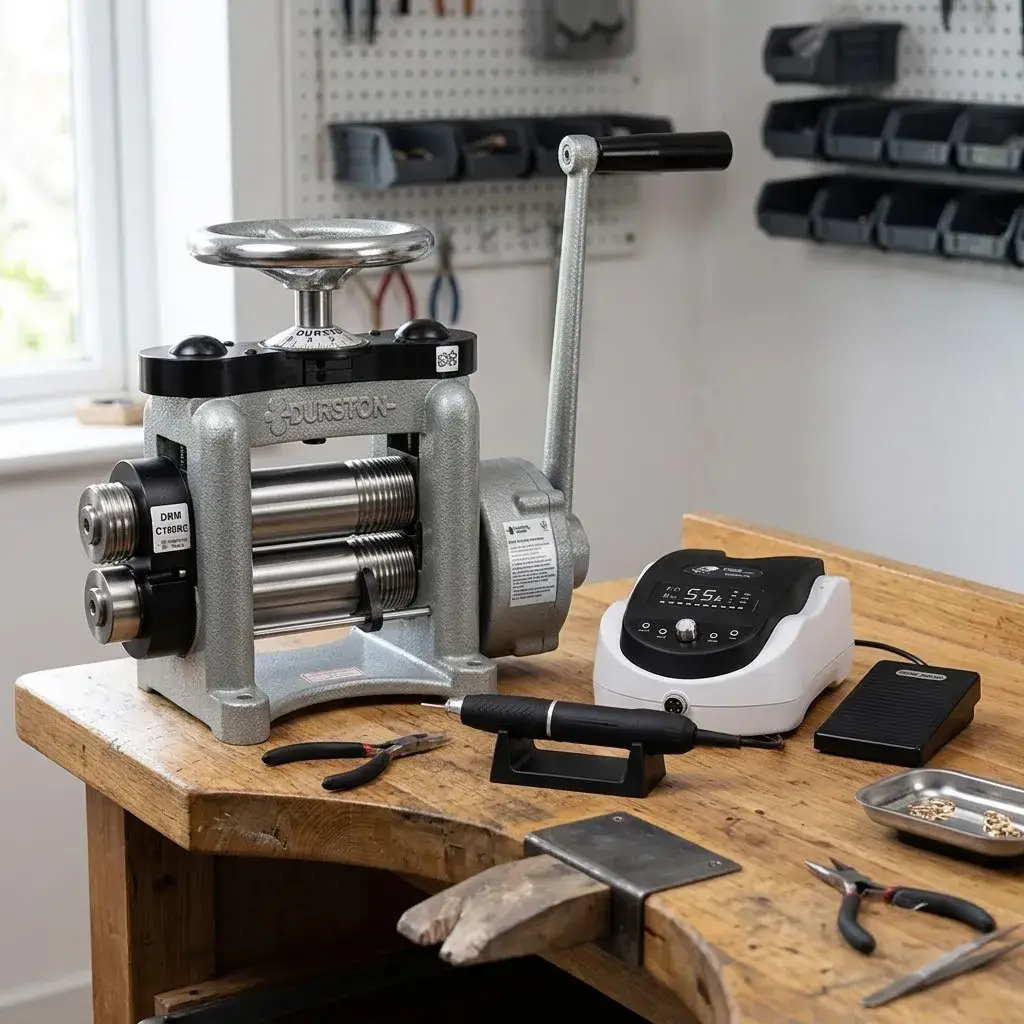
- Key Equipment: Heavy-duty manual or motorized reduction rolling mill, high-torque brushless bench micromotor system.
- Technical Highlights: Examine the mechanical bearings. The structural housing of your rolling mill must feature induction-hardened, high-carbon steel rollers (hardened up to 64 HRC). This prevents structural flexing under massive mechanical load. Without this rigidity, rolling out a platinum ingot will result in uneven sheet thickness. At the jeweler’s bench, discard cheap, flexible-shaft pendant drills that suffer from rotational lag. A professional micromotor handpiece must utilize a sealed brushless DC motor. This architecture maintains consistent, high torque (minimum 3.5 N·cm) even at lower operating speeds (1,000 to 5,000 RPM). True handpiece concentricity must exhibit less than 0.02 mm of rotational runout. Zero vibration prevents cutting burrs from skidding across a smooth metal surface.
Module C: Micro-Setting & Engraving (The Value-Adder)
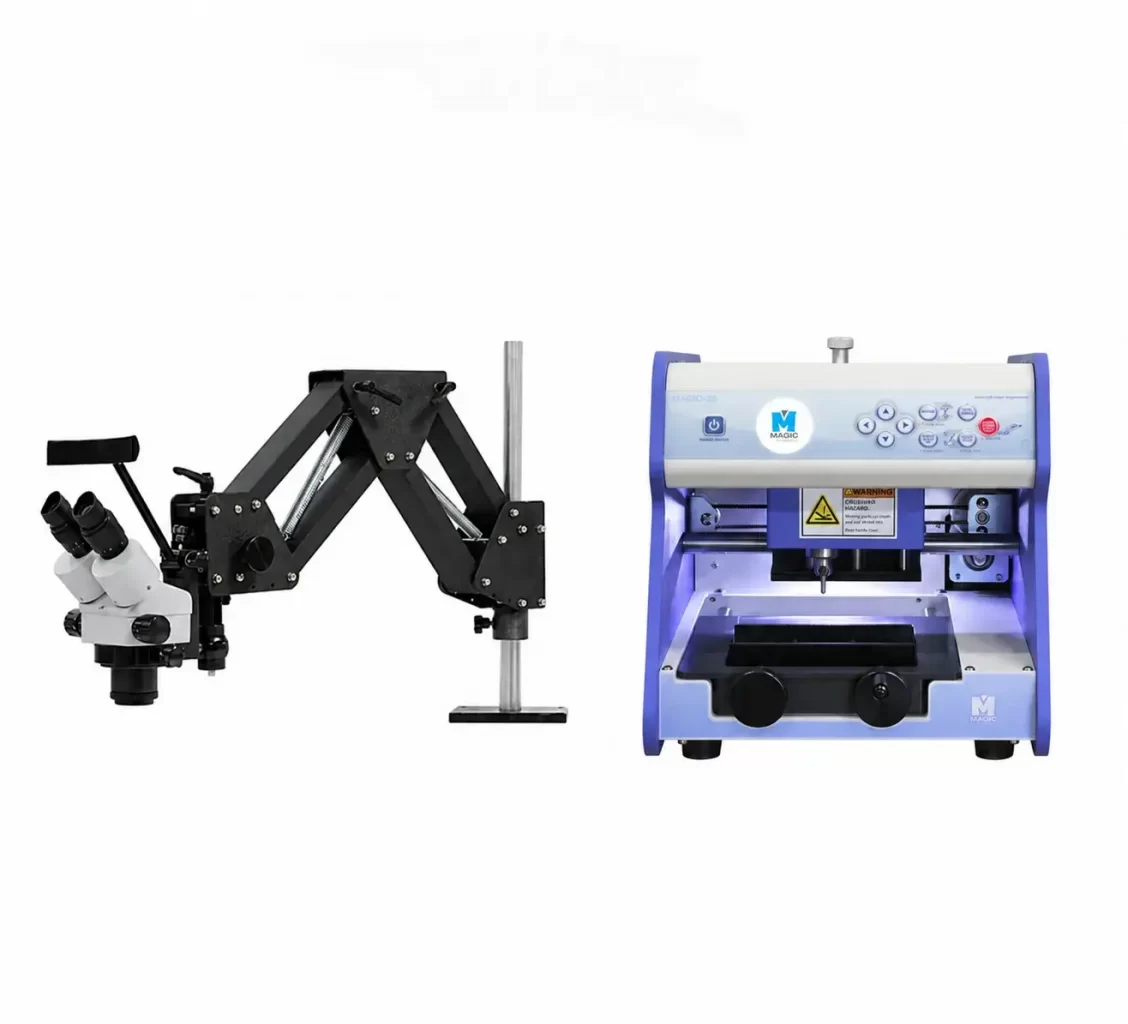
- Key Equipment: Stereomicroscope with boom stand, dual-stage pneumatic engraving system.
- Technical Highlights: Insist on an achromatic-aplanatic optical lens assembly. Cheap lenses distort color and warp image edges. Correcting these specific chromatic and spherical aberrations prevents debilitating eye strain and headaches during extended micro-setting shifts. Optical magnification should range smoothly from 3.5 x to 45 x via a continuous zoom knob. Furthermore, verify the physical working distance. Your optical setup must offer a constant 100 mm to 160 mm clearance. This physical space is mandatory. It allows you to manipulate deep stone-setting handpieces and large pitch bowls freely beneath the protective lens cover.
Module D: Finishing & Quality Control (The Final Polish)
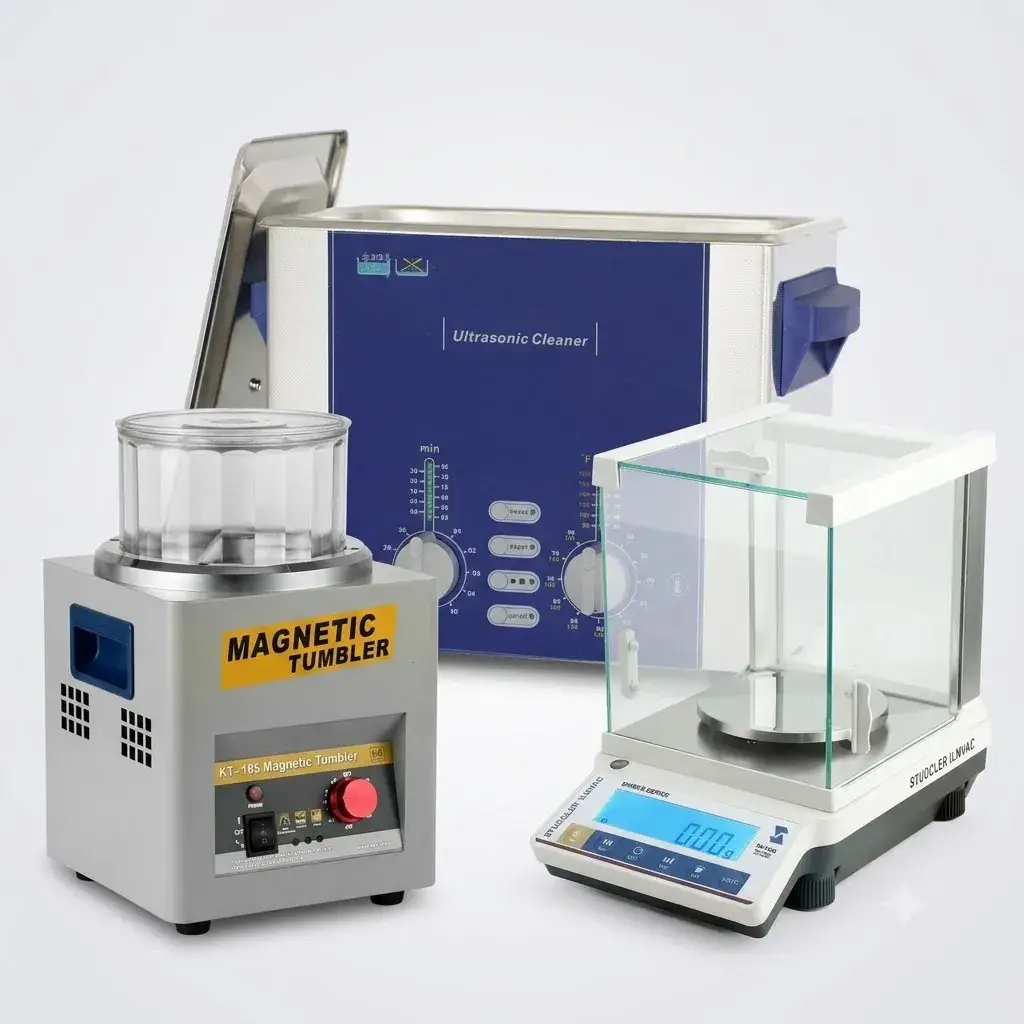
- Key Equipment: Variable-speed magnetic pin tumbler, multi-frequency industrial ultrasonic cleaner, certified high-precision analytical balance.
- Technical Highlights: Your analytical balance must meet international metrological standards. For high-value gold and gemstone auditing, a true 0.001 g (three decimal places) readability is mandatory. The balance must feature an integrated glass draft shield. Simple ambient air currents from an air conditioner can destabilize the internal electromagnetic force restoration sensor, causing weight readings to drift. For surface finishing, a magnetic tumbler using 0.3 mm stainless steel pins burnishes hidden under-gallery areas in less than thirty minutes. This mechanical step prepares the jewelry for a sweep-frequency ultrasonic cleaner operating at 40 kHz. This acoustic frequency blasts away caked-on tripoli and rouge polishing compounds without dislodging fragile pave-set diamonds, delivering a flawless, high-gloss luster.
3. Must-Haves vs. Nice-to-Haves: A Strategic Budget Allocation
Managing initial asset allocation determines whether your startup survives its first fiscal year. Allocate your physical capital into tools that directly control your final product quality or protect your inventory assets.
| Manufacturing Department | Must-Haves (Immediate Procurement) | Nice-to-Haves (Future Capital Upgrades) |
| Material Forming | High-hardness manual rolling mill with wire grooves. | Dual-motorized automated industrial rolling mill. |
| Rotary Benchwork | Brushless micromotor handpiece (0.02 mm maximum runout). | High-power pneumatic grinding workstations. |
| Micro-Assembly | Adjustable dual-eye stereo microscope (160 mm clearance). | Digital HD camera microscope with screen overlays. |
| Thermal Joining | Micro-flame oxygen/propane torch system with multi-tips. | 150 Joule enclosed benchtop laser welding system. |
| Asset Auditing | Class-certified analytical balance (0.001 g readability + draft shield). | Energy-dispersive X-ray fluorescence spectrometer. |
4. 3 Common Equipment Pitfalls New Jewelry Businesses Make
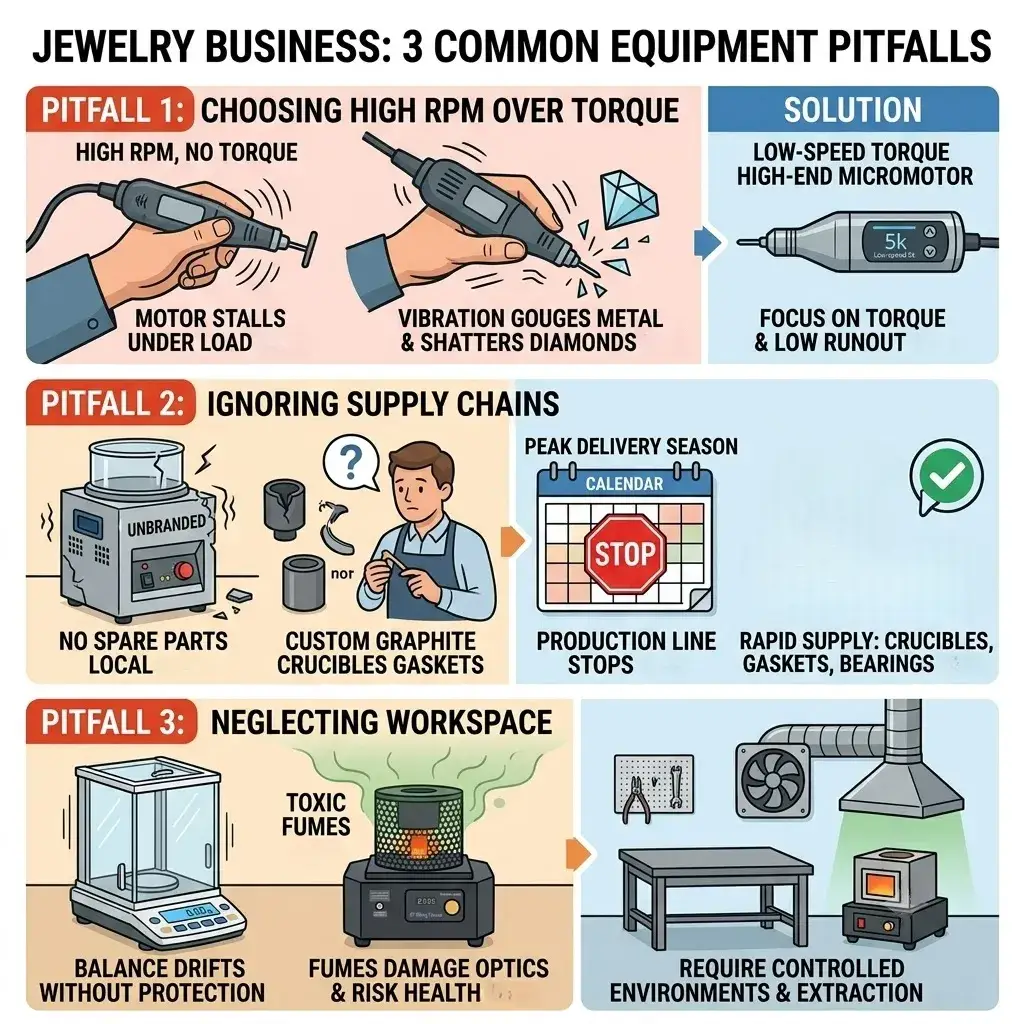
Pitfall 1: Choosing High RPM Over True Low-Speed Torque
Cheap rotary tools advertise high RPM but lack torque. Under load, the motor stalls. When the jeweler presses harder, the handpiece slips. This vibration gouges precious metal and shatters expensive accent diamonds. Focus entirely on low-speed torque stability and low runout.
Pitfall 2: Ignoring Spare Parts and Consumable Supply Chains
Unbranded machinery from unverified trading sites creates massive operational liabilities. If you cannot rapidly source custom graphite crucibles, silicone gaskets, or genuine replacement handpiece ball bearings locally, your entire production line stops during peak delivery seasons.
Pitfall 3: Neglecting Workspace and Environmental Conditions
Precision instruments require controlled environments. Analytical balances drift without heavy anti-vibration tables and draft protection. Additionally, melting and pickling generate toxic fumes; failing to install dedicated source extraction damages optics and risks staff health.
Conclusion
Minimize your startup risk. Optimize your production chain.
Navigating the technical landscape of jewelry equipment sourcing requires reliable engineering backing. As a direct manufacturer and global supplier, JYBS eliminates the expensive middleman. We specialize in providing precision-engineered jewelry tools with direct factory-floor pricing, offering significant wholesale discounts on bulk orders while supporting flexible minimum quantities for growing businesses.
Whether you need to outfit a single workbench with our high-torque, zero-vibration micromotor handpieces, or construct a complete, high-yield casting foundry from scratch, we supply the consistent hardware and long-term technical support your business needs to scale safely. Let us handle the machinery logistics so you can focus entirely on your craft and profitability. Explore our complete technical catalog today and secure the competitive manufacturing edge your new business deserves.