

In the jewelry industry, tool selection dictates the boundary between commercial success and costly bench inefficiency. Buying low-grade hobbyist equipment to save upfront leads to high breakage rates, ruined materials, and wasted labor. This data-driven guide relies on technical specifications to break down the five indispensable tool modules required to maximize production efficiency and ROI.
Module 1: Precision Measurement & Pattern Preparation
In jewelry manufacturing, a deviation of a hair’s breadth can ruin a custom piece. Precision during initial layout phases controls metal loss and protects your bottom line.
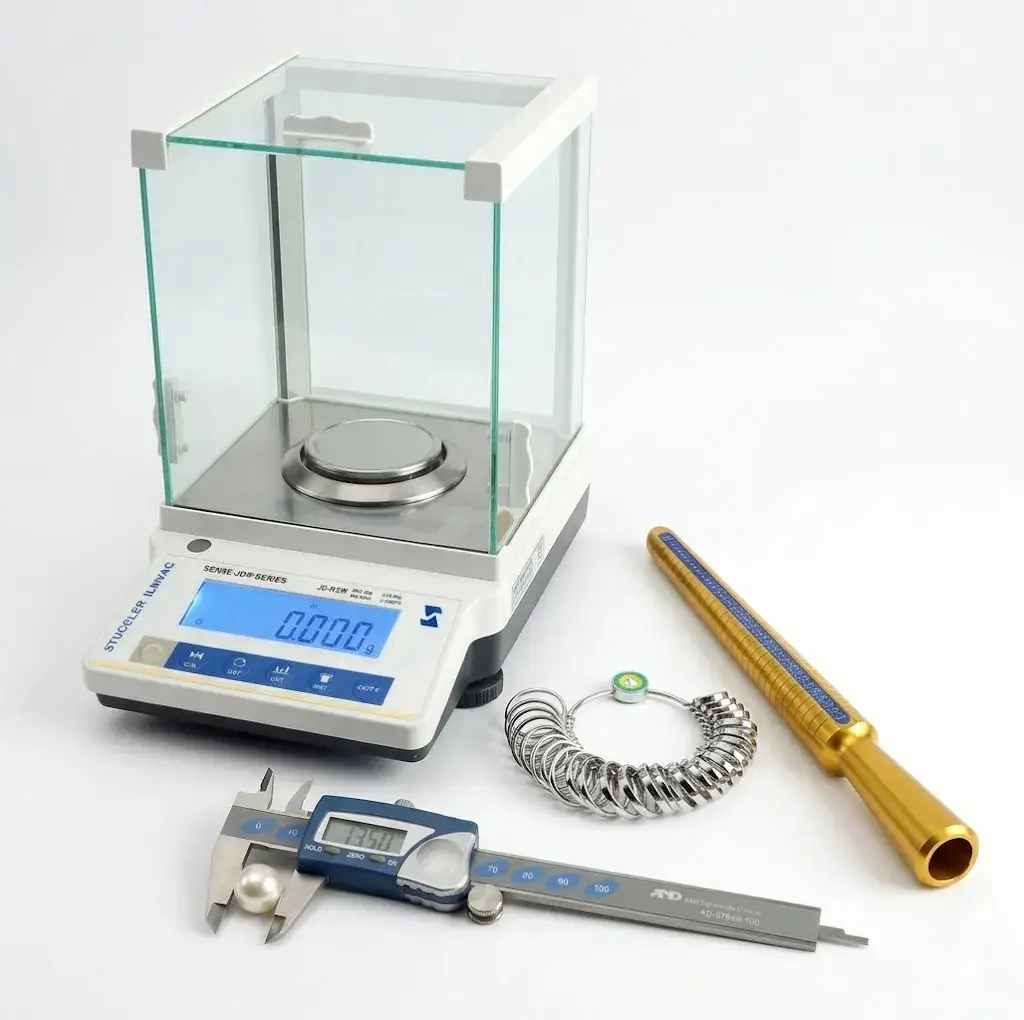
Digital Calipers
Precious metal fabrication requires accuracy down to the millimeter. A high-grade digital caliper is the absolute standard for measuring gemstone diameters, sheet thicknesses, and bezel wires. Buyers should select units with hardened stainless steel bodies that deliver readings accurate to within 0.01 mm. Linear encoder systems prevent data drift, ensuring repeatable measurements across large product batches.
High-Precision Analytical Balances
When handling gold, platinum, or palladium, every milligram impacts your profit margin. Standard strain-gauge scales lack the stability needed for serious commercial operations because they are highly prone to temperature drift and require frequent manual calibration. Professional workshops rely on balances utilizing Electromagnetic Force Restoration (EMFR) sensor technology.
Technical Insight: Unlike spring-based sensors, EMFR technology uses an electromagnetic coil to levitate the weighing pan. This design delivers zero drift, unparalleled linearity, and incredibly fast stabilization times.
To maintain accuracy under changing workshop conditions, look for balances featuring Automatic Internal Calibration. This built-in system uses an internal motorized weight to calibrate the balance automatically when room temperature changes. It saves technicians from tedious, manual calibrations, keeping production moving without interruption.
Ring Sizers & Ring Mandrels
Custom production requires perfect sizing. Studios must cross-reference verified steel ring sizers with hard-hardened steel ring mandrels. For international trade, choose multi-marked mandrels that feature US sizes, Hong Kong sizes, and European millimeter circumferences simultaneously.
Module 2: Cutting, Shaping, & Form Refinement
Efficient material removal determines the speed of your downstream assembly. High-performance cutting tools reduce physical fatigue and save unrefined scrap metal.
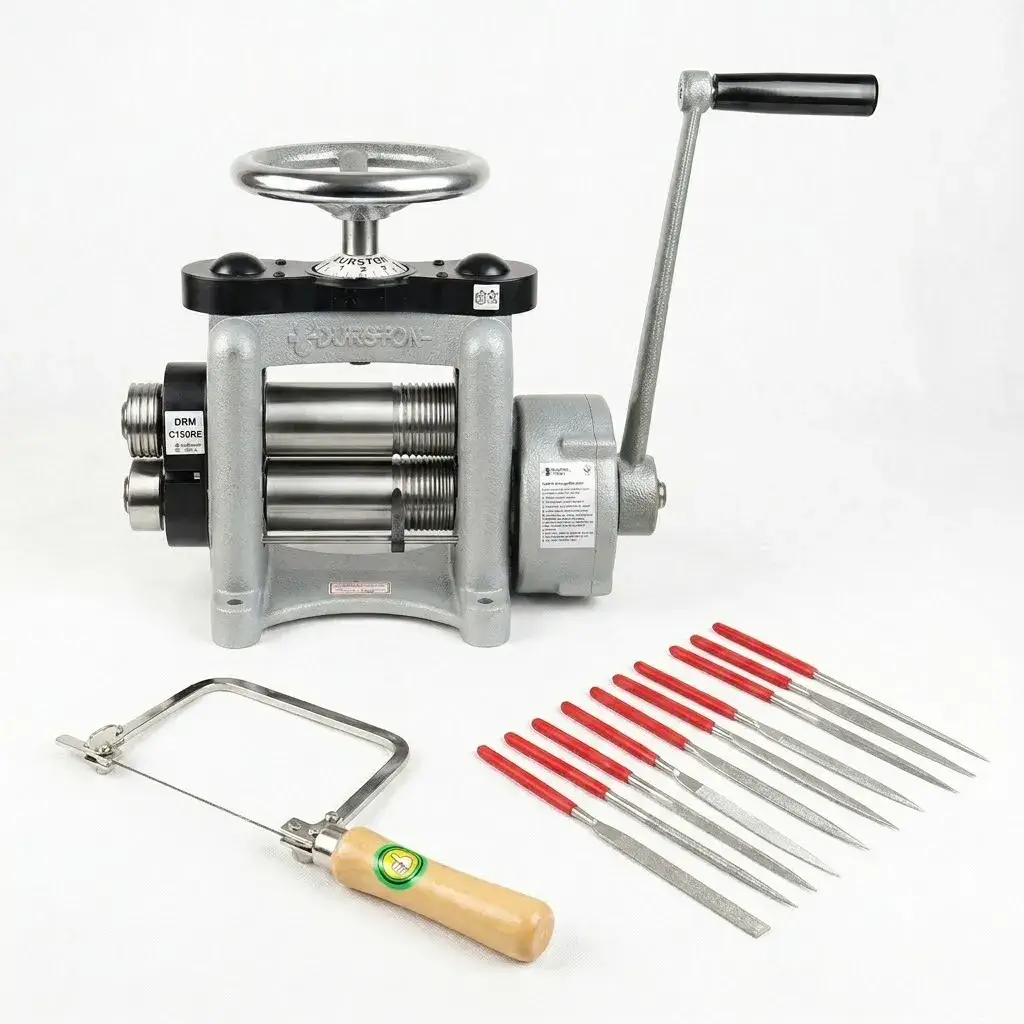
German-Style Jeweler’s Saw Frames & Blades
The traditional German-style saw frame remains unmatched for balance and tension adjustment. The real magic, however, lies in the blade. Jewelers must match the saw blade gauge (Teeth Per Inch, or TPI) directly to the metal sheet thickness.
- For heavy casting sprues: Use coarse #1 or #2 blades.
- For detailed sheet filigree: Opt for ultra-fine 1/0 to 4/0 blades.
- The Golden Rule: At least three blade teeth must contact the metal edge at all times.
Always coat blades with organic beeswax or specialized lubrication wax. This simple step lowers friction, prevents overheating, and cuts blade breakage rates by up to 40%.
Precision File Matrix
Files are the workhorses of the bench. A professional matrix requires Swiss-made premium files (such as the Vallorbe “Fish” brand) in distinct cut profiles.
| File Type | Coarseness Grade | Primary Application |
| #1 Cut Coarse File | Low teeth-per-cm | Rapid stock removal; leveling casting seams |
| #2 Cut Medium File | Intermediate teeth-per-cm | General shaping; blending flat and curved surfaces |
| #4 Cut Fine File | High teeth-per-cm | Pre-polish refinement; removing deep tool marks |
Dual-Axis Rolling Mills
To convert gold ingots into usable wire or custom-gauge sheet, a heavy-duty rolling mill is vital. Dual-axis models allow quick switching between flat rollers and square/half-round wire grooves. Operators must balance applied rolling pressure with proper material annealing. Forcing cold, work-hardened metal through tight rollers causes stress fractures, destroying the structural integrity of the alloy.
Module 3: Micro-Assembly and Fusion Soldering
Soldering forms the structural backbone of fine jewelry. Clean joins depend entirely on uniform heat management and rock-solid fixtures.
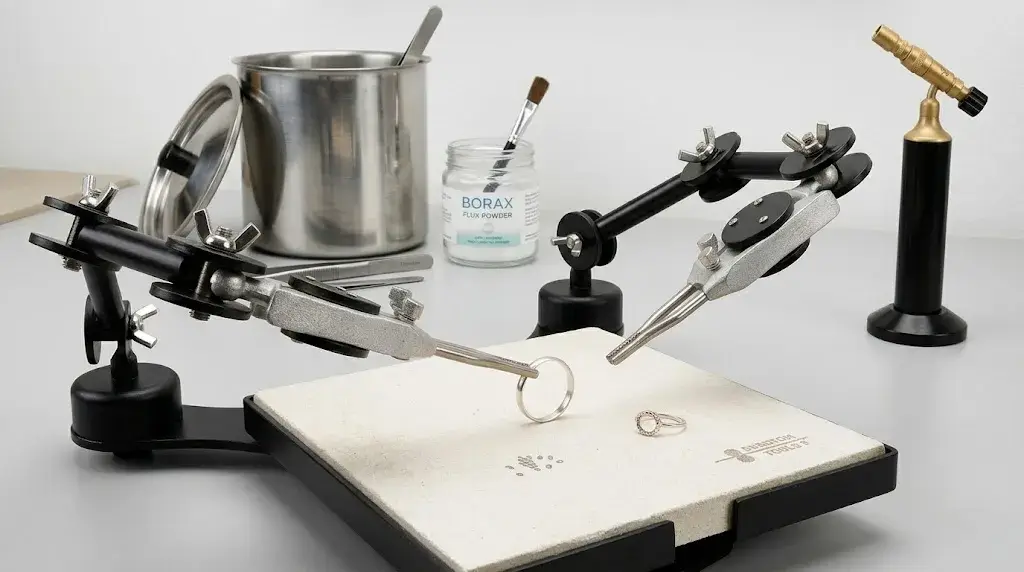
Micro-Precision Torches
Jewelers must match their heat delivery to the physical mass of the work.
- Hydrogen-Oxygen Generators: These machines split water into highly concentrated, clean-burning gas. They produce an ultra-hot, pin-point flame ideal for delicate prong adjustments or platinum repairs without carbon contamination.
- Gas-Powered Hand Torches: Utilizing propane or butane mixed with atmospheric air, these torches provide a broader, softer flame. This diffuse heat is necessary for annealing wide sheets or soldering chunky silver bracelets.
Soldering Fixtures & Bricks
Components must not shift when solder reaches its liquidus temperature. A “Third Hand” dual-clamp fixture holds small parts perfectly in place.
Pair this with a high-grade Refractory Honeycomb Brick. The ceramic honeycomb structure features hundreds of tiny holes that reflect heat back onto the workpiece. This thermal efficiency speeds up the soldering process and protects sensitive components from prolonged heat exposure.
Flux & Pickling Pots
Oxidation blocks solder flow. Applying protective borax-based flux prevents fire scale formation during heating. After soldering, parts must be dropped into a heated Pickling Pot filled with sodium bisulfate solution. This acid bath strips away spent flux and copper oxides.
Safety Alert: Never use steel tweezers inside a pickle pot. Steel creates a galvanic reaction that accidentally copper-plates your gold or silver pieces. Always use copper, plastic, or titanium tweezers.
Module 4: Precision Carving, Finishing, and Micro-Setting
This phase transforms rough castings into refined, stone-ready jewelry pieces. Tool concentricity and torque are critical here.
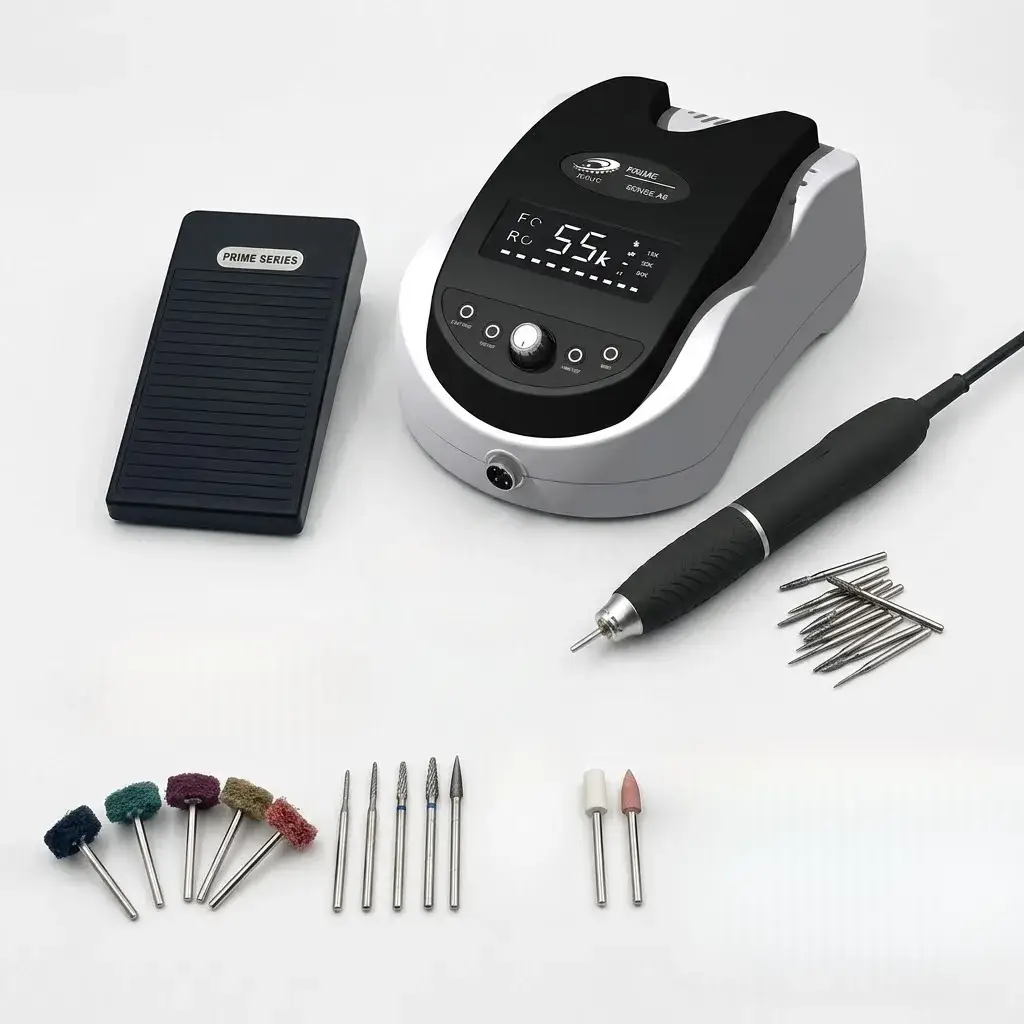
High-Power Rotary Handpieces
Choosing between a classic flexible shaft hanging motor and a modern desktop micro-motor depends on your daily production tasks.
- Hanging Flex Shafts: Driven by a foot pedal and flexible steel cable, these units deliver massive torque at lower speeds. They excel at heavy grinding, drilling large holes, and cutting thick casting sprues.
- Desktop Brushless Micro-Motors: These advanced systems place the motor directly inside the lightweight handpiece. They deliver ultra-high speeds (up to 50,000 RPM) with zero vibration and perfect concentricity. This stability is absolutely essential for pavé stone setting, micro-vane carving, and delicate prong work.
Rotary Burrs & Consumables
A bench jeweler needs a well-organized layout of tungsten carbide and diamond burrs. Tapered burrs cut precise stone seats, inverted cones clear out undercuts for flush settings, and saucer-shaped burrs trim metal prongs without scraping nearby gemstones.
Fiber Sanding Wheels
Traditional sandpaper rolls are slow and wear out quickly. Modern production lines utilize specialized Fiber Sanding Wheels and polishing wheels.
These flexible, fiber-impregnated abrasive wheels quickly remove fire scale and smooth rough edges. They conform effortlessly to complex, curved surfaces like domed rings or organic pendants. They outlast standard sandpaper sheets by five to one, saving time on consumable changeouts.
Module 5: Ultimate Surface Finishing and Polishing
Polishing is the final step that defines the quality of a piece. It creates the brilliant mirror finish that catches a customer’s eye.
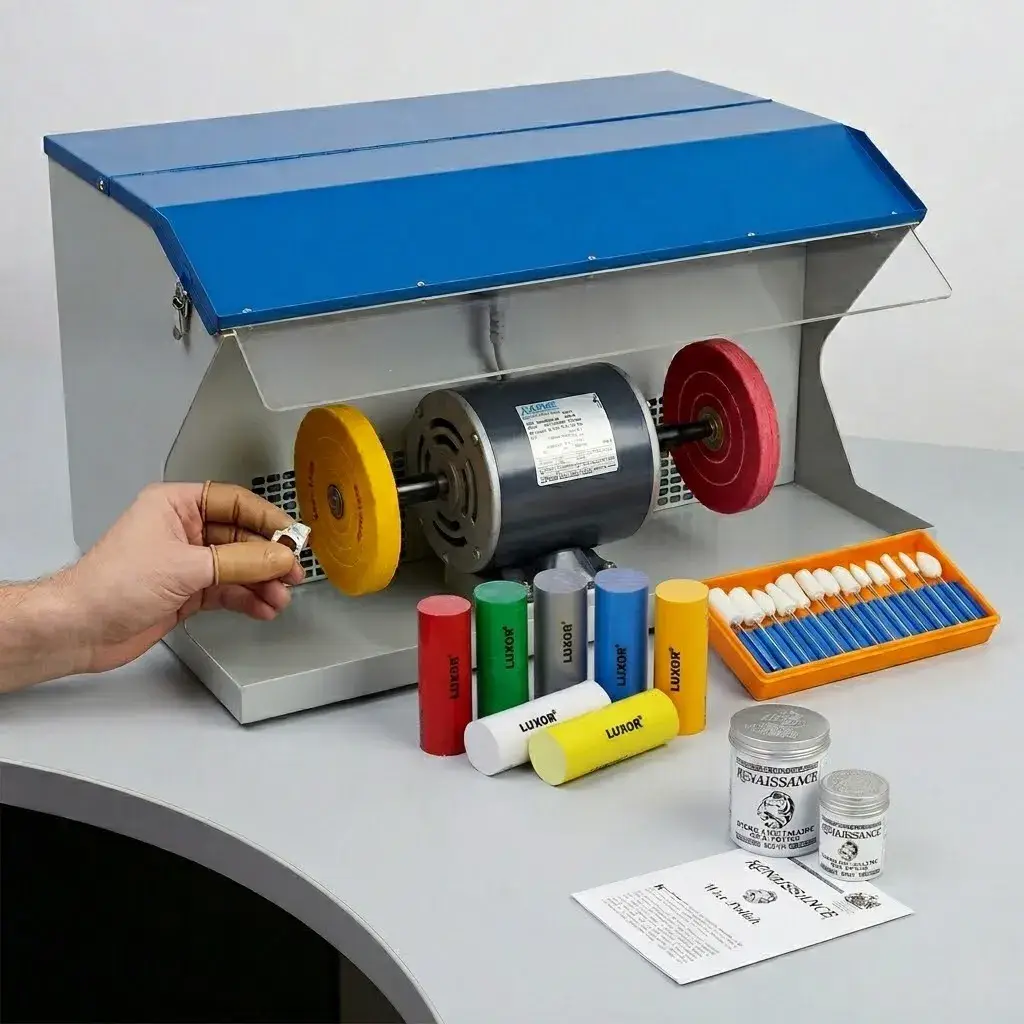
Benchtop Dust-Collecting Polishers
Polishing wheels generate high-speed friction debris, throwing off dangerous airborne particles. A professional benchtop polishing lathe must include an integrated suction hood and multi-stage HEPA filtration. This protects worker respiratory health and collects precious metal dust from the air. Over a year of high-volume production, recovering this refined gold and silver dust can pay for the machine itself.
Felt Bobs, Cloth Wheels, and Compounds
Achieving a true mirror finish requires a multi-step progression using different wheels and specialized compounds.
The process begins with aggressive cut and preparation. Technicians use rigid Felt Bobs paired with Red Rouge (iron oxide) to smooth out micro-scratches on raw gold or silver castings. Next, they switch to medium-weave stitched cotton wheels with White Rouge to create a uniform, satin sheen.
For the final high-gloss look, the piece is polished with loose, unstitched muslin or string wheels using premium Green Rouge (chromium oxide). This step brings out a deep, reflective mirror finish on platinum and high-karat gold. For fine detailing, horsehair string wheels are used to polish intricate filigree and tight interior corners without rounding the sharp edges.
Microcrystalline Protective Wax
Freshly polished silver and low-karat gold tarnish quickly in display cases or shipping boxes. To prevent this, master jewelers apply a thin layer of microcrystalline protective wax, such as industry-standard Renaissance Wax. Originally developed by the British Museum, this acid-free wax seals the metal surface. It provides long-lasting defense against oxidation, humidity, and oily fingerprints without changing the metal’s color.
For large manufacturing facilities or high-frequency trade workshops, buying small hobbyist tins is inefficient. Sourcing large-capacity 3-liter bulk tins provides a significant return on investment (ROI). It lowers unit costs, simplifies inventory management, and ensures your finishing station never runs out of protective sealant.
Summary
Beautiful, high-end jewelry requires both refined artisan skill and high-performance manufacturing equipment. High-quality Jeweler Tools are not consumable expenses. They are long-term assets that protect your margins, reduce labor overhead, and improve product consistency.
Take a close look at your workshop today. Identify where your production slows down. Is it slow manual weighing, frequent saw blade breaks, or vibration from an old flex shaft? Upgrading these areas with commercial-grade equipment will immediately improve your workshop output.
Ready to outfit your manufacturing line or stock your wholesale inventory? Visit JYBS to explore our complete selection of premium jewelry tools, analytical balances, and workshop consumables. We specialize in factory-direct bulk purchasing and B2B supply orders. Let us help you streamline your production line today.