

In the modern jewelry market, personalization drives brand loyalty. Whether engraving wedding dates or family crests, choosing the right tool is vital. Should you stick with traditional mechanical cutting or embrace high-speed laser technology?
This article compares the ROI and technical capabilities of both to help you find the best fit for your business.
I. What Is Mechanical Jewelry Engraving?
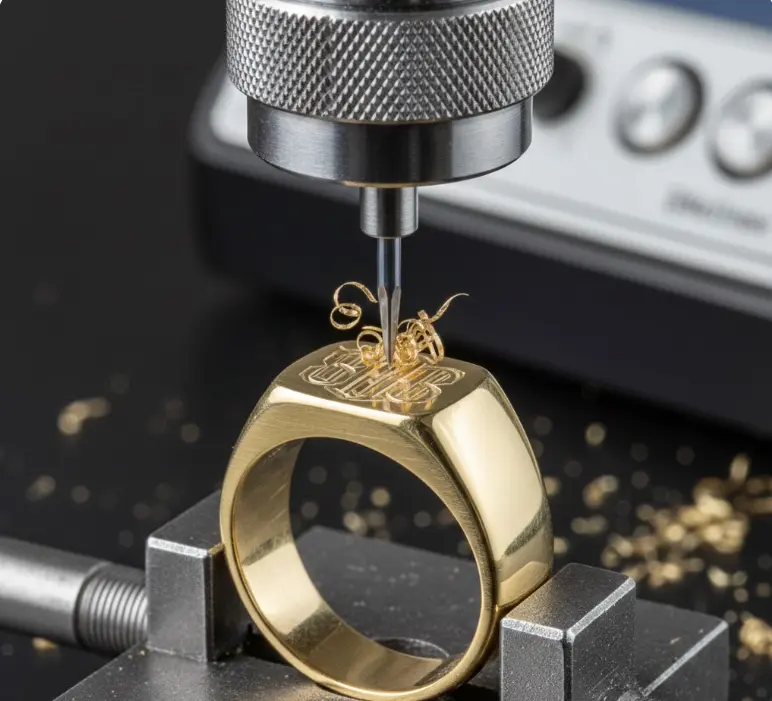
Mechanical engraving is a traditional subtractive process. It uses a high-speed rotating diamond tip to physically carve designs into the metal surface.
- V-Cut Texture: Creates angled walls that reflect light naturally. The results are visually brighter and more three-dimensional.
- Physical Contact: The machine must firmly fix the jewelry with a clamp. This ensures the tool can apply the necessary pressure to cut.
- Tactile Feel: You can physically feel the depth of the engrave. It carries the weight and “soul” of traditional goldsmithing.
- Best For: Traditional signet rings, luxury monograms, and high-end custom deep engraving.
II. What Is Laser Jewelry Engraving?
Laser engraving is a modern, non-contact technology. It uses a high-energy fiber laser beam focused on the metal surface to instantly vaporize it.
- The Fiber Standard: Fiber lasers are the industry standard for gold, silver, and copper. They offer far better absorption than ordinary CO2 lasers.
- Non-contact Process: No physical pressure is required. This protects delicate inlaid structures and fragile filigree from bending or breaking.
- Extreme Precision: Capable of engraving micro-text or anti-counterfeiting labels thinner than a human hair.
- Digital Versatility: If you can design it on a computer, the laser can engrave it. This includes high-definition photos and complex fingerprints.

III. Direct Comparison: Mechanical vs. Laser Engraving
3.1 Speed & Efficiency
- Mechanical: This is a slow, methodical process. It requires manual clamping, tool setting, and multiple cutting passes. Each step adds up.
- Laser: Utilizing high-speed galvanometer (Galvo) technology, the beam moves at incredible speeds. You can complete an inside-ring engraving in under 30 seconds. This allows for “instant gratification” in a retail setting.
3.2 Precision and Fine Details
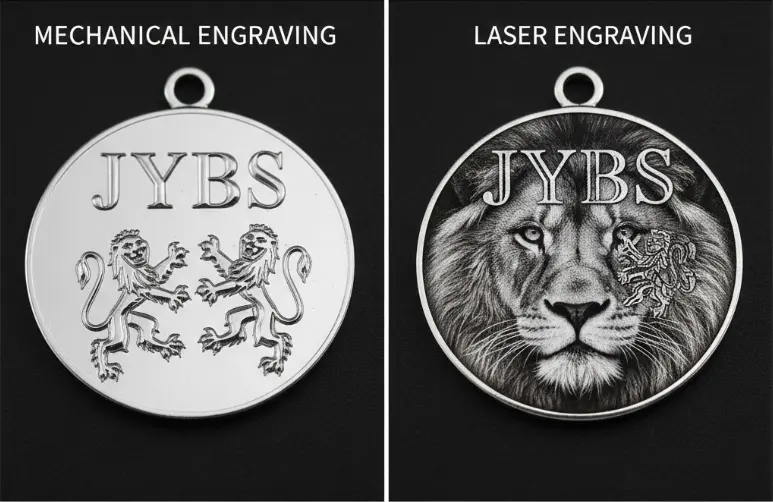
- Mechanical: Precision is limited by the tool tip radius (typically 0.1mm to 0.3mm). While great for bold lines, it struggles with micro-details. Intricate crests often become “muddy” because the tool is too large for the smallest gaps.
- Laser: A fiber laser spot size is approximately 0.02mm. This extreme fineness allows you to engrave high-definition photos on a tiny pendant. If the human eye can see it, the laser can engrave it with perfect clarity.
3.3 Material Compatibility
- Traditional Metals: Mechanical tools excel with soft metals like 24K gold. However, they struggle with tough modern alloys.
- Hard Materials: For Titanium, Tungsten, or Stainless Steel, mechanical bits dull almost instantly. Lasers master these materials with zero wear.
- Gemstones: A fiber laser can safely mark the girdle of a diamond (e.g., GIA serials). Because it is non-contact, there is zero risk of chipping the stone.
3.4 Curved Surface Processing
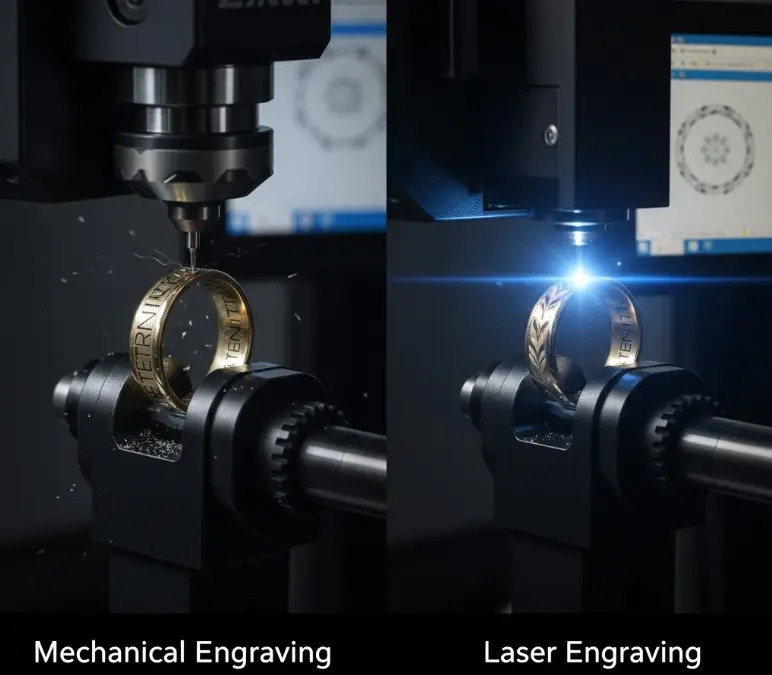
- Mechanical: Carving a cylindrical surface is difficult. If a ring is slightly “out-of-round,” a physical tool will cut too deep in some areas and skip others.
- Laser: When paired with a professional Rotary Axis, the laser system achieves flawless synchronization. The software automatically compensates for the curvature in real-time. It is the gold standard for seamless 360° wraps on wedding bands and bangles.
3.5 Maintenance and Lifespan
- Mechanical: This is a high-maintenance investment. You must stock diamond drag bits and replace them often. Mechanical bearings and belts require constant lubrication to stay accurate.
- Laser: A Fiber Laser has virtually no moving parts. The light source is rated for 100,000 hours. That is over 11 years of continuous use. With zero consumables, the long-term operating cost is nearly zero.
IV. Comparison Table Summary
| Feature | Mechanical Engraving | Laser Engraving (Fiber) |
| Processing Method | Physical Cutting (Contact) | Beam Vaporization (Non-contact) |
| Processing Speed | Slow (Minutes) | Extremely Fast (Seconds) |
| Rotary Work | Difficult / Manual Clamping | Simple / Automatic Sync |
| Maintenance | High (Frequent bit changes) | Extremely Low (No consumables) |
| Gemstone Safety | Medium to Low (Vibration) | Extremely High (Zero pressure) |
V. Final Verdict: Which One Suits Your Business?
Choose mechanical engraving if: You are a traditional goldsmith. You prioritize the classic V-cut reflective texture and deep tactile engraving. It is ideal for low-volume, high-end boutique work.
Choose laser engraving if: You operate a modern studio, retail chain, or custom factory. You need to scale production and reduce labor costs. The comprehensive advantages of fiber laser machines in speed and precision make them the best choice for business growth.
Summary
While mechanical tools offer a traditional touch, Fiber Lasers are the future of jewelry customization. They provide cleaner results, faster turnaround, and lower operating costs from day one.
Ready to upgrade your workshop? Explore our professional Jewelry Engraving Machines today. Visit the JYBS official website to find the perfect equipment to elevate your craft.