

When selecting a magnifier for precision grading or technical inspection, the underlying optical structure is the single most critical factor determining image quality. While entry-level magnifiers rely on low-cost single or double-lens systems, professional environments heavily favor the multi-element Triplet Lens. Understanding the physical and performance differences between these configurations is essential for making an informed equipment selection that avoids visual errors and excessive eye strain.
Optical Architecture: Breaking Down the Differences
The distinction between these lenses lies in how many glass pieces are engineered into the lens housing and how they manipulate light.
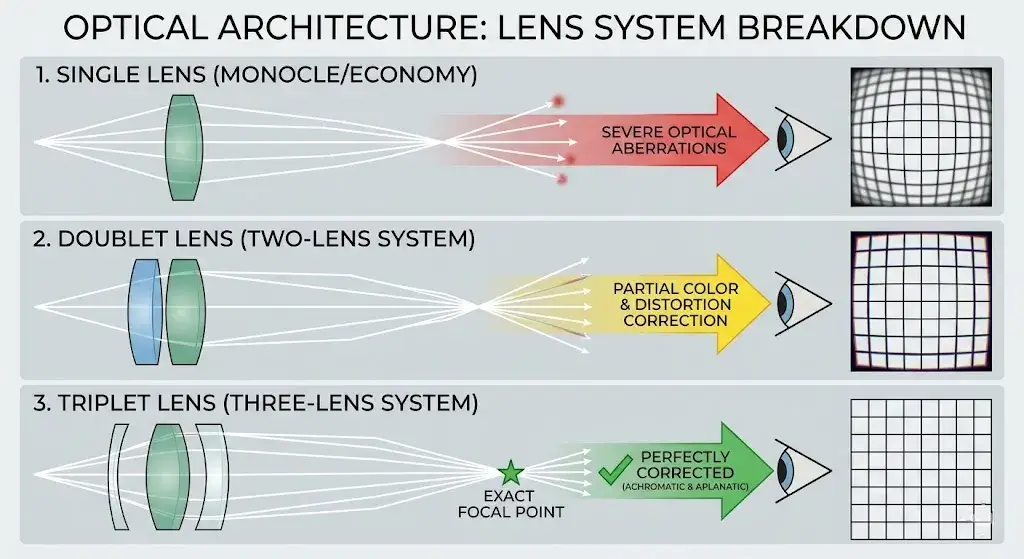
- Single Lens (Monocle/Economy): This structure uses a single piece of molded glass or plastic. Because it lacks corrective elements, light passing through its curved surface suffers from severe optical aberrations. The center may be legible, but the periphery is heavily warped and blurred, often creating a pronounced “fish-eye” effect.
- Doublet Lens (Two-Lens System): A doublet pairs two separate glass elements together. While it can partially correct for color fringing, it struggles to maintain a completely flat field of view across larger lens diameters, leaving the edges prone to distortion.
- Triplet Lens (Three-Lens System): The triplet architecture bonds three distinct glass elements together using specialized, high-transparency optical cement. The central double-convex lens provides the primary magnification, while two outer meniscus lenses serve as precise correctors. This geometry forces all light wavelengths from the center to the rim to converge at a single, exact focal point.
Technical Comparison: Triplet vs. Lower-Tier Optics
| Feature | Triplet Lens (3-Element) | Doublet Lens (2-Element) | Single Lens (1-Element) |
| Edge-to-Edge Clarity | Perfectly Sharp | Center only; blurry edges | Severe peripheral blur |
| Spherical Distortion | Near Zero (Flat Field) | Moderate warping | High “fish-eye” curvature |
| Chromatic Fringing | Fully Corrected (Neutral) | Partially corrected | High (Visible rainbow halos) |
| Resolution Standards | ≥ 67 lines/mm | ≈ 30$ lines/mm | Unrated / Low |
| Ocular Fatigue | Very Low (Extended Use) | Moderate | High (Short use only) |
Top Recommendations Based on Optical Structure
1. Alfa Mirage® CARTON LOUPE PRO 10X
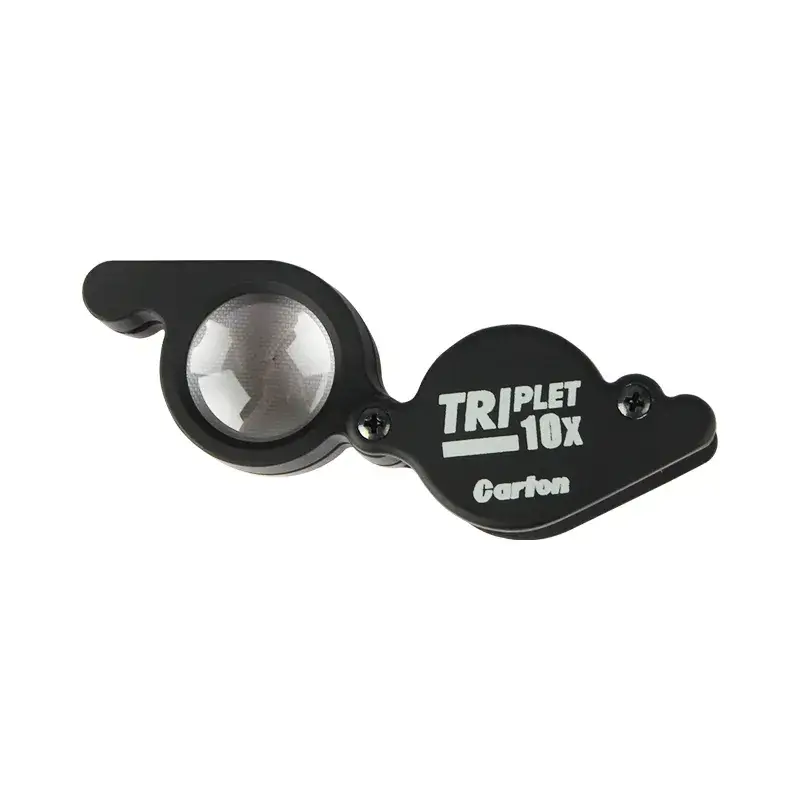
- Lens Structure: High-class Japanese Steinheil Triplet (Achromatic & Aplanatic).
- Key Metrics: 18mm non-coated lens delivering a high resolution of over 67 lines/mm.
- Best For: Master-grade diamond color comparisons and laboratory-level clarity grading.
2. Professional Triplet Hexagon Loupe with Rubber Grip
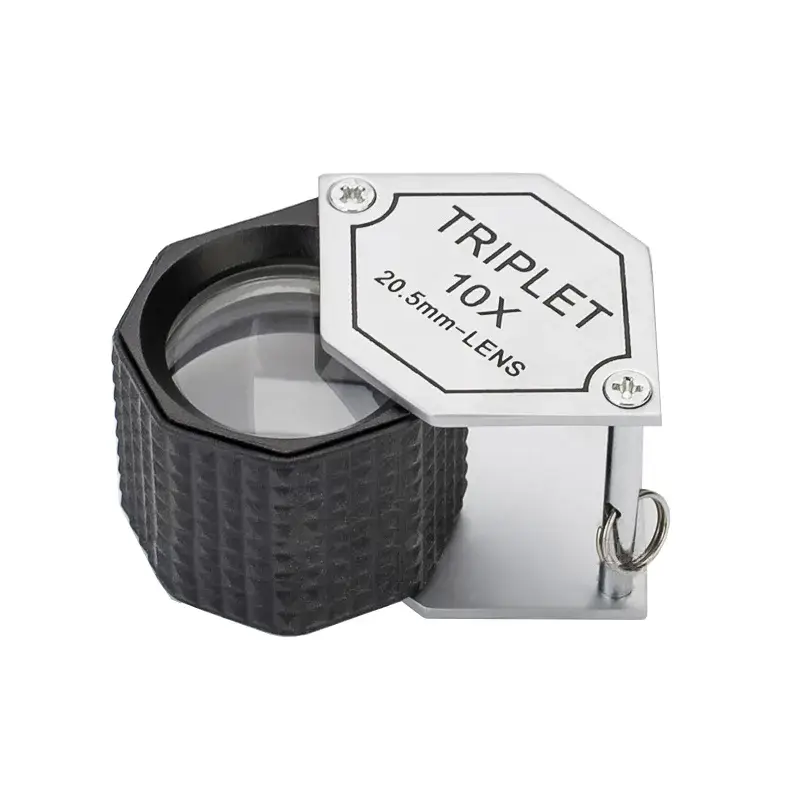
- Lens Structure: 10x multi-element triplet system (20.5mm lens) engineered for distortion-free performance.
- Key Metrics: Large aperture paired with a textured, non-slip rubber grip and a flat black inner lens holder to eliminate ambient glare.
- Best For: Continuous, high-volume jewelry workshop inspection, field buying, and watchmaking repair.
3. HARALD SCHNEIDER® Diamond Loupe L1
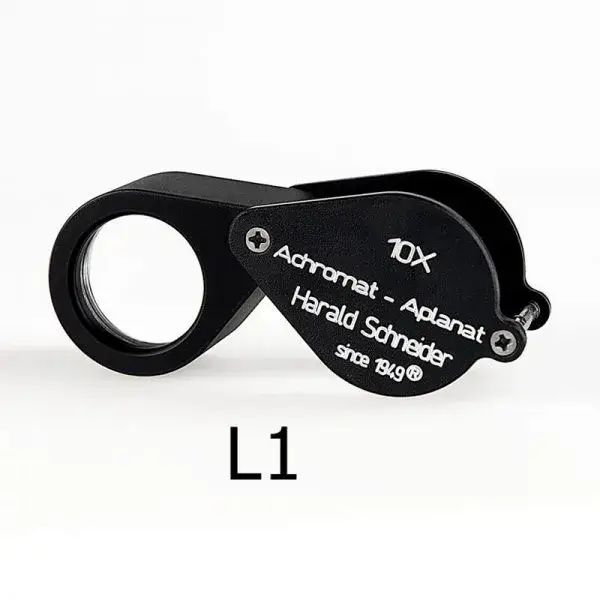
- Lens Structure: Elite 10x fully-corrected Achromatic-Aplanatic Triplet lens system crafted from premium German optical glass.
- Key Metrics: Large 20mm viewing area (18mm thickness) with an advanced anti-reflective coating for maximum light transmission and depth of focus.
- Best For: Authoritative diamond grading, critical gemstone inclusion inspection, and high-stakes purchasing decisions where absolute edge-to-edge sharpness is required.
Frequently Asked Questions
- Q: Why does a single lens magnifier make the edges of an object look distorted?
- A: This is caused by spherical aberration. Because a single lens has a uniform curve, light rays passing through its outer edges refract more aggressively than rays in the center, causing the outer image to warp and blur.
- Q: Can a doublet lens achieve true color grading accuracy?
- A: No. While doublets improve on single lenses, they cannot fully align all color wavelengths simultaneously. For professional grading, a true triplet is required to eliminate artificial color fringing.
- Q: How does a triplet lens reduce eye strain during long shifts?
- A: Your eye muscles naturally strain to “fix” blurred or warped images. Because a triplet provides a completely flat field of view with uniform focus, your eyes remain relaxed, preventing headaches and fatigue.
- Q: What is the significance of a “67 lines/mm” resolution rating?
- A: This represents professional optical resolution. It means the triplet can clearly separate 67 pairs of microscopic lines within a single millimeter, a level of detail necessary to find VVS inclusions.
- Q: Is a larger single lens better than a smaller triplet lens?
- A: No. A larger single lens actually increases optical distortion because it exposes more curved glass surface to incoming light. A smaller, well-aligned triplet will always outperform a large single lens in clarity and accuracy.
Strategic B2B Partnerships
JYBS operates as a specialized supplier for global jewelry tool manufacturers and industrial laboratories. We focus on supplying high-precision instruments that strictly adhere to the rigorous technical standards of professional work environments.
Looking for Wholesale Pricing or Bulk Procurement?
- B2B Bulk Orders: Customized tiered pricing structures designed to scale for tool retailers, educational institutions, and gemological laboratories.
- Worldwide Shipping: We support worldwide procurement with reliable global shipping. Our professional tools—including industry-standard loupes—can be delivered directly to international buyers and facilities across the globe.
- Technical Consulting: Acquire the detailed specification sheets and high-volume wholesale quotes you require within a guaranteed 3-hour turnaround.
Contact our B2B Sales Team for a Professional Quote