

Why Stone Setting Quality Control Requires a Specialized Loupe
Structural Inspection Focus
For a master stone setter or bench jeweler, the loupe serves as a structural tool rather than a color grading device. It is used to verify the symmetry of pave beads, ensure V-prongs are perfectly flush against princess-cut diamonds, and check for microscopic girdle chipping caused by setting pliers.
The Challenge of Working Distance
The primary optical hurdle for QC is the balance between working distance (focal length) and Depth of Field (DoF). If a setter needs to touch up a prong with a graver while observing through the loupe, the narrow clearance (25mm / 1 inch) of standard optics makes it difficult to work safely.
Specialized Magnification Solutions
To provide enough space to use sharp tools under magnification without the risk of scratching the lens, setters often opt for lower magnifications (5x to 7x) to extend the focal length up to 2 inches (50mm).
Critical Optical Specs for Stone Setting Standards
For structural QC, depth of field and tool clearance supersede extreme magnification.
| Key Specification | Recommended Standard | Why It Matters for Stone Setters |
| Depth of Field (DoF) | High (Deep Focal Plane) | Allows the setter to see the top of a prong and the girdle of the diamond in focus simultaneously without constantly moving their head. |
| Focal Length | 25mm to 50mm | Crucial for “tool clearance.” A longer focal length allows the jeweler to use gravers, pushers, or burnishers while actively looking through the lens. |
| Distortion Control | Edge-to-Edge Sharpness | Essential when inspecting halo settings. The setter must be able to view multiple pave diamonds at the edge of the lens without them appearing warped. |
Top 3 Loupe Recommendations for Stone Setting Quality Control
Engineered for workbench ergonomics and deep focal planes, these loupes are perfect for QC:
1. Zeiss D40 & D36 Loupe
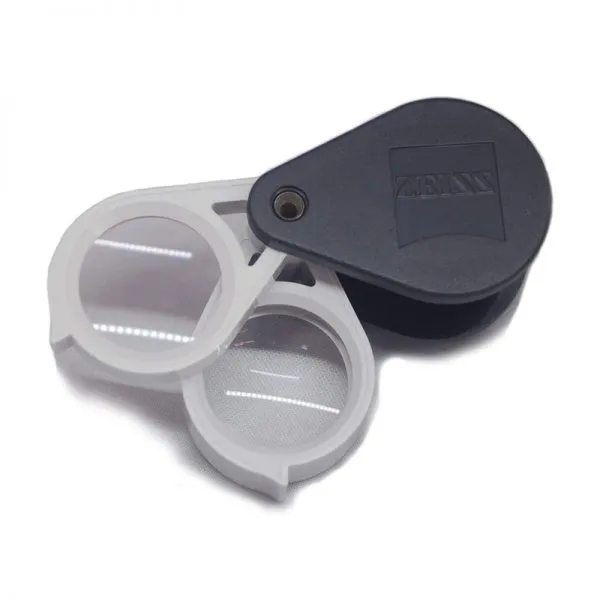
- Specs: Made in Germany. Aplanatic-achromatic optics. D40 features fixed 10x magnification (13mm triplet lens). D36 features selectable 3x/6x/9x magnification (22mm dual-lens). Both feature T* Anti-Reflective Coating.
- Verdict: The ultimate high-precision QC tool for checking final structural integrity and pave symmetry.
- Key Advantage: Zeiss’s legendary optical engineering effectively eliminates color dispersion and geometric aberration. The edge-to-edge sharpness allows the setter to inspect an entire row of pave diamonds or a complex halo setting without the edges warping. The D36 model is particularly valuable for setters needing flexible magnification with a wider 22mm view.
2. Hand Grip 5x & 7x Wide-Field Loupe
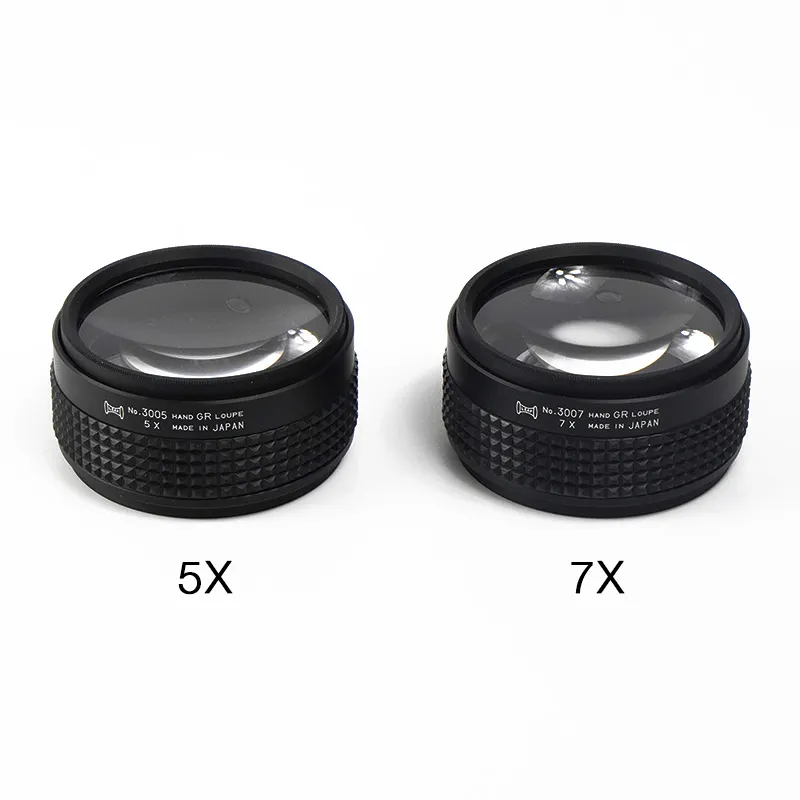
- Specs: Available in 5x (Model 3005) or 7x (Model 3007). Features a massive 53.5mm lens diameter. Weighs 110g-120g.
- Verdict: The perfect large-field inspection tool for continuous, high-volume QC sessions between tool applications.
- Key Advantage: By dropping the magnification to 5x or 7x, the working distance is significantly extended. Combined with the exceptionally wide 53.5mm lens, this gives the setter a massive viewing area to quickly inspect pave symmetry and prong alignment across the entire piece, reducing eye strain. It provides ample clearance to safely identify exactly where a graver or pusher needs to be applied next.
3. Original OptiVISOR Headband Magnifier
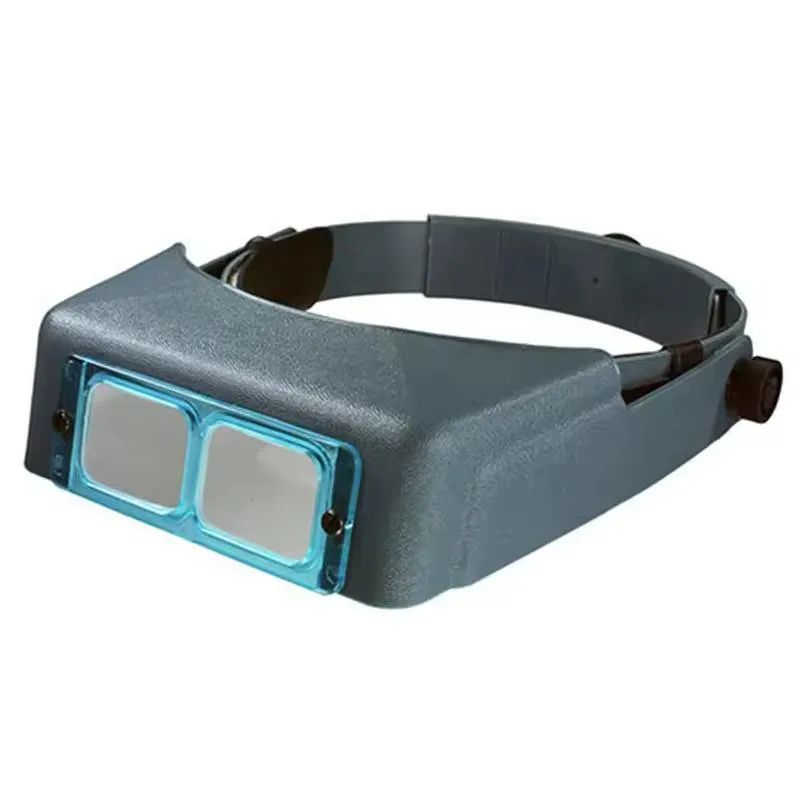
- Specs: Made in USA. Optical glass prismatic lenses. Available in magnifications from 1.75x (DA3) to 3.5x (DA10). Focal lengths range from 14 inches down to 4 inches. Features an adjustable comfort headband.
- Verdict: While technically a headband magnifier rather than a traditional pocket loupe, the OptiVISOR is the undisputed industry standard for hands-free pave setting, engraving, and continuous bench work.
- Key Advantage: Provides true binocular 3D vision, allowing the setter to perceive accurate depth while working. It frees up both hands for manipulating tools and the engraving block. With extended focal lengths (up to 14 inches) and the ability to tilt out of the way, it offers ultimate tool clearance during long hours of setting.
How to Clean and Protect Your Stone Setting Loupe
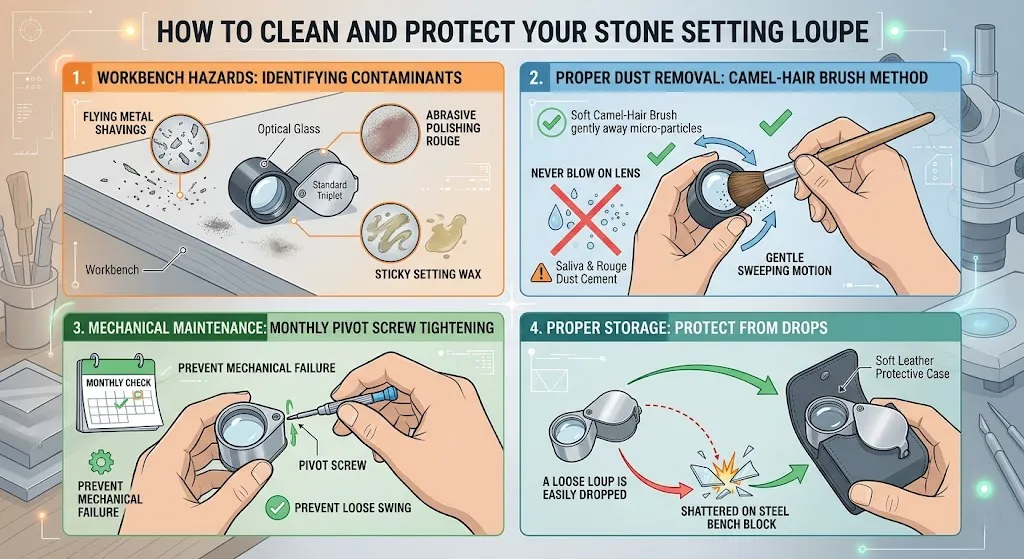
- Workbench Hazards: Because the workbench is a hazardous environment, flying metal shavings, abrasive polishing rouge, and sticky setting wax will inevitably contaminate the optical glass.
- Proper Dust Removal: Use a soft camel-hair brush to gently sweep away gold or platinum shavings before attempting to use a microfiber cloth. You should never blow on the lens to remove metal dust, as saliva can cause rouge dust to cement itself to the glass surface.
- Mechanical Maintenance: If your loupe features a metal housing, ensure the pivot screw is tightened monthly to prevent mechanical failure. Keeping the pivot screw tight is crucial because a loose, swinging loupe is easily dropped and shattered on a steel bench block.
FAQ: Selecting a Loupe for Stone Setting
- Q: Why does my 10x loupe hit my setting tools when I try to work?
- A: You are using a higher-magnification loupe which inherently has a short focal length (working distance). For tasks requiring active tool use, a headband magnifier (like OptiVISOR) or lower power loupes (5x/7x) are required to push the focal point further away, giving your hands room to work.
- Q: Is chromatic aberration a big deal for setting?
- A: Less so than for diamond grading, but it is still distracting. Spherical aberration (shape distortion) is your true enemy, as warped edges make it impossible to tell if a line of pave diamonds is set perfectly straight.
- Q: Can I use a loupe to check for fractured stones?
- A: Yes. After setting a fragile stone (like an emerald or tanzanite), use a 10x triplet loupe to inspect the corners and girdle for any stress fractures (cleavages) caused by excessive prong pressure.
Need to bulk buy for your Stone Setting team?
Get a Quick Quote. Our optical specialists will respond within 3 hours.