

When analyzing gemstone parcels or assessing complex jewelry structures, magnification power is only one part of the operational equation. The other critical determinant of throughput efficiency is the Field of View (FOV)—the total observable area visible through the optic at one time. In high-volume procurement or continuous quality control environments, utilizing a lens with an inadequate, constricted field of view creates a restrictive “tunnel vision” effect. This forces the operator to perform excessive micro-adjustments, drastically slowing down inspection speed and increasing the risk of missing critical peripheral defects.
The Optical Physics: Lens Diameter vs. Field of View
The spatial width of your field of view is governed by fundamental optical geometry and lens architecture:
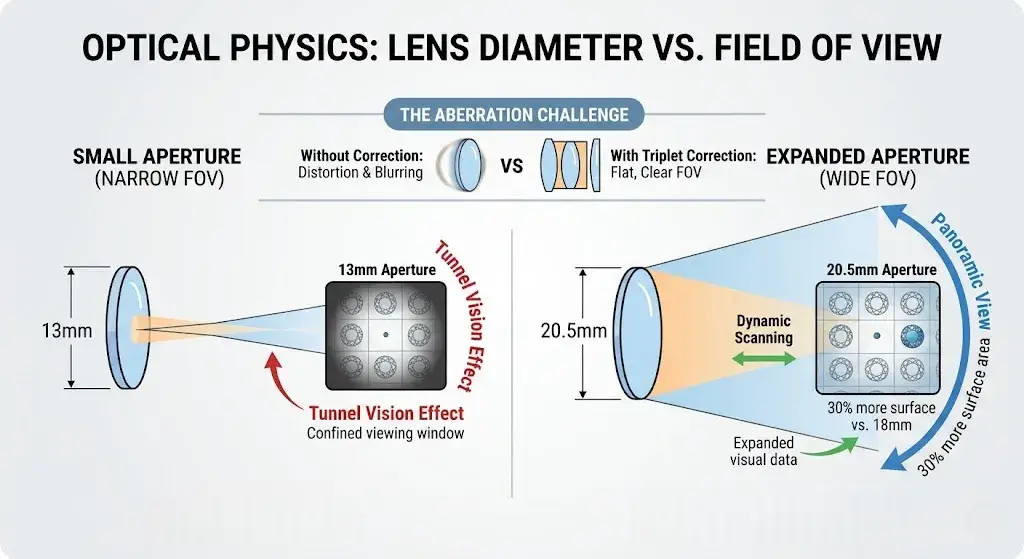
- The Diameter-to-FOV Correlation: The physical size of the field of view is directly restricted by the clear aperture (diameter) of the lens structure. While entry-level 13mm apertures provide a highly confined, pinpoint viewing window, an advanced 20.5mm expanded aperture increases the viewable surface area by nearly 30% compared to the industry-standard 18mm benchmark. This significantly expands the volume of visual data accessible in a single glance.
- The High-Power Contrast: Physics dictates that as magnification increases, the field of view naturally narrows. For instance, a 10x magnifier offers a wide, comfortable canvas for scanning entire stones, while a 20x or 25x lens compresses the view down to a tiny focal point, shifting its utility from a scanning tool to a micro-detail verifier.
- The Aberration Challenge: Engineering a large-diameter lens while maintaining edge-to-edge sharpness is highly complex. Without proper optical correction, expanding the lens diameter simply introduces massive distortion and blurring at the borders. A precision-aligned multi-element design (such as a triplet configuration) is mandatory to keep the expanded field flat, clear, and usable from center to rim.
Operational Throughput: Scanning vs. Target Inspection
In a fast-paced work environment, implementing an optic with an optimized, wide field of view provides distinct operational advantages:
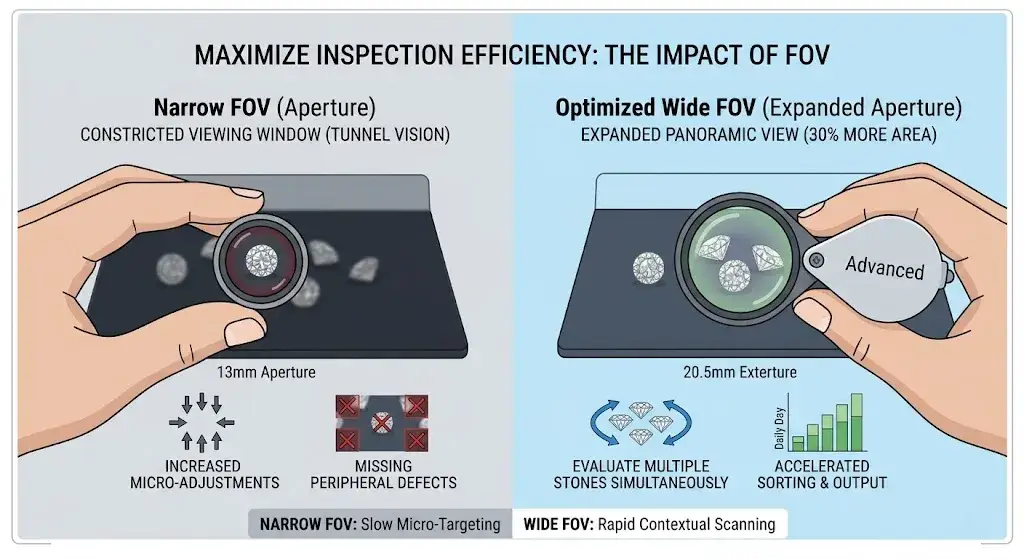
- Accelerated Parcel Sorting: When reviewing a parcel of small accent stones (melee diamonds) or raw specimens, a wide field of view allows the appraiser to evaluate multiple stones simultaneously, accelerating the sorting process and increasing daily output.
- Contextual In-Focus Observation: In symmetry analysis or jewelry repair, it is crucial to observe how an inclusion or prong alignment relates to the entire piece. A wide field provides the necessary context, letting you see the margins of the object without constantly shifting the loupe.
- Ergonomic Visual Comfort: A narrow field forces the user to lock their neck and eye muscles into a rigid, precise alignment to prevent the image from clipping. An expanded viewing window creates a forgiving “eye box,” allowing for natural micro-movements that prevent headaches and physical fatigue over long shifts.
Technical Comparison: Lens Diameter vs. Visual Coverage
| Lens Diameter | Field of View Window | Visual Layout Capacity | Primary Workflow Role |
| 12mm to 13mm Aperture | Narrow / Restrictive | Focuses on tight, isolated points | Quick single-target spot checks and micro-details |
| 18mm Industry Standard | Balanced / Standard | Standard single stone coverage | Traditional grading and laboratory analysis |
| 20.5mm to 21mm Expanded | Extra-Wide / Panoramic | Simultaneous multi-stone observation | High-volume sorting, bench manufacturing, parcel grading |
Top Recommendations for Extended Field Coverage
1. JYBS Professional Triplet Hexagon Loupe
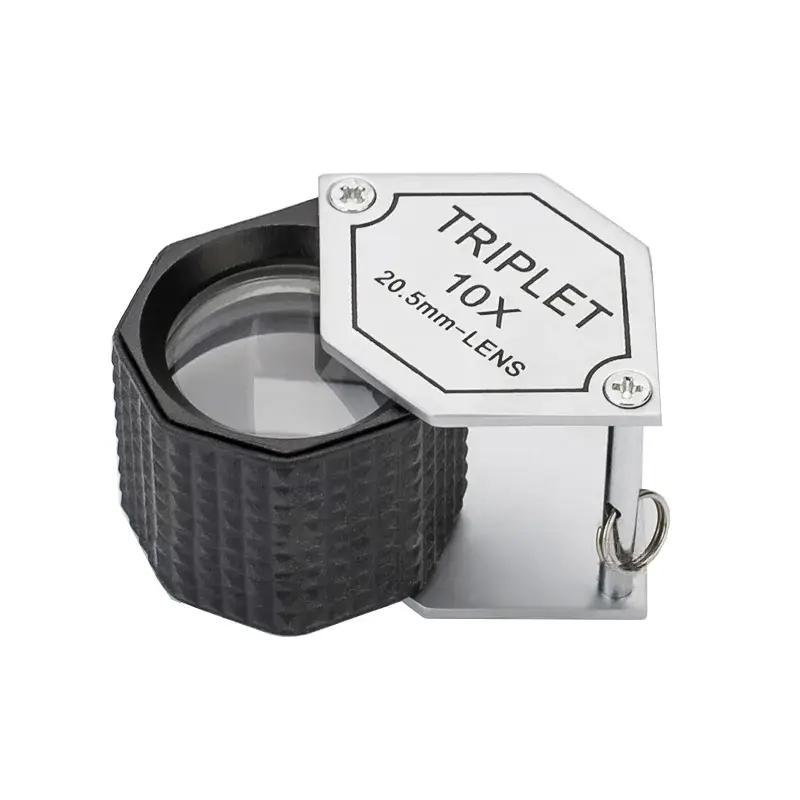
- Visual Dynamics: Features an oversized 20.5mm lens aperture, engineered specifically to deliver an extra-wide, panoramic field of view that maximizes visual data intake during volume grading.
- Optical Layout: A premium 10x multi-element triplet system that delivers an optimized 1-inch (25.4mm) balanced working clearance. It features a flat black inner lens holder that structurally prevents color distortion and controls glare, paired with ridged outer sides for a steady, non-slip grip.
- Design Merit: Finished in a sleek white/silver metal casing that swivels closed to fully protect the lens when not in use. It includes a dedicated pouch for easy storage and long-term upkeep.
- Best For: High-volume diamond and gemstone grading, parcel sorting, and continuous bench manufacturing where maximizing daily throughput and eliminating eye strain are absolute priorities.
2. Alfa Mirage® CARTON LOUPE PRO 10X
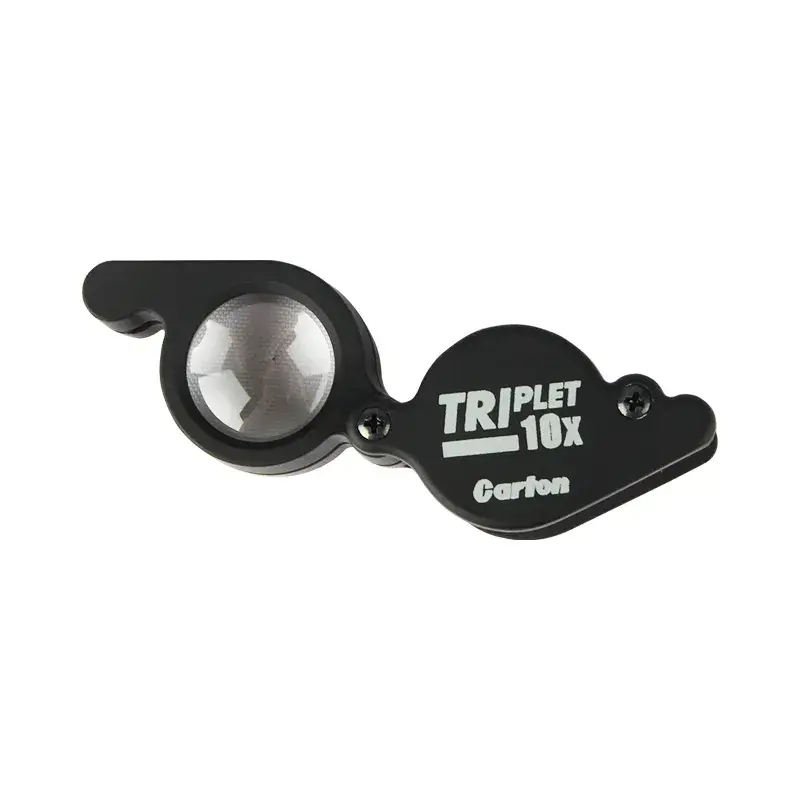
- Visual Dynamics: Utilizes an uncompromised 18mm Steinheil triplet frame optimized for exact international laboratory testing parameters.
- Optical Layout: Premium Japanese non-coated glass rated at an extreme resolution of over 67 lines/mm ensures that within its standard field of view, clarity is structurally flawless and uniform from edge to edge to distinguish micro-color differences.
- Best For: Rigorous laboratory clarity grading, certificate verification, and master-stone color testing.
3. Nikon® 10X Triplet Loupe
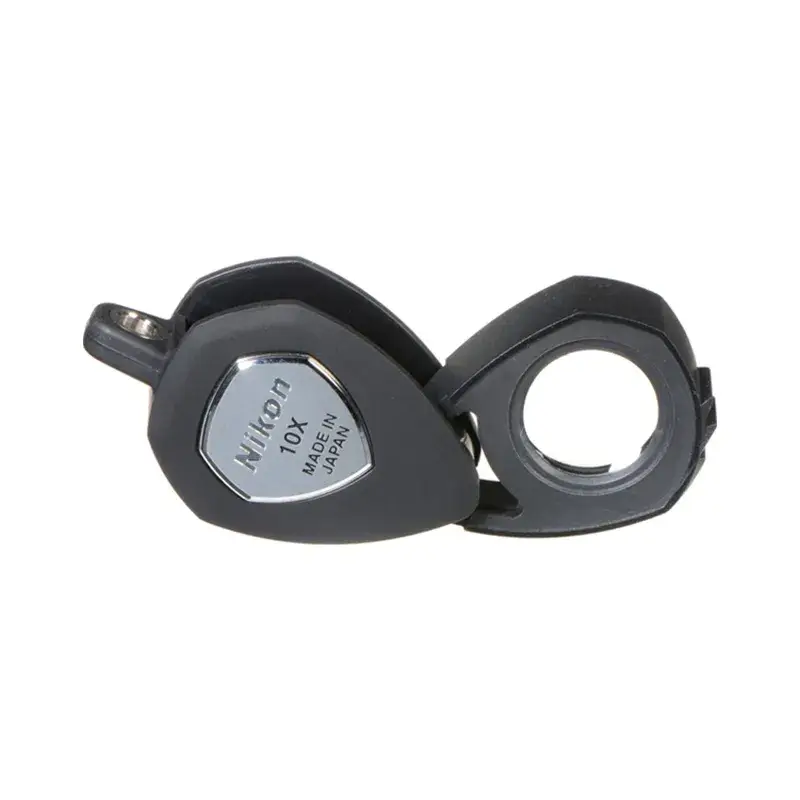
- Visual Dynamics: Engineered with a compact, ultra-precise 13mm lens diameter housed in a lightweight frame, optimized for targeted, zero-distortion spot-checks.
- Optical Layout: Features orthoscopic, color-corrected compound optics delivering more than 63 lines/mm of high-definition resolution. It intentionally concentrates its entire optical power into the core 13mm visual zone, eliminating the blurry, out-of-focus edge artifacts found in uncorrected larger lenses.
- Best For: Rapid on-the-go inspections, detailed inclusion characterization, and high-stakes buying trips where portability and flawless core optical sharpness are required.
Frequently Asked Questions
Q: Can I increase the field of view of my magnifier by pulling it further away from my eye?
A: No, doing so will actually decrease your field of view and create a narrow “peep-hole” effect. To maximize the viewable area, the loupe must be held as close to your eye as comfortably possible.
Q: Why does a 20x loupe have a much smaller field of view than a 10x loupe?
A: This is an unbendable rule of optical physics. Higher magnification requires shorter, more aggressive lens curves, which mathematically shrinks the focal plane and narrows the viewing window.
Q: Does a wide field of view cause the edges of the lens to look warped?
A: It will if you use a cheap single lens. However, a high-quality triplet lens uses corrective outer glass elements specifically to flatten the field, ensuring the edges remain straight, sharp, and clear even at an expanded 20.5mm diameter.
Q: Is a wide field of view better for individuals who wear spectacles?
A: Yes. Spectacles create physical distance between your eye and the loupe glass. A larger lens diameter (like 20.5mm) provides a broader, more forgiving “eye box,” making it significantly easier to capture a full panoramic image without removing your glasses.
Q: How does a wider field of view prevent physical fatigue at the workbench?
A: It allows for slight natural movements of your hands and eyes. When the field is wide, you do not have to maintain a frozen, rigid posture to keep the workpiece perfectly aligned with the absolute center of the lens.
Strategic B2B Partnerships
JYBS operates as a specialized supplier for global jewelry tool manufacturers and industrial laboratories. We focus on supplying high-precision instruments that strictly adhere to the rigorous technical standards of professional work environments.
Looking for Wholesale Pricing or Bulk Procurement?
- B2B Bulk Orders: Customized tiered pricing structures designed to scale for tool retailers, educational institutions, and gemological laboratories.
- Worldwide Shipping: We support worldwide procurement with reliable global shipping. Our professional tools—including industry-standard loupes—can be delivered directly to international buyers and facilities across the globe.
- Technical Consulting: Acquire the detailed specification sheets and high-volume wholesale quotes you require within a guaranteed 3-hour turnaround.
Contact our B2B Sales Team for a Professional Quote