

A master jeweler’s productivity at the bench is only as dependable as the precision of their cutting instruments. Substandard blades and dull cutters introduce hidden fabrication bottlenecks, robbing workshops of valuable bench time and eroding thin margins. Upgrading to professional jewelry cutting equipment transforms tedious post-processing into a clean, repeatable, and highly profitable workflow.
I. Why Standard Cutting Tools Are Sabotaging Your Delivery Efficiency and Profit Margins
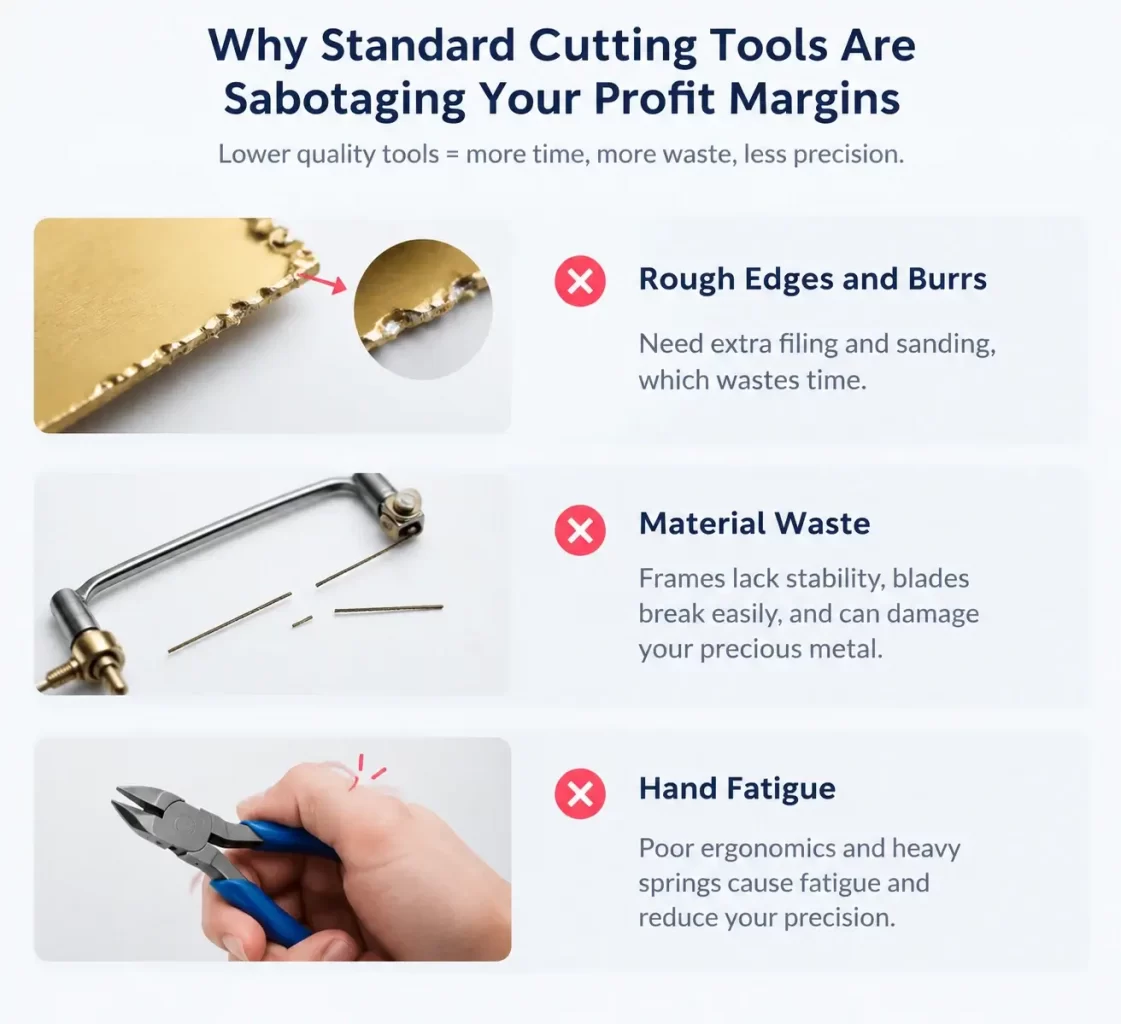
Many jewelry studios unknowingly bleed labor hours during the initial roughing-out stage. Relying on mass-market, budget-tier cutting gear creates downstream complications that severely impact bottom-line profitability.
- Hidden Time Costs from Rough Edges and Burrs: Standard cutting tools rarely shear cleanly; they crush and tear metal, leaving jagged, raised burrs. Bench jewelers are then forced to spend excessive, non-billable bench time filing, grinding, and sanding surfaces true. What should be an instantaneous cut turns into several minutes of corrective smoothing that interrupts production pacing.
- Material Waste Due to Instability and Frequent Blade Breakage: Traditional stamped or thin-gauge iron saw frames lack structural torsional rigidity. Under dynamic cutting loads, even the slightest lateral wrist tilt twists the frame, instantly snapping fine saw blades. Beyond blade replacement costs, broken blades frequently skip across metal surfaces, gouging mirror-polished sheet and creating irreversible precious metal loss through scrap and aggressive remediation.
- Ergonomic Flaws Leading to Hand Fatigue and Reduced Precision: Entry-level cutters and bulky frames feature poor weight distribution and harsh return springs that demand excessive hand force. This induces rapid tendon and forearm fatigue during repetitive batch work. As hand stability deteriorates, precision drops, leading to wavering cut lines, inaccurate prong heights, and mismatched joinery during delicate openwork piercing.
II. Technical Advancements and Upgrade Solutions for Essential Workbench Cutting Tools
High-volume manufacturing facilities and master goldsmiths eliminate mechanical inconsistencies by replacing generic tools with engineered cutting systems. Upgrading workbench gear requires targeting the specific mechanical principles that dictate clean metal separation.
Sawing Systems: Moving from Manual Body-Tensioning to Mechanical Constant Tension and Zero-Tilt Frames
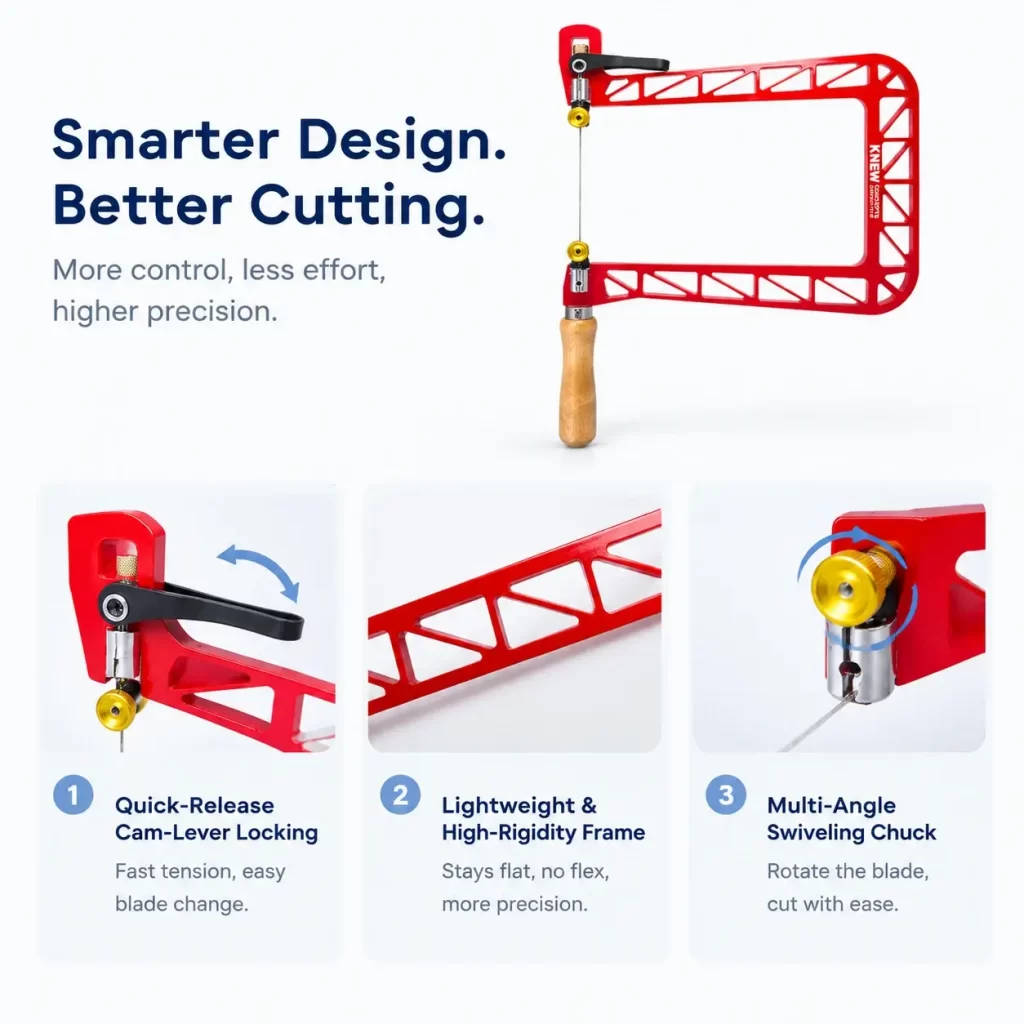
Traditional piercing frames force artisans to press the front of the frame against the edge of their workbench or their sternum, using body weight to compress the frame while tightening thumbscrews. This crude approach yields inconsistent tension, misaligns the blade axis, and bows the frame laterally.
Modern jewelry cutting engineering solves this through rigid structural geometry and repeatable mechanical leverage.
- Quick-Release Cam-Lever Locking: A dedicated cam-action lever applies immediate, calibrated tension across the blade with a single flick. Releasing the lever slackens the blade instantly for threading through internal pilot holes, and returning the lever snaps the blade back to the exact same tension. When plucked, the blade sounds a crisp, high-frequency note, completely eliminating bodily compression and wrist strain.
- Lightweight, High-Rigidity, Torsion-Resistant Frame: Replacing flexible solid iron bars with truss-style, aircraft-grade aluminum eliminates frame flex. The frame stays dead flat throughout aggressive curves, guaranteeing that the blade stays 90° perpendicular to the metal surface without undercutting or wandering.
- Multi-Angle Self-Locking Swiveling Chuck: Swivel blade clamps allow jewelers to index the blade angle off-axis. Rotating the blade enables infinite rip cuts along long gold sheets without the frame spine ever colliding with the edge of the workpiece.
Recommended Benchmark Upgrade: KNEWCONCEPTS® Mk4 8″ Lever-Tension Precision Swivel Saw Frame (#124.008CS)
Engineered from powder-coated aircraft-grade aluminum, this 275-gram frame delivers 50 to 60 lbs of constant blade pre-tension—up to six times greater than standard saw frames. The integrated cam-release lever maintains tension settings across repeated piercing operations, while 360° rotating clamps snap into rigid positive stops every 45°, virtually ending the frustration of snapped #4/0 to #8/0 blades.
Wire-Cutting Tools: From Bi-directional Compression Shearing to Zero-Chamfer, Perfectly Flush Cutting
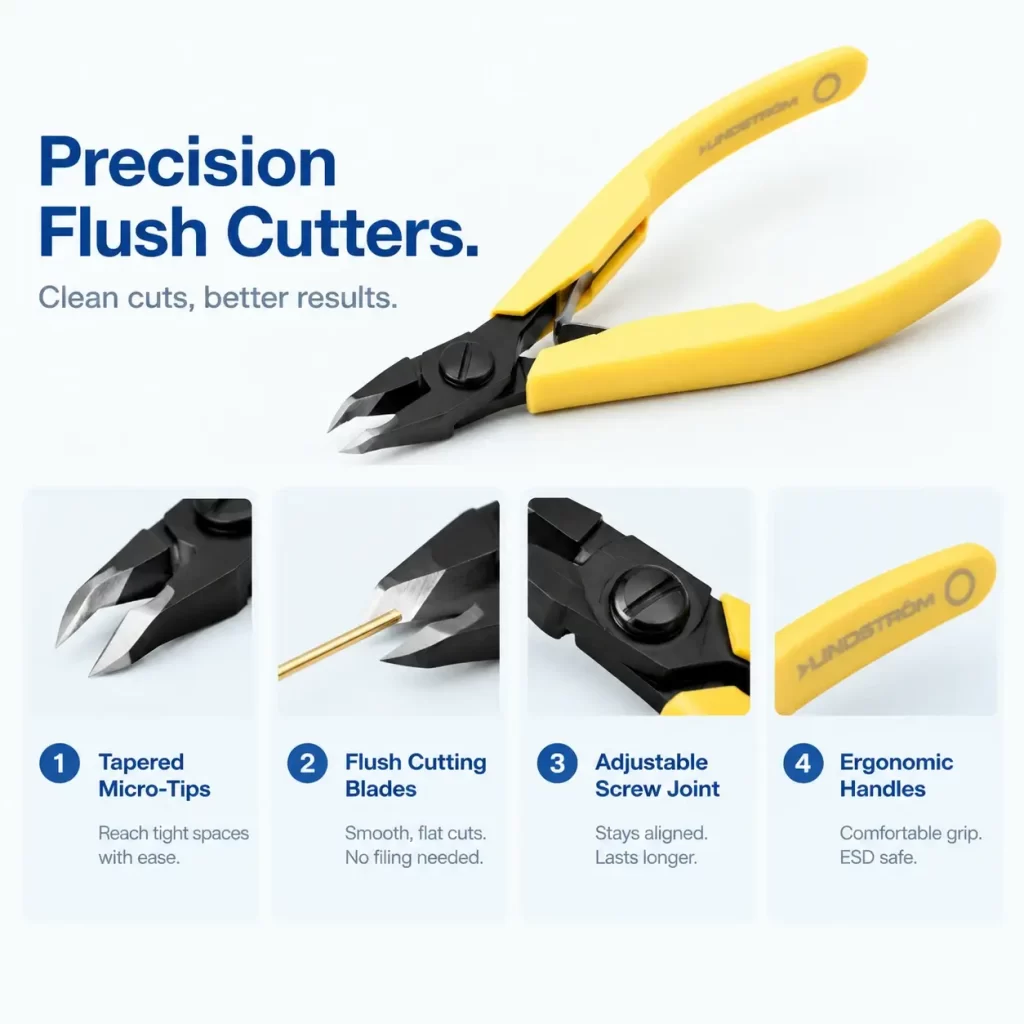
Standard diagonal wire cutters are manufactured with beveled jaws that pinch wire from both sides. This dual compression wedges metal apart, leaving a sharp “roof-shaped” ridge across the wire end that must be filed flat before seating against flat stock or laser welding.
Professional-grade flush cutters replace wedge action with ground knife-edge blades designed for true planar separation.
- Slim, Tapered Micro-Tips: A tapered, low-profile jaw profile clears surrounding prongs, channel walls, and delicate filigree without obstruction. This gives jewelers direct visual alignment when trimming pavé prongs or clipping tight sprues.
- Precision Flush-Grinding: Fully flat outer blade faces cut through ductile silver, copper, and karat gold wires smoothly, leaving an ultra-smooth, planar wire termination that seats flush against adjoining metal with zero secondary filing.
- Precision Screw-Adjustable Joint: Conventional lap joints loosen over time, allowing cutting jaws to cross over and dull one another. Precision-threaded screw joints hold the blades in axial alignment throughout hundreds of thousands of cycles, maintaining frictionless motion without side-to-side wobble.
Recommended Benchmark Upgrade: LINDSTROM® 80 Series Precision Flush Cutters (#8248)
Calibrated specifically for micro-range soft wire from Ø 0.20 mm to 0.80 mm (32–20 AWG), the Swedish-made #8248 model utilizes high-performance alloy steel induction-hardened to 63–65 HRC. Its tapered and relieved head profile provides direct sightlines into congested settings, while its adjustable precision screw joint and ESD-safe handles produce flat cuts that are immediately ready for soldering.
Cutting Sheet Metal and Profiles: From Stretching and Curling to Guided, Reference-Plane Forming
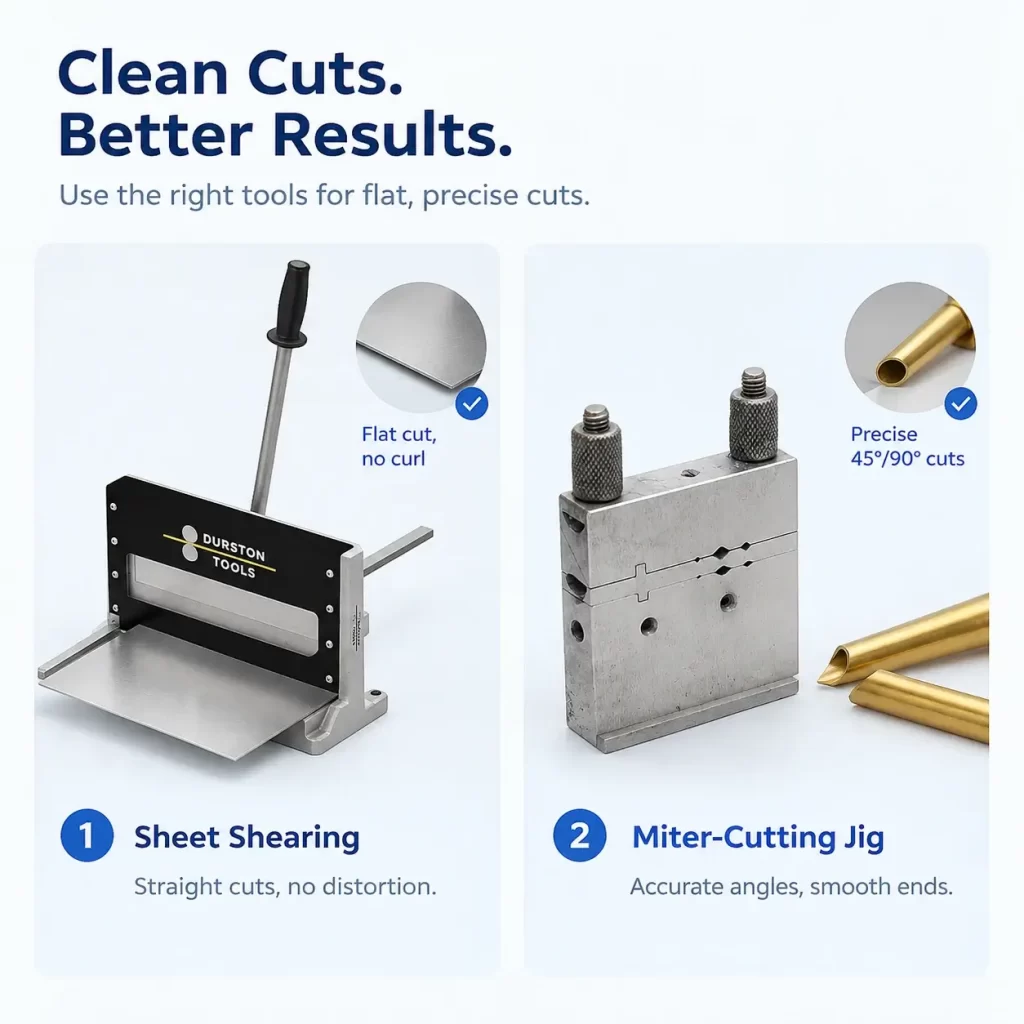
Using handheld tin snips to cut thick silver and gold sheets is inherently flawed. Hand shears exert asymmetrical shear force, stretching the cut strip into a curled spiral and work-hardening the metal edge. Similarly, freehand sawing of tube and wire stock relies entirely on muscle memory, almost always yielding out-of-square cuts.
Eliminating these errors requires guiding the workpiece against a physical reference plane.
- Vertical Sheet-Shearing Mechanism: A dedicated bench guillotine shear translates manual leverage through compound linkages into pure vertical downward force. Combined with an adjustable 90° squaring fence, it slices through 1.5 mm to 2.0 mm metal sheet without twisting, distortion, or edge curl. Stock emerges flat and immediately ready for layout scribing, bypassing tedious mallet flattening and re-annealing cycles.
- Hardened Steel Miter-Cutting Jig: Freehand sawing of tubing and round wire often leads to angled, mismatched ends. A precision miter-cutting jig utilizes case-hardened steel blocks ground with true 45° and 90° channels alongside built-in stop gauges. The jeweler clamps the wire in the channel and runs the saw blade directly against the hardened face, yielding a flat face that locks up with zero light gap at the solder seam.
III. Key Evaluation Criteria for Upgrading to Professional-Grade Cutting Tools
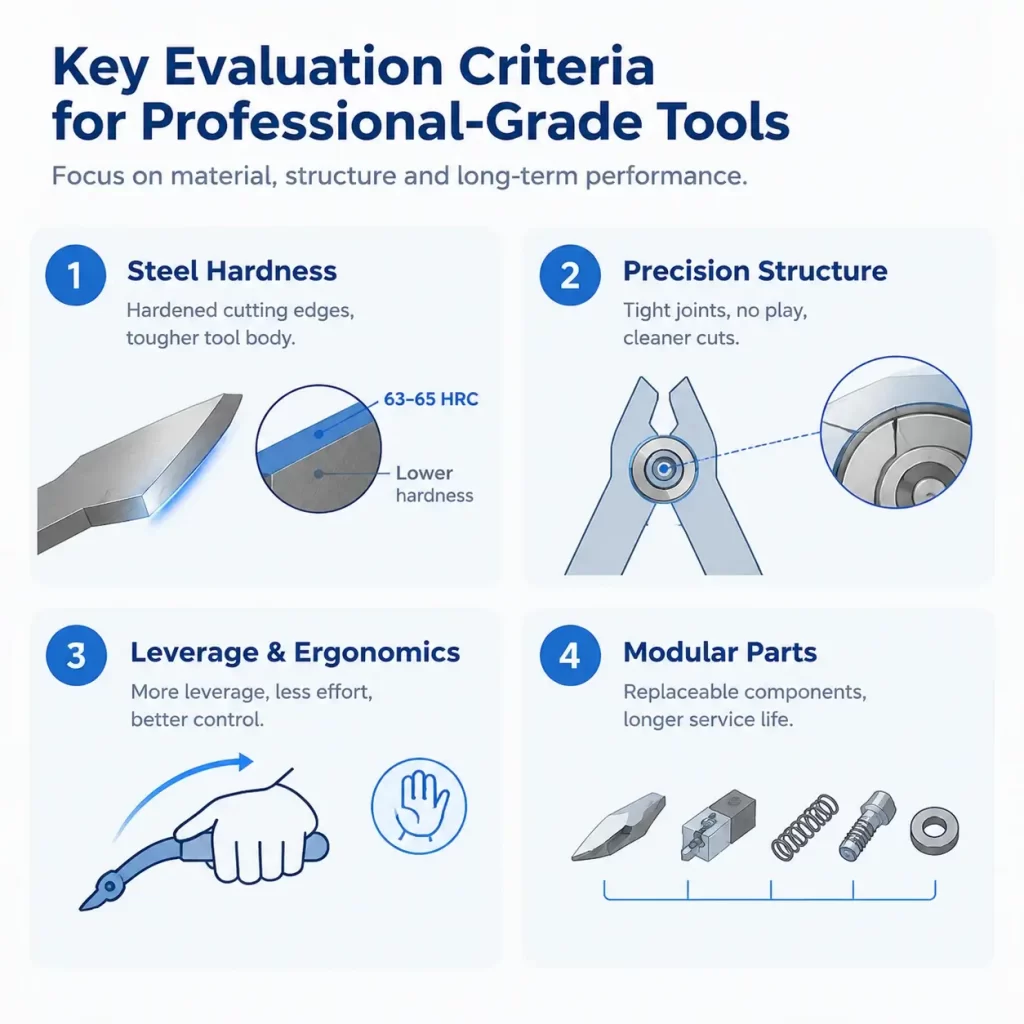
Investing in commercial jewelry cutting tooling requires evaluating the physical metallurgy and structural tolerances of the equipment rather than aesthetic finishes.
- Steel Hardness Gradient and Localized Heat Treatment: A resilient tool balances wear resistance with impact toughness. Look for differential induction hardening: cutting edges should reach 63–65 HRC to retain acute edges against precious alloys, while the supporting tool body remains at a slightly lower temper to absorb shock without fracturing.
- Bearing Precision and Zero-Clearance Assembly: Inspect joint construction. Premium diagonal cutters and bench shears employ box joints or ground-threaded pivot assemblies that eliminate lateral play. A joint with zero clearance ensures that fine cutting edges cleanly slice delicate foils and micro-wires rather than wedging them between loose blades.
- Leverage Ratios and Ergonomics: Evaluate the mechanical advantage between the pivot point and handle reach. High leverage ratios multiply hand force smoothly, delivering clean, controlled shearing with minimal grip pressure. Handles must support natural palm geometry to prevent localized nerve pressure and chronic carpal strain.
- Modular Spare Parts and Maintainability: Commercial-grade tools are designed as repairable assets. Quality manufacturers offer interchangeable blade clamps, tension levers, replacement return springs, and modular blades, ensuring your workshop’s core cutting framework delivers decades of service.
IV. Maintenance Protocols for Preserving Precision and Extending the Lifespan of Professional-Grade Tools
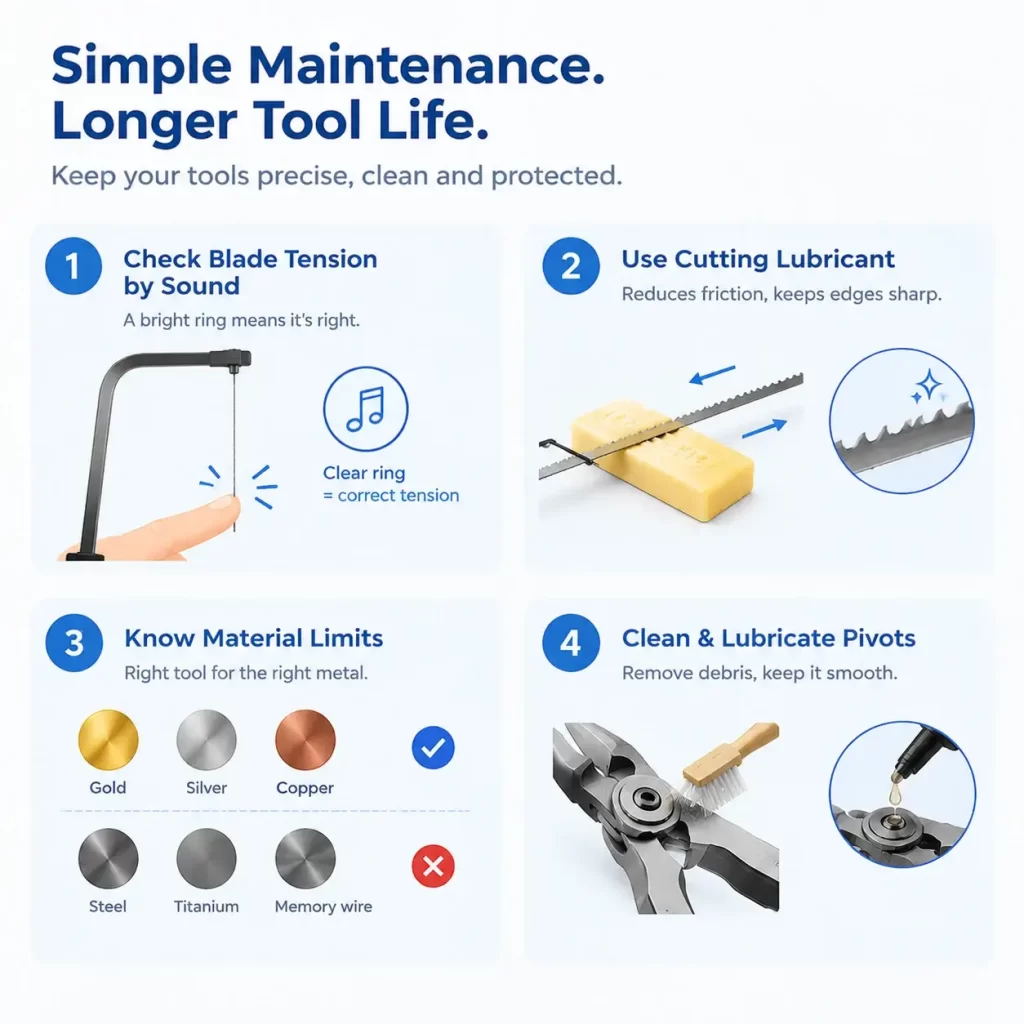
Precision cutting instruments maintain their tight tolerances only when protected from mechanical abuse and environmental corrosion. Integrating strict workshop protocols safeguards your tool investments.
- Calibrating Saw Blade Tension by Sound: After securing a new jeweler’s piercing blade, pluck the center span with a fingernail. An adequately tensioned blade emits a bright, high-pitched ring. A dull, thudding sound indicates insufficient tension, which causes the blade to wander, catch on internal corners, and snap. An overtightened blade puts unnecessary strain on mounting threads.
- Proper Use of Microcrystalline Cutting Lubricant: Friction generates localized heat that anneals saw blade teeth and dulls edge hardness. Regularly draw saw blades and burrs through solid, acid-free synthetic microcrystalline wax during deep cuts. Lubricant eases chip evacuation, lowers cutting temperatures, and noticeably extends consumable blade life.
- Distinguishing Wire Gauge Limits and Metal Hardness: Keep micro-flush cutters dedicated strictly to soft precious alloys (karat gold, fine and sterling silver, platinum, and copper). Never cut memory wire, spring steel, titanium, or thick sprues with precision wire cutters. Standardize a strict workshop policy: label fine-wire cutters clearly to prevent catastrophic blade chipping caused by rogue hard metals.
- Clearing Debris from Precision Pivots and Applying Low-Viscosity Anti-Rust Lubricant: Abrasive gold, silver, and investment dust settles into pivot bearings, accelerating mechanical wear. Use a stiff natural-bristle brush to sweep away particulate build-up at the end of each shift. Apply a drop of low-viscosity, non-gumming synthetic oil to the joint mechanism weekly to displace humidity and preserve smooth action.
Maximize Your Production Efficiency with Professional Cutting Solutions
Upgrading your bench with professional jewelry cutting tools eliminates hidden labor costs, protects valuable metals, and ensures every joint aligns with precision. Moving away from standard, uncalibrated hand tools frees your workshop to focus on high-yield production, clean craftsmanship, and faster project turnarounds.
Ready to upgrade your toolkit? Visit JYBS to explore our professional-grade Jewelry Cutting Tools. As a trusted supplier of jewelry-making equipment, JYBS specializes in large-scale wholesale solutions tailored for B2B clients.