

Why Karat Gold Alloying Needs a Specific Type of Rolling Mill
- Commercial Jewelry Foundations: Fabricating with karat golds—specifically 14K and 18K alloys—is the cornerstone of commercial jewelry manufacturing.
- Varied Alloy Behavior: However, not all karat golds behave the same.
- Material-Specific Challenges: While 18K yellow gold (alloyed with silver and copper) is highly cooperative, 14K nickel-white gold is notoriously problematic.
- Nickel-White Gold Properties: Nickel imparts extreme hardness and tensile strength to the gold, making it stubborn, springy, and highly susceptible to edge-cracking (stress fractures) during the rolling process.
- Structural Integrity Requirements: A rolling mill tasked with processing high-tensile karat golds must possess uncompromising structural integrity.
- High-Pressure Consequences: If you attempt to process a thick ingot of 14K white gold on a poorly constructed mill, the immense upward pressure from the metal will cause the top roller to flex.
- Deflection and Uniformity Issues: This deflection leads to uneven sheet thickness and forces the metal to curve violently as it exits the mill.
- Breakdown Station Essentials: To successfully break down karat gold alloys, you require a mill with a solid cast-steel frame, high-tolerance bearing blocks, and a precise reduction gear to deliver smooth, unyielding compression.
Key Technical Specs for Karat Gold Applications
When dealing with tough alloys like nickel-white gold, rigid frame construction and precise gear alignment are non-negotiable.
| Specification | Recommended Range | Why It Matters for Karat Gold |
| Frame Construction | Cast Steel or Billet Steel | Prevents micro-flexing. 14K white gold will exploit any weakness in the frame, resulting in cambered (curved) wire or sheet. |
| Gear Ratio | 4:1 to 5:1 | Essential for overcoming the high yield strength of complex karat alloys without causing operator strain or stalling the rollers. |
| Roller Hardness | HRC 62 – 64 | Karat gold ingots, especially after a fresh pour, can be quite hard. High HRC ratings prevent the rollers from denting under pressure. |
Top 3 Rolling Mill Recommendations for Karat Gold Alloying
Engineered to tame the toughest jewelry alloys, these mills are essential for the professional goldsmith:
1. US Made 1HP Double Heads Electric Rolling Mill 130MM – JYBS
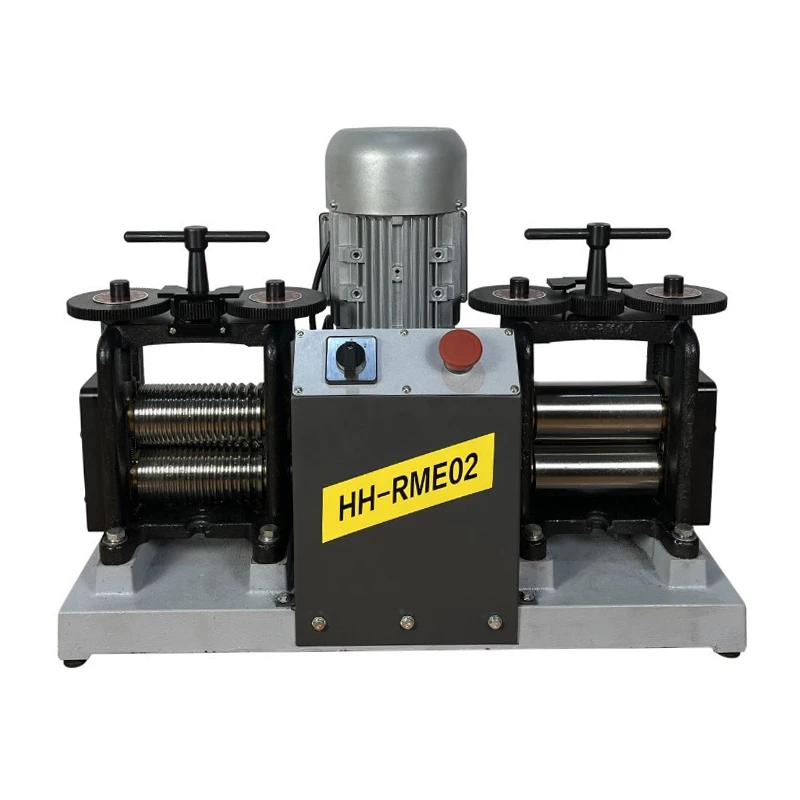
- Key Specs: Dual-head configuration (Dedicated Flat & Wire), 1HP high-torque motor, 130mm Flat area, 1.0mm–8.0mm Square Wire grooves, 108KG total structural mass.
- Verdict: The ultimate breakdown station for high-volume karat gold production. Processing thick ingots of stubborn 14K white gold requires immense pressure that can flex lighter frames. With a massive 108KG chassis, this motorized mill guarantees absolute zero deflection. The dual-head setup allows you to switch from rolling wide sheet metal to drawing 8.0mm square wire for heavy 18K chains without any tool reconfiguration, ensuring a seamless workflow for bespoke alloy fabrication.
2. Single Sided 1.5HP Desktop Electric Rolling Mill – JYBS
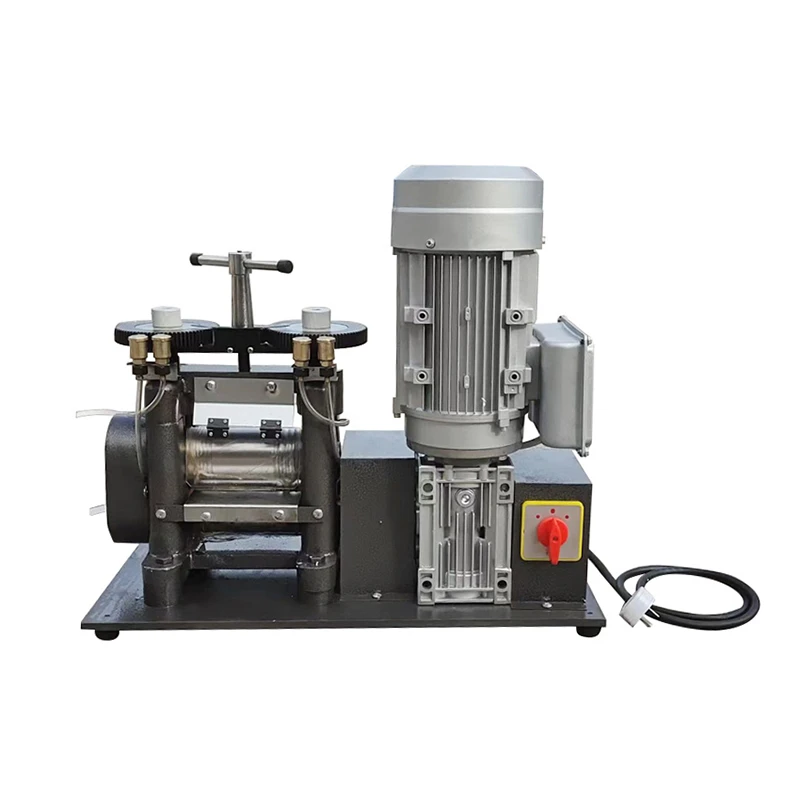
- Key Specs: 1.5HP (1.125KW) industrial-grade motor, 70*140mm Chrome Steel Rollers, 70KG structural weight, 220V.
- Verdict: The powerhouse for karat gold sheet fabrication. 14K nickel-white gold is notoriously springy and susceptible to edge-cracking if the pressure is inconsistent. The 1.5HP motor provides a constant, powerful rotational speed that manual cranking cannot match, delivering perfectly uniform thickness across the entire 140mm width. The ultra-hard Chrome Steel rollers are specifically designed to withstand the high yield strength of complex karat alloys without sustaining surface damage.
3. Combination Rolling Mill 130MM(L)65MM(D) – JYBS
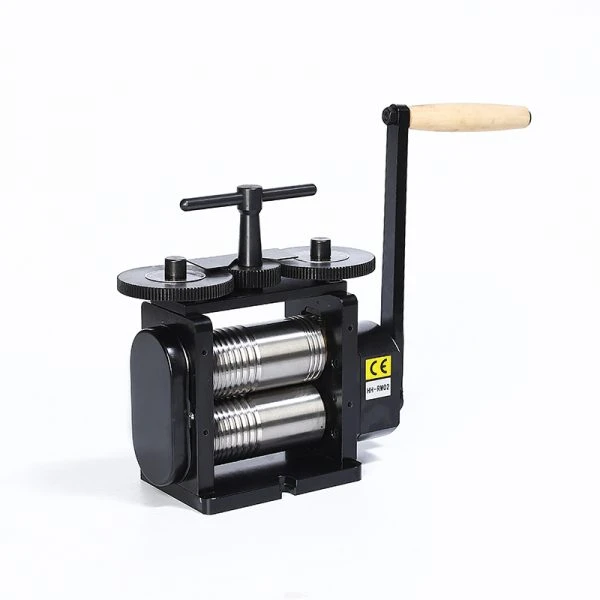
- Key Specs: 130mm combination width, 65HRC induction-hardened mirror rollers, 4:1 Reduction Gear, One-piece solid precision steel body.
- Verdict: The definitive manual mill for the boutique goldsmith specializing in custom alloys. While 14K nickel-white gold presents the ultimate test for manual equipment, the ultra-hard 65HRC induction-hardened rollers on this JYBS model are the critical differentiator—they withstand the extreme yield strength of complex karat alloys without sustaining surface pitting or damage. The integrated gear-driven adjustment system ensures that even under high-tensile loads, both rollers descend in perfect synchronization, providing the consistent pressure required to minimize cambering and keep your ring shanks and wire straight.
Maintenance Tips for Karat Gold Workshops
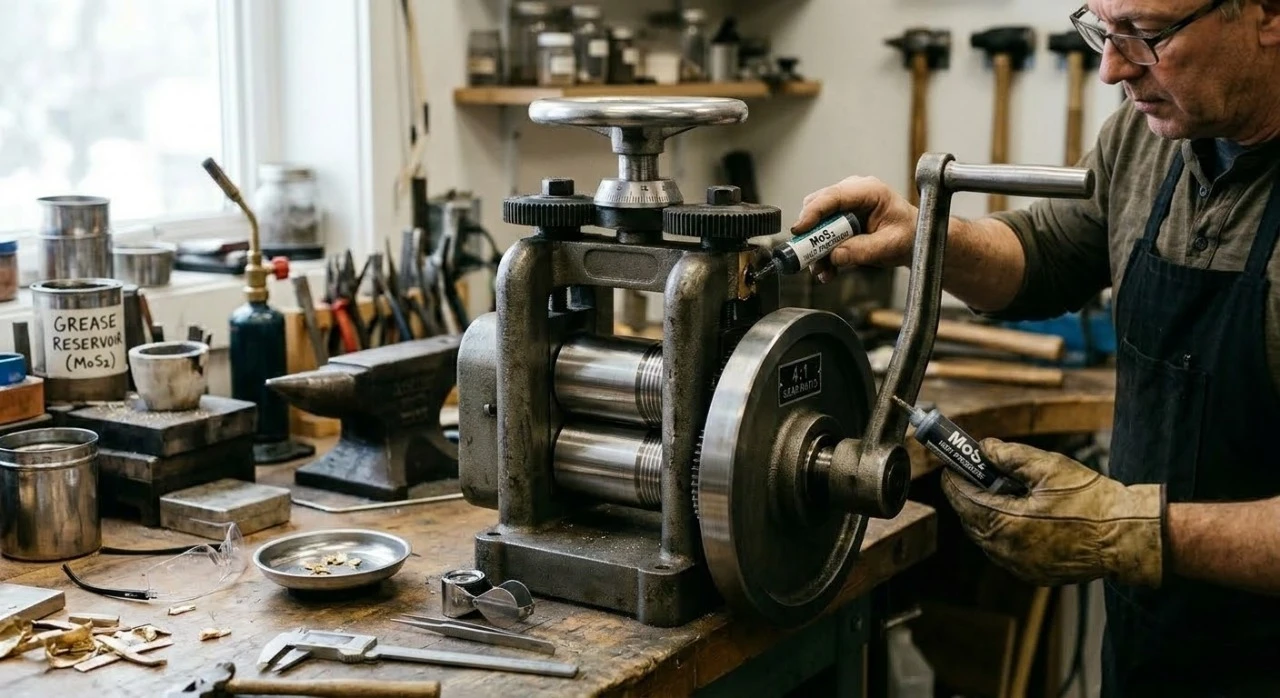
- Contamination Risk Management: Because goldsmiths often alloy their own metal, the risk of rolling a contaminated ingot is high.
- Hot Shortness Hazards: If an ingot exhibits “hot shortness” (cracking due to trace impurities like lead or silicon), pieces of the brittle gold can snap off under the high pressure of the rollers.
- Safety and Inspection: Always wear safety glasses, and routinely inspect the V-grooves for tiny shards of gold that may have become wedged in the steel.
- Bearing Block Care: Keep the bronze bearing blocks heavily greased. The immense downward force exerted by 14K white gold will quickly wear out dry bearings, causing the top roller to lose its parallelism. We recommend using a high-pressure Molybdenum Disulfide (MoS2) grease for the screw-down assemblies; this ensures the adjustment remains smooth and calibrated even when the rollers are under maximum compression.
Frequently Asked Questions about Karat Gold Tools
- Q: Why does my 14K white gold always curve when it comes out of the mill?
- A: Curving (cambering) occurs when one side of the mill is applying more pressure than the other. This means either your metal wasn’t fed straight, or the mill’s frame is flexing under the extreme hardness of the white gold.
- Q: Should I forge my karat gold ingot before rolling it?
- A: Yes. Always forge the edges of a newly poured karat gold ingot with a heavy hammer on an anvil. This compresses the porous edges and drastically reduces the chance of edge-cracking during the first few passes through the mill.
- Q: How much can I reduce 18K gold before annealing?
- A: 18K yellow gold is quite ductile and can typically be reduced by 50% to 60% of its thickness before requiring annealing. 14K white gold, however, should be annealed after a 30% to 40% reduction.
- Q: Can I use the same mill for 18K gold and platinum?
- A: Yes, a mill strong enough for platinum will easily handle 18K gold. However, ensure the rollers are meticulously cleaned with alcohol between uses to prevent cross-contamination.
- Q: Why are the edges of my gold sheet splitting like a zipper?
- A: You have severely overworked the metal without annealing, or your original pour was contaminated with oxygen or trace base metals. Once edge cracks appear, you must file them away completely before rolling again, or they will propagate deeper.
Ready to upgrade your Karat Gold Alloying setup?
Get a Quick Quote. Our team will provide a detailed quote sheet within 3 hours.