

Why Hand Engravers Require a Specialized Loupe
- Conflict with Standard Rules: For an engraver cutting intricate scrollwork into a platinum watch case or executing micro-pave setting, the optical requirements defy standard gemological rules.
- Safety and Range of Motion: Because engravers hold sharp, high-carbon steel gravers and pneumatic handpieces, they cannot use a standard 10x loupe; its 25mm (1 inch) focal length would force their face dangerously close to the cutting tool, blocking light and restricting movement.
- Working Distance (Focal Length): Engravers demand extreme working distance to push the focal plane 2 to 4 inches away from their face, allowing room for tools and illumination.
- Magnification Preferences: Unlike gemologists, engravers often require lower magnification ranges—typically 3x to 5x—to maintain a massive Depth of Field (DoF) and a broader view of the workpiece.
- Hands-Free Requirements: Because engravers work continuously for hours, they require hands-free solutions such as eye-loupes (held in the ocular orbit) or headband-mounted visors.
- Spherical Correction: Absolute Aplanatic (spherical) correction is vital; if straight lines appear curved through the lens, the engraver’s cuts will be fundamentally misaligned.
Critical Optical Specs for Hand Engraving Standards
For micro-carving, tool clearance, ergonomic sustainability, and true stereoscopic depth perception are the absolute priorities.
| Key Specification | Recommended Standard | Why It Matters for Engravers |
| Focal Length (Working Distance) | 50mm to 100mm (2 to 4 inches) | Provides the physical clearance required to maneuver sharp gravers and pneumatic handpieces safely without striking the lens. |
| Magnification | 3x to 5x | Lower magnification exponentially increases the depth of field, allowing the engraver to see both the surface of the metal and the bottom of the cut simultaneously. |
| Spherical Correction | Aplanatic Flat-Field | Prevents “pincushion” or “barrel” distortion. Engravers must trust that the straight lines they see in the lens are actually straight on the metal. |
Top 3 Loupe Recommendations for Hand Engravers & Micro-Carvers
Engineered for tool clearance, stereoscopic vision, and fatigue-free operation:
1. Original Optivisor Head Magnifier
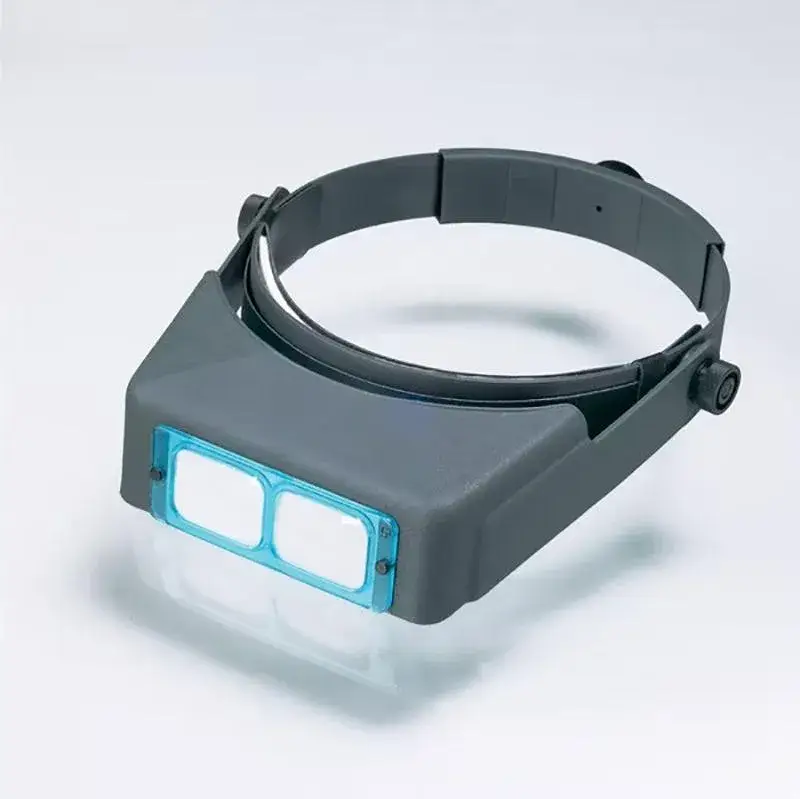
- Specs: Headband-mounted binocular visor, ultra-lightweight (approx. 160g), premium optical glass and plastic lenses, adjustable tilt. Available with interchangeable DA series lens plates ranging from 1.75x to 3.5x.
- Verdict: The ultimate traditional tool for 8-hour engraving shifts, offering highly customizable focal clearance.
- Application: As standard hand-held loupes block tool movement, the Optivisor is the industry standard for continuous work. The completely hands-free design prevents fatigue. For hand engravers and stone setters, selecting the correct DA lens plate is critical for balancing magnification with safe tool clearance:
- DA4 Plate (2.0x / 10″ Focal Length): Ideal for general layout, broad scrollwork, and maintaining perfect posture.
- DA5 Plate (2.5x / 8″ Focal Length): The “sweet spot” for most engravers, offering exceptional detail while providing a safe 8-inch working distance for pneumatic handpieces.
- DA7 (2.75x / 6″) & DA10 (3.5x / 4″): Best reserved for ultra-fine micro-pave setting or extreme detail inspection where closer working distances are strictly required.
2. ESCHENBACH MaxDetail 2X Headset Magnifier
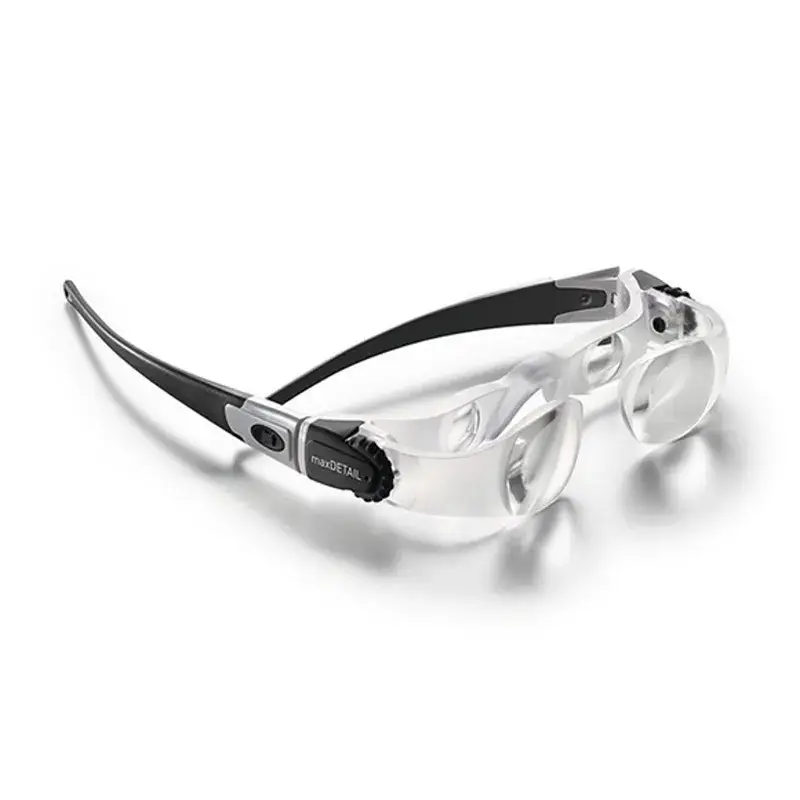
- Specs: 2x Magnification, glasses-style wearable design, precision German optics.
- Verdict: For lightweight, fatigue-free broad workpiece viewing and layout.
- Application: Worn just like standard eyeglasses, this wearable magnifier provides an incredibly comfortable, wide working distance (up to 16 inches). The 2x magnification exponentially increases the depth of field, allowing the engraver to maintain perfect posture while clearly seeing the layout lines and surface of the metal without hunching over the bench.
3. Tripod Loupe-JYBS
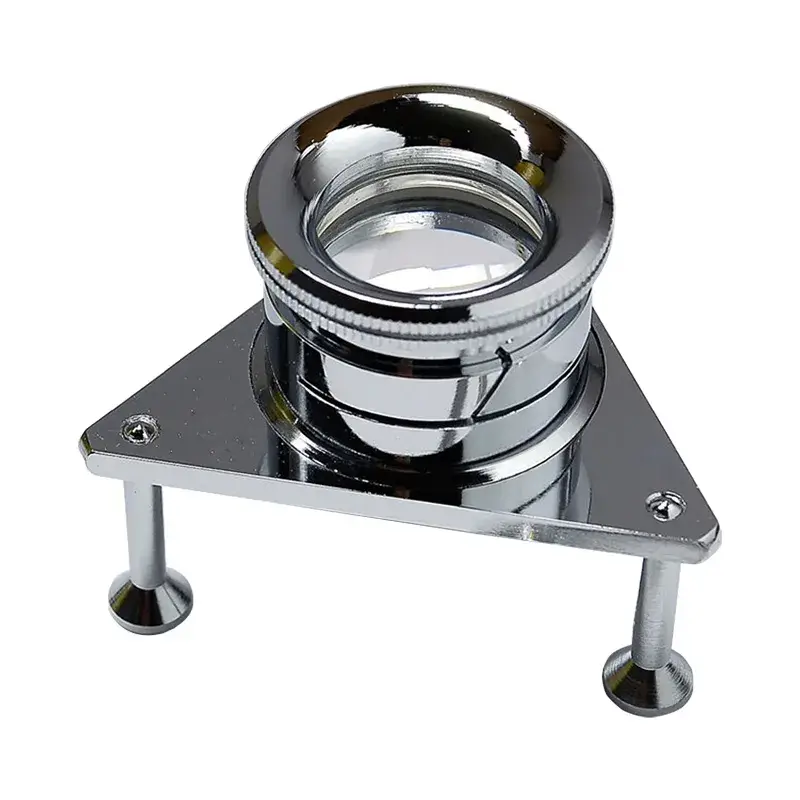
- Specs: Fixed-focus desktop loupe, open-base design, high-resolution optical lens.
- Verdict: The perfect benchtop companion for post-cut inspection.
- Application: While visors are used during the actual cutting, engravers still need a traditional loupe to inspect the micro-details of their shading and lines. The Tripod Loupe rests directly on the flat engraved metal plate, maintaining perfect focus automatically. The open base allows ambient light to hit the engraving, letting the artist inspect their work hands-free without needing to hold a standard jeweler’s loupe steady.
How to Clean and Protect Your Engraving Loupe
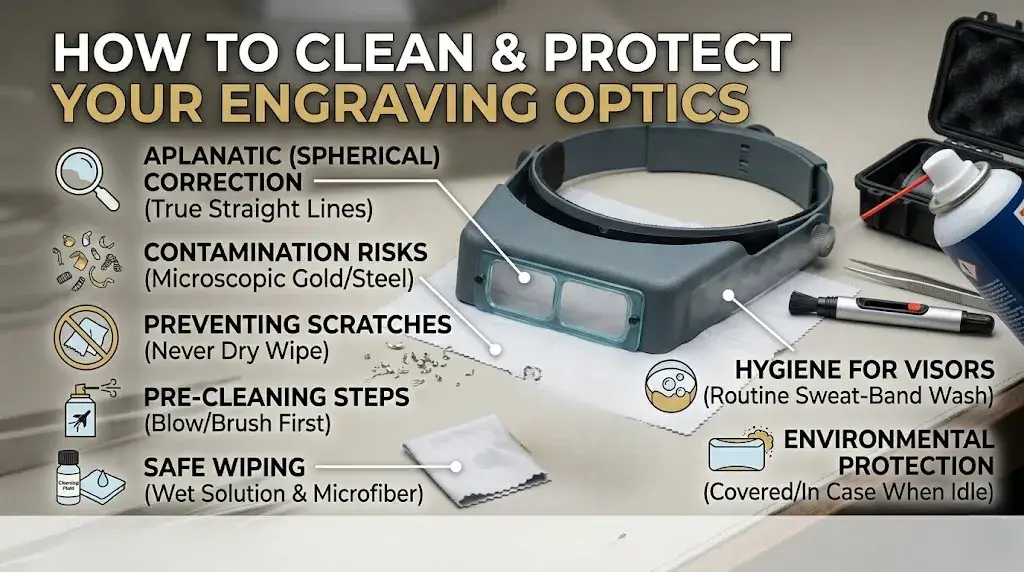
- Hazardous Debris: The engraving bench is showered with microscopic metal shavings and flying chips of gold or steel.
- Preventing Scratches: Never wipe an engraving loupe with a dry cloth, as you will grind these metal chips directly into the optical glass.
- Pre-Cleaning Steps: Always blow the lens off with high-pressure air first, or use a soft optical brush, before applying any cleaning solution.
- Safe Wiping: Only after removing loose metal fragments should you use a wet lens cleaning solution and a clean microfiber cloth.
- Hygiene for Visors: For headband-mounted visors, routinely wash the sweat-band to prevent bacteria buildup and skin irritation during long shifts.
- Environmental Protection: When not in use, keep your optics covered or in a case to prevent the continuous accumulation of workbench dust and metallic particles.
FAQ: Selecting a Loupe for Hand Engraving
- Q: Why can’t I just use my 10x diamond grading loupe for engraving?
- A: A 10x loupe requires you to be exactly 1 inch away from the metal. Your graver handle is longer than 1 inch. You will physically hit the loupe with your tools, and you will block all ambient light from hitting the work surface.
- Q: Is binocular (two-eye) vision better than an eye-loupe?
- A: Generally, yes. Binocular visors provide stereoscopic depth perception, which is crucial for judging the depth of a cut. However, some master engravers prefer the intense, isolated focus of a single eye-loupe.
- Q: Why does the metal look warped at the edges of my visor?
- A: Cheap visors use molded acrylic lenses with severe spherical aberration. Professional visors use ground, prismatic optical glass that ensures flat-field, distortion-free viewing across the entire metal plate.
Need to bulk buy for your Hand Engraving Studio?
Get a Quick Quote. Our optical specialists will respond within 3 hours.