

When purchasing an illuminated magnifier for professional grading or gemstone buying, selecting the right light source is just as critical as the lens quality. Many commercial loupes offer built-in lighting, but professionals frequently face a choice between standard White LED illumination and UV (Ultraviolet) light. These two wave spectrums serve entirely different, mandatory functions at the inspection bench. Using the wrong light source can cause you to miss synthetic color treatments, overlook structural flaws, or fail to detect diamond fluorescence completely.
White LED: The Workhorse for Surface and Clarity Inspection
Standard white LED light is designed to mimic neutral, daylight-balanced environmental lighting. It provides the high-intensity illumination necessary to flood the lens cavity and make structural details visible.
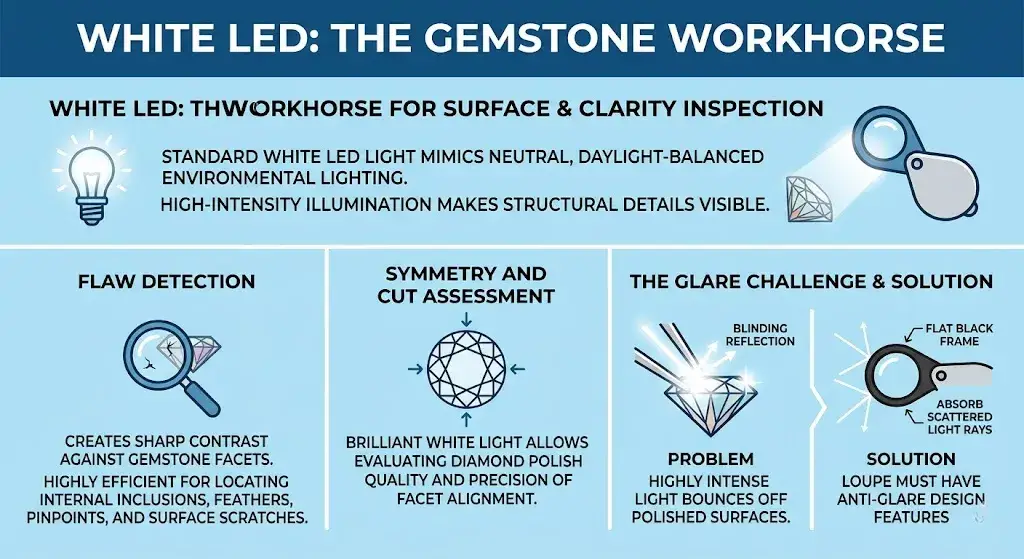
- Flaw Detection: White LED light creates sharp contrast against the gemstone’s facets, making it highly efficient for locating internal inclusions, feathers, pinpoints, and surface scratches.
- Symmetry and Cut Assessment: Brilliant white light allows stone setters and appraisers to evaluate the quality of a diamond’s polish and the precision of its facet alignment.
- The Glare Challenge: Because white LED light is highly intense, it can bounce aggressively off polished metal prongs and shiny diamond tables. To prevent this blinding reflection, a loupe must be paired with anti-glare design features, like a flat black frame, to absorb scattered light rays.
UV Light: The Forensic Tool for Fluorescence and Authentication
Ultraviolet light operates on a completely different wavelength (typically 365nm long-wave UV). It is not designed to help you see structural inclusions, but rather to trigger a photochemical reaction known as fluorescence.
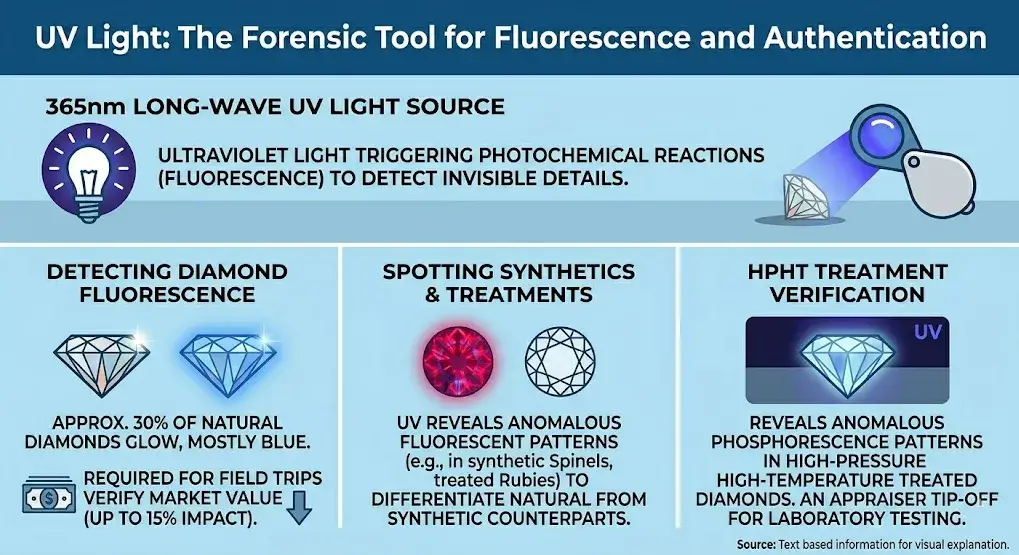
- Detecting Diamond Fluorescence: Approximately 30% of natural diamonds fluoresce under UV light, most commonly glowing blue. Strong fluorescence can impact a diamond’s market value by up to 15%, making a UV light source mandatory for field buying trips to verify the stone’s pricing accuracy.
- Spotting Synthetics and Treatments: Many gemological laboratories use UV light to differentiate natural gemstones from synthetic counterparts. For example, synthetic spinels or certain treated rubies display distinct, anomalous fluorescent patterns or synthetic-specific glow intensities under ultraviolet rays that alert the appraiser to potential artificial origins.
- HPHT Treatment Verification: Some diamonds undergo High-Pressure High-Temperature (HPHT) treatments to improve their color grade. A UV light source can reveal anomalous phosphorescence patterns that tip off an appraiser to perform deeper laboratory testing.
Technical Comparison: White LED vs. UV Light Functions
| Technical Feature | Built-In White LED | Built-In UV Light (365nm) |
| Primary Purpose | Structural Inspection & Clarity Grading | Fluorescence Identification & Testing |
| Visual Effect | Floods the area with neutral daylight | Causes specific minerals to glow/fluoresce |
| Inclusion Visibility | High (Sharp contrast on flaws) | Low (Too dark for internal grading) |
| Authentication Value | Standard (Verifies physical structure) | Extreme (Exposes synthetics & treatments) |
| Workflow Role | Everyday bench work and sorting | Quality control, buying trips, and fraud prevention |
Top Recommendations for Illuminated Inspection
1. Triplet Loupe with LED/UV Lighted LED – JYBS
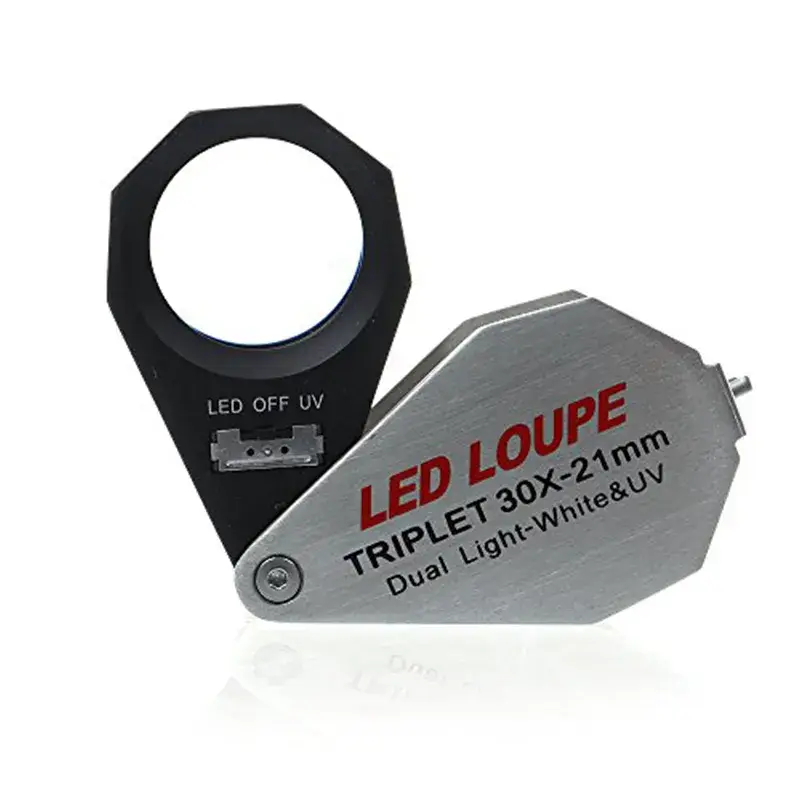
- Technical Specifications: Model Number: LUEA0018 | 10X Magnification | 21mm Lens Diameter | Powered by 3×1.5W Button Batteries | Package Weight: 78g.
- Illumination Engineering: This innovative dual-purpose instrument features an advanced dual-source lighting system: a built-in band of six ultra-bright white LEDs wrapping around the edge of the lens for shadowless clarity grading, paired with a specialized UV light built into the base. With the flip of a switch, you can instantly alternate between full daylight-balanced illumination and a targeted 365nm UV beam perfect for gemstone fluorescence testing, identifying treatments, and fraud prevention. It emits a cool, high-intensity light that guarantees a clear image and excellent visibility even in poor light conditions.
- Optical Performance: Engineered with a premium triplet lens system (three separate lenses bonded together) that is both achromatic and aplanatic. This configuration corrects for color distortions and spherical aberrations, ensuring a larger true-color field of view from side to side and showcasing fine micro-detail.
- Best For: Mobile gemstone buyers, trade show purchasing trips, diamond inspection, and complete on-site diamond authentication.
2. Triplet Loupe with LED Lighted – JYBS
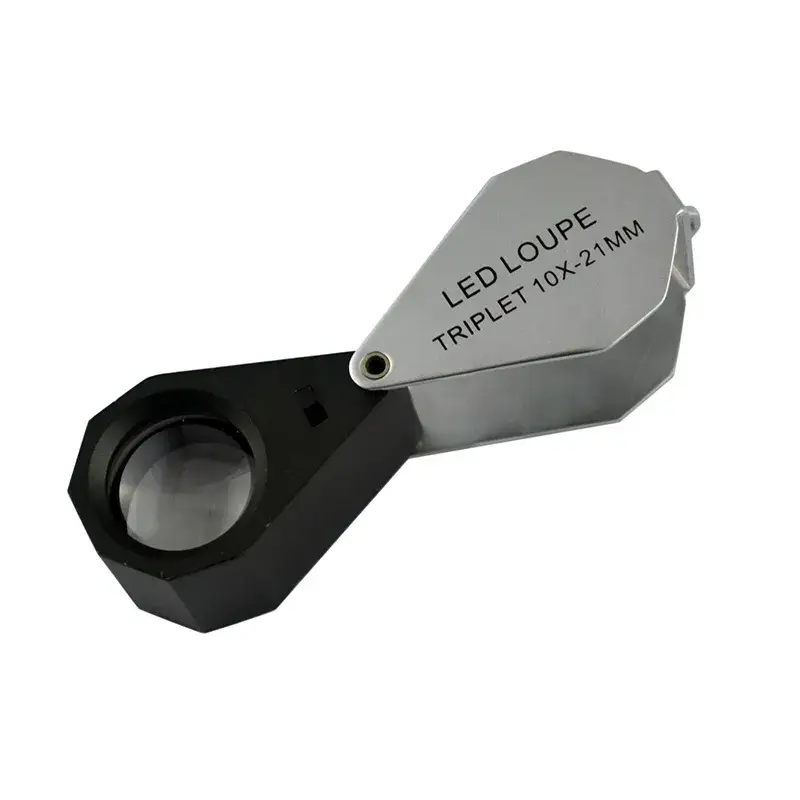
- Technical Specifications: Model Number: LUEA0017 | 10X Magnification | 21mm Lens Diameter | Non-Reflective Black Surround.
- Illumination Engineering: Ideal for use in poor lighting conditions, this loupe features 6 ultra-bright, white LED bulbs arranged around the edge of the lens to deliver direct, shadowless illumination. To overcome the white LED glare challenge, the bulbs are covered with a specialized diffuser to reduce glare, paired with a flat black frame design that prevents light from reflecting onto the object being viewed.
- Optical Performance: Utilizes an achromatic and aplanatic optical glass triplet lens. The three lenses bonded together eliminate distortion at the outer edges and correct for color variations, keeping every part of the wide field of view in sharp focus for true color clarity.
- Best For: High-volume clarity grading, detecting fine inclusions, watch movement inspection, electronics repair, and micro-parts soldering.
3. M-100 Handheld Flash LED Jewelers Magnifier
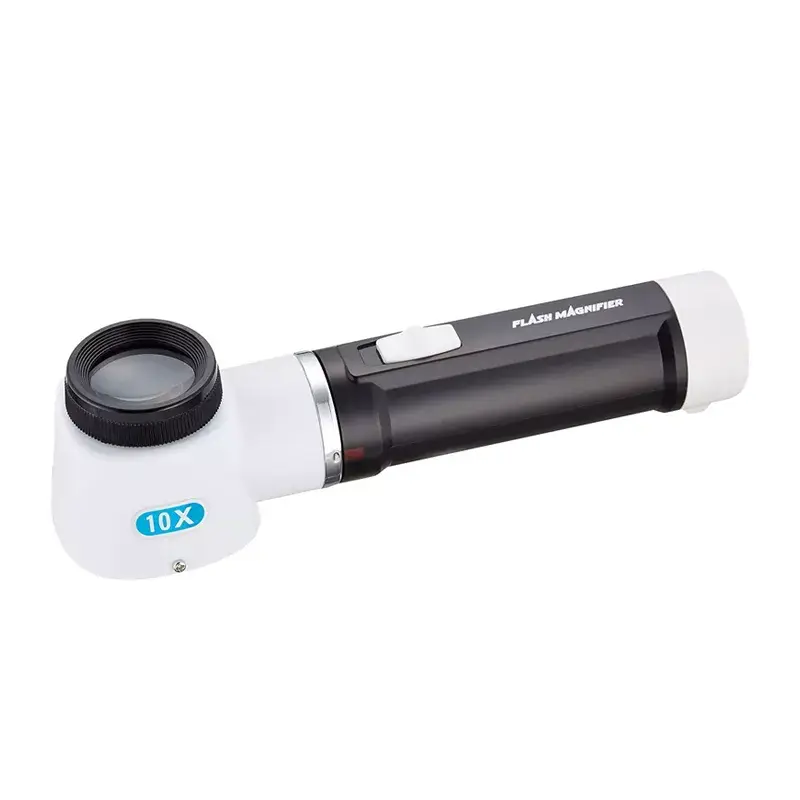
- Technical Specifications: Brand Name: Alfa Mirage | Place of Origin: Made in Japan | Item Code 106-236 | 10X Magnification | Ultra-Wide 30mm Glass & Precision Optical Polymer Lens | Weight: 95g | Powered by 2 C-size batteries.
- Illumination Engineering: Features a heavy-duty, ergonomic handheld flashlight configuration. The integrated white LED light makes bright, uniform viewing easy for continuous observation across a wider target path.
- Measurement Advantage: This professional Japanese-made magnifier integrates precision scales with a 0.5mm resolution directly into the viewing layout. It allows inspectors and appraisers to measure and observe fine structural micro-details simultaneously.
- Best For: Preliminary bulk rough stone sorting, high-volume warehouse inventory counts, pawnbroker evaluations, and fast-paced parcel lot scanning.
Frequently Asked Questions
Q: Can I use the built-in UV light on my loupe to grade a diamond’s color?
A: Absolutely not. UV light causes diamonds to fluoresce, which artificially changes their perceived body color. Color grading must always be done under a neutral, non-UV white light or natural daylight.
Q: Why does my loupe’s UV light look dim compared to the white LED?
A: Ultraviolet light is mostly invisible to the human eye. You are only seeing the safe, violet edge of the light spectrum. The light is actually highly active; you will only see its true power when it hits a fluorescent gemstone and causes it to glow brightly.
Q: Does a blue diamond fluorescence mean the stone is synthetic?
A: No, quite the opposite. Blue fluorescence is highly common in natural diamonds. However, the strength and pattern of that glow help appraisers verify whether the stone matches its grading certificate.
Q: Will a white LED light scratch or damage sensitive gemstones?
A: No. LEDs emit cold light, meaning they generate zero infrared heat waves. They are completely safe for heat-sensitive gemstones like opals or pearls, unlike old incandescent bulbs.
Q: Why do professional gem buyers insist on carrying a loupe with a 365nm UV light?
A: When buying stones in the field, you cannot bring a massive laboratory setup. A pocket loupe with a built-in UV light is the fastest, most portable way to instantly check a stone for synthetic signatures or undisclosed fluorescence before making a cash purchase.
Strategic B2B Partnerships
JYBS operates as a specialized supplier for global jewelry tool manufacturers and industrial laboratories. We focus on supplying high-precision instruments that strictly adhere to the rigorous technical standards of professional work environments.
Looking for Wholesale Pricing or Bulk Procurement?
- B2B Bulk Orders: Customized tiered pricing structures designed to scale for tool retailers, educational institutions, and gemological laboratories.
- Worldwide Shipping: We support worldwide procurement with reliable global shipping. Our professional tools—including industry-standard loupes—can be delivered directly to international buyers and facilities across the globe.
- Technical Consulting: Acquire the detailed specification sheets and high-volume wholesale quotes you require within a guaranteed 3-hour turnaround.
Contact our B2B Sales Team for a Professional Quote