

Achieving showroom-ready jewelry comes down to microscopic tolerances. When prongs scratch, seats wobble, or edges turn out dull, the culprit is often subpar equipment rather than technique. Equipping your bench with the right professional gemstone setting tools eliminates these errors, ensuring pristine, commercial-grade mountings straight off the bench.
I. What Makes a Gemstone Setting Tool “Professional Grade”?
The divide between amateur and professional tooling comes down to micro-engineering. Entry-level tools suffer from runout and soft alloys, whereas professional-grade setting tools are hardened to HRC 64+ and machined to micrometer tolerances to physically prevent flaws.
Professional results rely on three strict benchmarks:
- Zero-Gap Seat: The gem drops perfectly flush and level with zero wobble.
- Zero Stray Marks: Metal surfaces remain free of slips, jaw bites, or file gouges.
- Reflective Symmetry: Prongs form smooth, snag-free domes alongside crisp, mirror-like bright-cuts.
Flawless mountings cannot be salvaged by aggressive post-polishing. Clean results require rigid, precision tools from the very first cut.
II. Essential Workholding Setting Tools: Ball Vises and Fixtures for Scratch-Free Stability
Holding a ring shank with finger pressure or an unyielding wooden hand clamp invites catastrophic errors. Unsupported workpieces deflect microscopically under cutting pressure; the moment a bur catches or a graver meets a hard spot in an alloy, the tool slips forward, gouging deep channels across pre-polished shoulders.
High-Stability Workholding Essentials
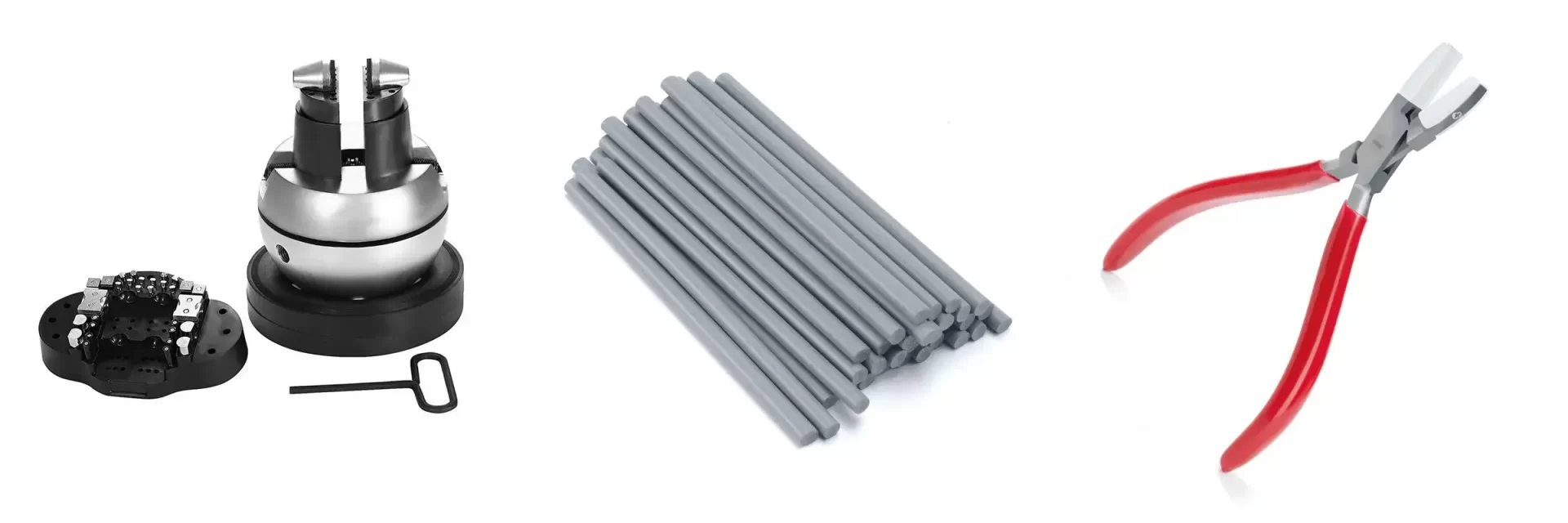
- Heavy-Duty Micro Engraver’s Ball Vise (Block): Cast from solid steel to provide substantial anchoring weight, high-end ball vises utilize machined double-bearing races to deliver silky-smooth rotational resistance. You can spin, tilt, and lock the workpiece under a microscope using one hand without loosening the jaw grip.
- Thermo-Loc & Fixture Compounds: Heat-softening polymer compounds mould directly around complex cluster heads, organic bands, or fragile wire settings. Once cooled to room temperature, the polymer achieves stone-like rigidity, supporting fine gallery wires from beneath to absorb the shockwaves of hammer handpieces or hand pushers.
- Nylon & Brass Jaw Pins: Traditional serrated steel pins crush polished ring shanks. Swapping to non-marring brass sleeves, Delrin pins, or contoured nylon inserts allows firm clamping pressure without indenting soft 18K yellow gold or 950 platinum.
By anchoring the workpiece within a 360° rotational sphere, your non-dominant hand smoothly indexes the angle of cut while your dominant hand provides short, controlled forward force. This mechanical isolation stops tools from skipping off the metal.
III. Precision Rotary Gemstone Setting Tools: Micromotors and Burs for Wobble-Free Seats
Milling a seat with an eccentric, vibrating bur instantly ruins a setting. Budget rotary tools and aging flex-shaft cables often exhibit high Total Indicated Runout (TIR). If a bur oscillates off-center by even 0.05 mm, it carves an oblong, stepped cavity instead of a concentric bearing. When the gemstone rests on these uneven high points, the localized pressure applied during prong closing will fracture the stone’s pavilion or girdle.
Precision Rotary Tooling
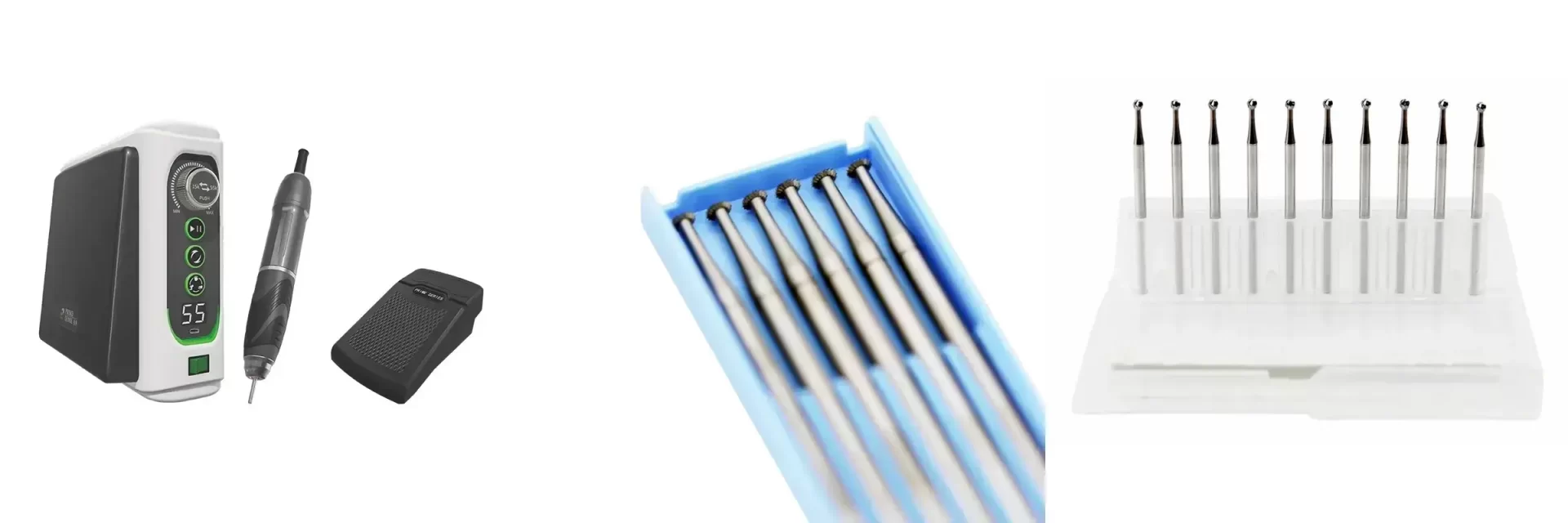
- Low-Runout Micromotor Handpiece: Unlike hanging flex-shafts driven by coiled inner cables, high-end brushless micromotors integrate the motor directly inside the handpiece. They feature sealed ceramic bearings delivering near-zero runout and continuous, flat torque curves even down at 1,000–5,000 RPM. This controlled low speed lets you shave delicate ribbons of metal without skittering across the prong.
- Swiss-Made 70° & 90° Hart Burs: Hart burs (bearing cutters) cut the precise profile needed for gemstone girdles. Premium Swiss carbide and vanadium-steel variants feature uniform tooth geometry that cleanly slices precious alloys rather than smearing or galling the metal.
- Bearing/Setting Burs & Ball Burs: Precision-ground flat-bottom setting burs establish a crisp, uniform shelf inside bezel cups or flush-setting holes, ensuring faceted stones sit dead-level.
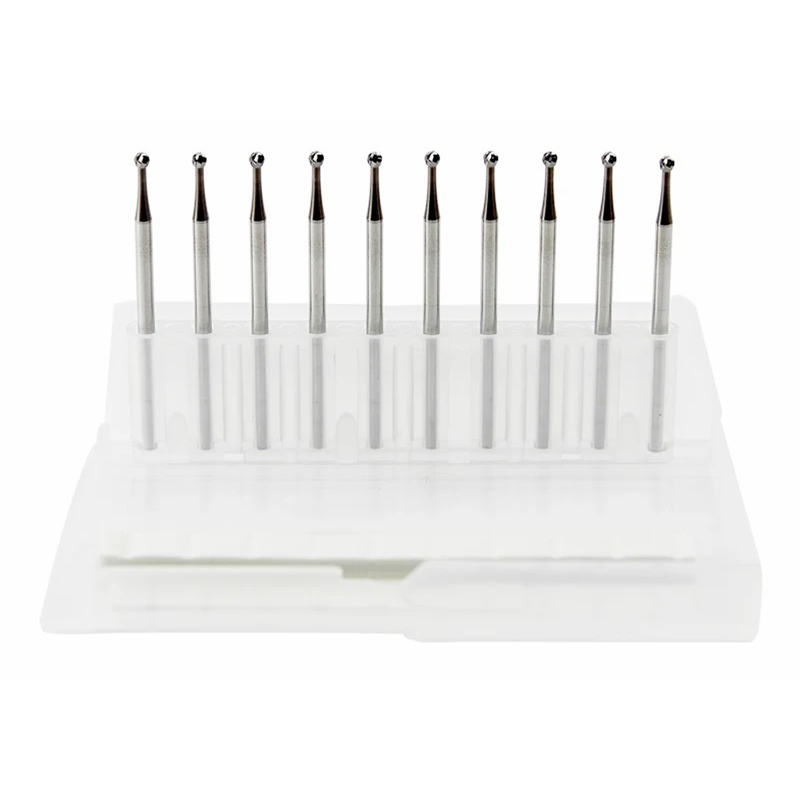
Slicing cleanly through metal grain prevents burrs from rolling into the seat cavity, allowing the stone to drop into place with an audible, reassuring snap.
IV. Manual Gemstone Setting Tools: Pushers, Pliers, and Rockers for Seamless Bezels & Prongs
Once the stone sits true, closing the metal demands controlled plastic deformation. Standard serrated bench pliers or square-edged steel pushers concentrate force onto tiny contact points, resulting in faceted, dented bezel walls and crushed prong profiles.
Non-Marring Manual Forming Tools
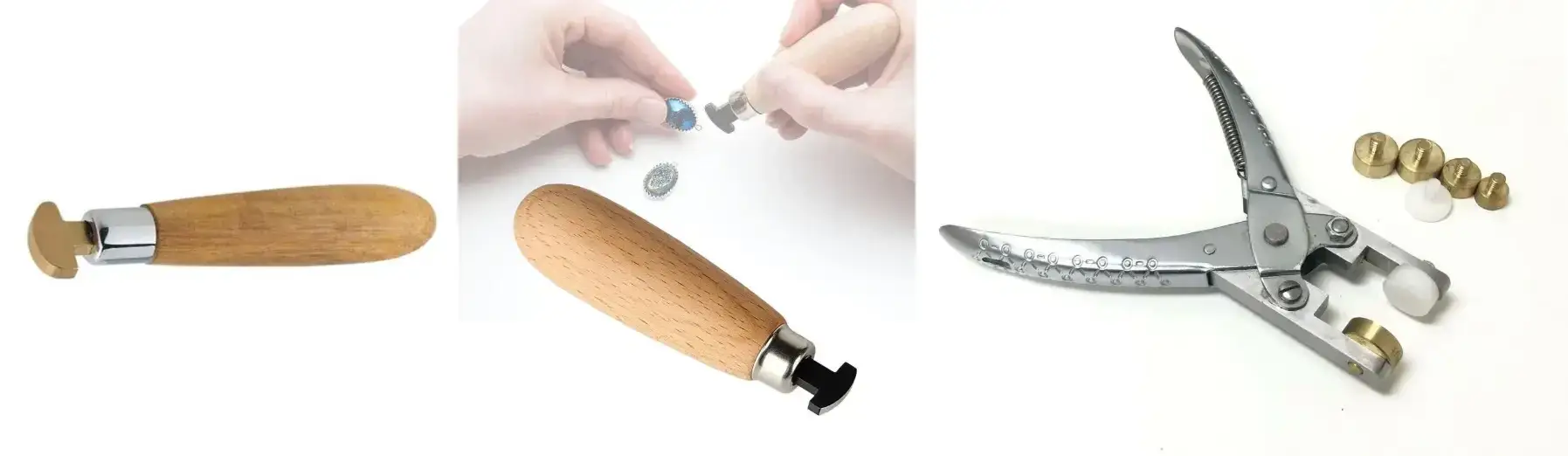
- Rounded Brass & Pre-Polished Steel Bezel Pushers: Pushers should feature curved working faces with softened, high-polish edges. Softer brass pushers compress silver and high-karat gold bezels without marring, while mirror-polished steel variants apply firm, direct force to thick platinum collets without digging into the rim.
- Bezel Rockers and Rollers: Designed with ergonomic hardwood handles and curved, polished steel rocker faces, these tools leverage rocking wrist motion to distribute lateral force evenly. They smoothly wrap bezel edges over domed cabochons or faceted stones without creating accordion-like ripples.
- Parallel-Action Stone Setting Pliers: Standard box-joint pliers close in an arc, squeezing the top of the prong inward while kicking the lower shank outward. Parallel-action jaws stay strictly aligned through their entire stroke. Outfitted with brass, Delrin, or grooved nylon jaw faces, they apply pure vertical vector force, tucking prongs tightly over the stone crown with zero lateral slide.
This uniform application of force creates smooth, level bezel tops and symmetric prong facets that eliminate hours of restorative needle-file cleanup.
V. Refining and Finishing Setting Tools: Beading Tools and Gravers for Flawless Bright-Cuts
The true hallmark of high-end bench work lies in the finishing details: micro-beads that resemble liquid spheres and interior borders that cast brilliant, uninterrupted light. Raw cut prongs often leave sharp, uneven edges prone to catching fabric, which must be transformed into clean, highly polished spherical beads.
Essential Finishing Instruments
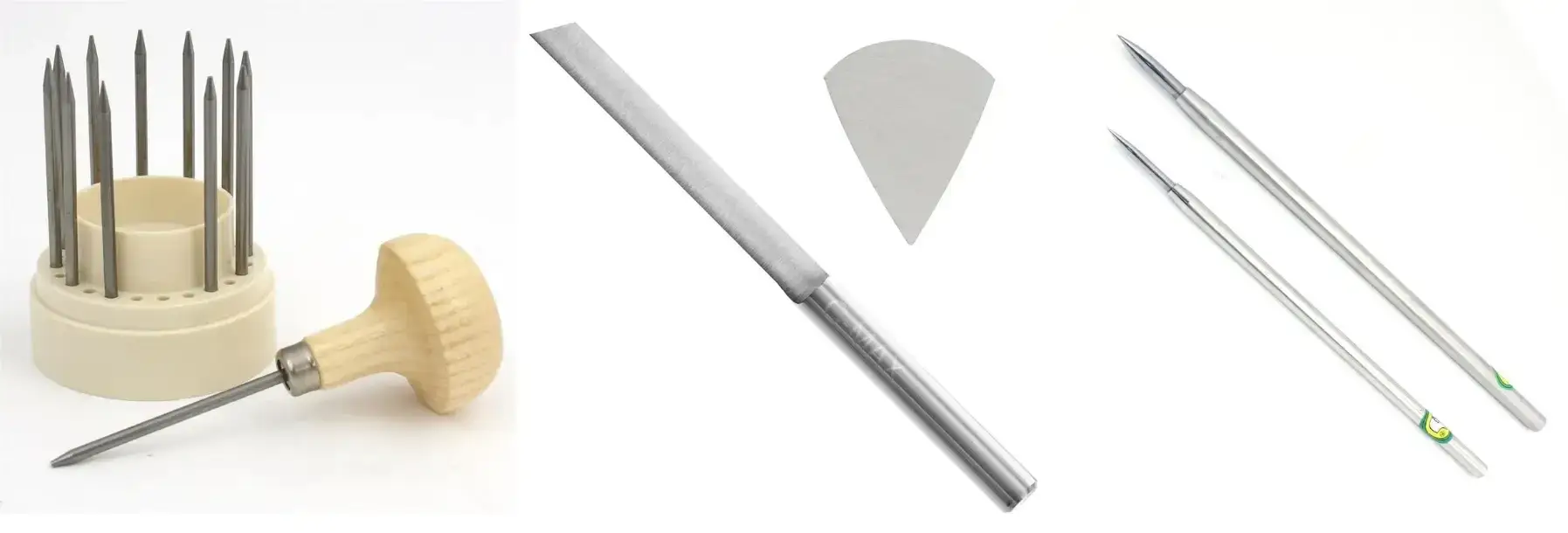
- Mirror-Polished Beading Tools & Concave Punches: Used to form round grains in pavé or round the tips of wire prongs, these tempered-steel tools feature micro-machined concave cups. When the interior cup is lapped to a mirror polish, swirling it over an irregular prong instantly cold-forms the metal into a smooth, high-gloss bead.
- Tungsten Carbide Flat & Onglette Gravers: High-speed steel gravers dull rapidly when cutting tough alloys like palladium-white gold or platinum. Solid micro-grain carbide gravers hold a keen, razor-sharp edge through hundreds of cuts. A flat carbide graver cuts a razor-clean 45° chamfer alongside stone lines, creating structural bright-cuts that mirror light just like the facets of the gem.
- Ultra-Hard Tungsten Carbide Burnishers: For bezel tops and channel edges, mirror-finished carbide or natural agate burnishing points glide over the metal surface, compressing micro-porosity and generating a glass-smooth rim without removing any base metal.
Rounding prongs with polished beading cups prevents garments from catching on the setting, while razor-sharp gravers leave edges that require no abrasive wheels, keeping the crisp geometry of your work intact.
VI. Best Gemstone Setting Tool Matrix: Features, Applications, and Pro Results
| Tool Category | Core Tools | Key Materials & Specs | Issues Solved | Clean Pro Results |
| Workholding | Micro-setting ball vise + thermoplastic | Heavy cast steel base, smooth damping, non-metallic clamping | Workpiece shifting, loss of tool control, slipping | Zero scratches on metal surfaces; vibration-free cutting throughout |
| Rotary Seat Forming | Low-runout handle + Swiss Hart bur | Tungsten carbide/HSS, high concentricity, 70°/90° angles | Oval holes, uneven depth, rough walls, broken stones | Gemstone sits level; girdle fits seamlessly without wobbling |
| Manual Closing | Rounding pusher + parallel closing pliers | Brass/mild steel pusher tip, parallel-action mechanism | Plier marks, dented/wrinkled bezel walls, faceted prongs | Vertical force application prevents collapse; walls remain smooth and tight |
| Finishing | Hardened bead burnisher + tungsten flat graver | Mirror-finish concave cup, ultra-hard flat carbide blade | Snagging prongs, dull/gray edges, blurred design lines | Uniformly rounded, high-gloss tips; bright-cut edges refract light like diamonds |
VII. 3 Pro Workshop Habits That Keep Every Setting Pristine
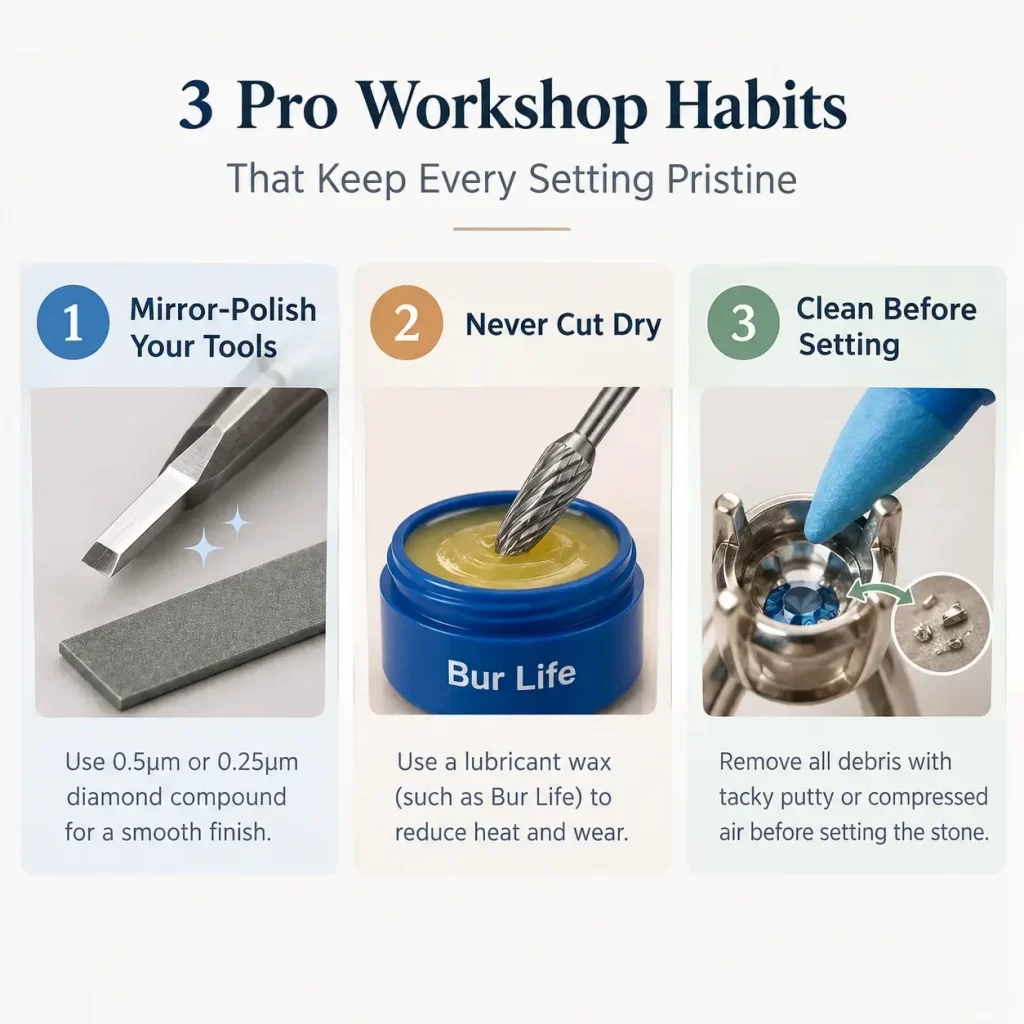
Even the most sophisticated bench equipment underperforms if basic shop maintenance is neglected. Incorporate these three non-negotiable habits into your daily setting routine:
- Mirror-Polish Your Tools Before First Use
Never let the cutting face of a new graver, the interior cup of a beading tool, or the nose of a steel pusher touch precious metal straight out of the package. Factory grind marks will stamp their rough texture directly into gold or silver. Prepare your tools using diamond lapping film down to 0.5μm or 0.25μm diamond compound on a hard cast-iron or ceramic lap. The finish on your tool determines the finish on your metal. - Never Cut Dry — Always Use Bur Life
Cutting dry causes friction heat that anneals bur flutes and welds microscopic chips of gold or platinum back onto the cutter’s teeth. Once loaded with debris, the bur tears and scores the metal seat. Dip burs and saw blades into a dedicated lubricant wax (such as Bur Life) before every cut. Lubrication extends tool life and leaves an impeccably smooth seat. - Thorough Debris Removal Before Stone Setting (Tacky Gel Cleaning)
After milling seats, tiny metal chips often sit inside the bearing pocket. If you place a diamond or sapphire over loose shavings and cinch down the prongs, that trapped metal flake acts as a sharp fulcrum point, creating uneven stress that can crack the gemstone. Press a clean dab of specialized tacky watchmaker’s putty (such as Rodico) into every seat or flush it out with compressed air to clear out all debris before seating the stone.
Upgrading Your Setting Bench for Commercial Success
Achieving clean, professional gemstone settings is a discipline of microns. Producing showroom-ready rings, pendants, and pavé bands is not about luck or struggling through tedious repairs; it is about establishing physical control at every step of your process.
Diagnose where your settings currently lose their edge:
- If slipped tools are marring your work, stabilize your foundation with a solid micro-setting ball vise.
- If your stones tip or sit unevenly, eliminate vibration with a low-runout micromotor and premium Swiss-milled burs.
- If your prongs lack symmetry, upgrade to mirror-finished beading tools and micro-grain carbide gravers.
Setting up a reliable, high-production bench requires dependable sourcing. When you are ready to expand your workshop or standardize operations across multiple benches, explore the comprehensive inventory of gemstone setting tools at JYBS. As an established international jewelry tools supplier, JYBS provides independent master jewelers and commercial studios with direct access to professional-grade equipment, offering flexible single-unit orders alongside competitive bulk purchasing terms to keep your business running smoothly.