
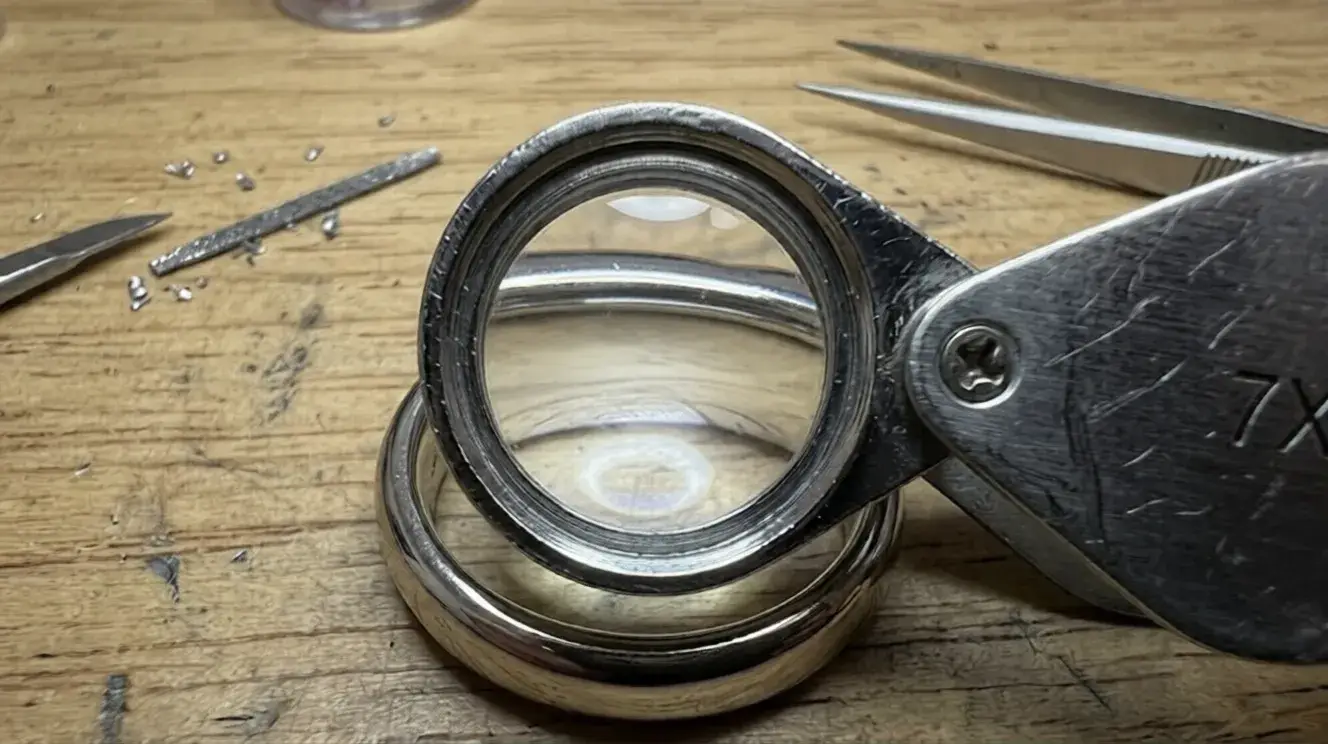
Why Hallmark & Solder Joint Inspectors Require a Specialized Loupe
- Metallurgical Mandate: Quality control inspectors in factories or assay offices focus on verifying metallurgical integrity rather than grading gemstones.
- Microscopic Verification: Their work involves reading microscopic laser-engraved hallmarks (e.g., “Au750” or “Pt950”) and inspecting laser-welded or torch-soldered joints for structural defects.
- Identifying Specific Flaws: Inspectors must detect microscopic porosity (gas bubbles), cold-shuts, or incomplete solder flow that could compromise the piece.
- Extreme Magnification Requirements: Standard 10x magnification is often insufficient for detecting sub-surface porosity in platinum joints before final polishing; therefore, inspectors frequently rely on 15x to 20x magnification.
- The Lighting Mandate: High magnification drastically reduces focal length, causing the loupe to block ambient light. An integrated, angled LED lighting system is mandatory to cast shadows into microscopic pits and highlight structural flaws.
Critical Optical Specs for Metallurgical Inspection Standards
When verifying structural integrity and assay stamps, magnification power and directional light are paramount.
| Key Specification | Recommended Standard | Why It Matters for Solder Inspectors |
| Magnification | 15x or 20x | Necessary to identify microscopic gas porosity in solder seams or to read deeply worn, heavily polished assay hallmarks. |
| Illumination | Directed LED (Brightfield) | High magnification blocks room light. Built-in LEDs illuminate the dark recesses of ring shanks where solder joints are typically located. |
| Lens Correction | Aplanatic Hastings Triplet | At 20x, spherical distortion is severe. An Aplanatic lens ensures that the edges of a hallmark stamp do not blur, preventing misidentification. |
Top 3 Loupe Recommendations for Hallmark & Solder Joint Inspectors
Engineered for extreme resolution and structural flaw detection:
1. SmartPro Triplet Loupe H14
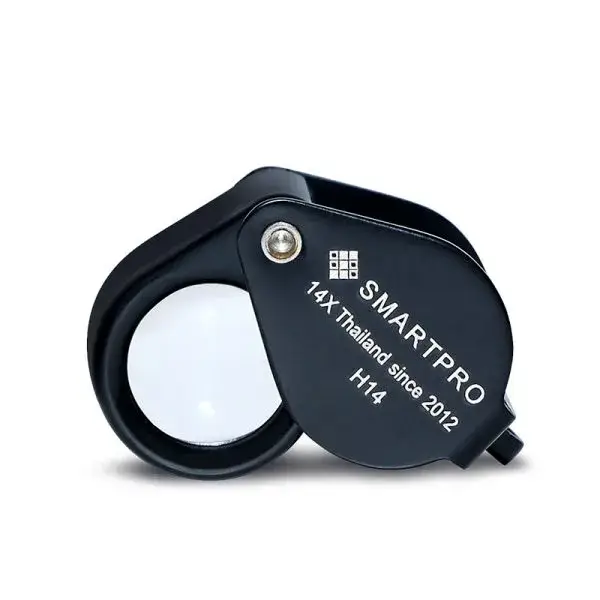
- Specs: 14X magnification (± 1%), 10.8mm effective diameter, 11mm focus distance, >63 lines/mm resolving power. Made in Thailand.
- Verdict: The ultimate high-resolution tool for assay offices. With 14X magnification and a professional resolving power of over 63 lines/mm, this loupe provides the extra power needed to read tiny, modern laser-engraved hallmarks that standard 10X loupes might miss. Its black non-reflective frame ensures that metallic glare from polished gold does not interfere with the inspection.
2. LED/UV Lighted Triplet Loupe
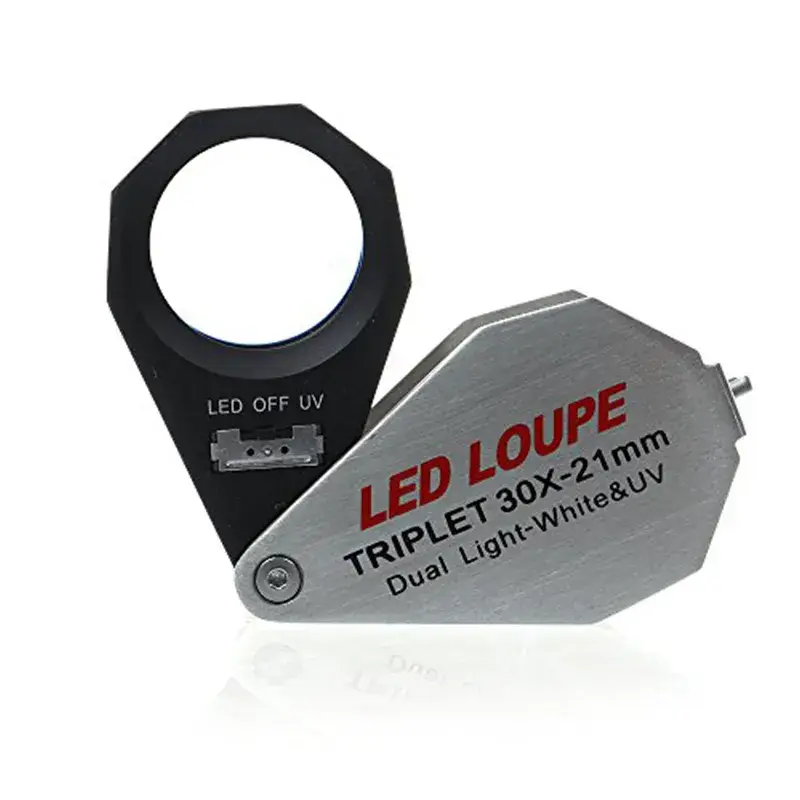
- Specs: 10X magnification, 21mm lens diameter, 6-LED ring light + 1 UV light source, Achromatic & Aplanatic.
- Verdict: The expert for shadowed solder joints. The integrated band of six LED lights wraps around the edge of the lens to provide direct, shadow-free illumination. This is critical when inspecting the interior solder joints of rings or deep settings. As an added benefit, the toggleable UV light allows for quick fluorescence testing on any stones set near the solder site.
3. Eschenbach 1186-9 Dual-Power Folding Magnifier
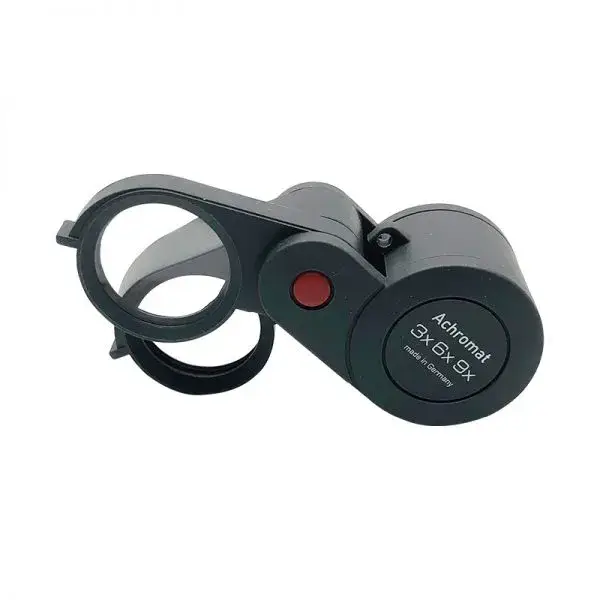
- Specs: Dual-lens system (3X + 6X = 9X), 23mm achromatic glass lenses, reinforced glass-fiber polyamide body. Made in Germany.
- Verdict: Designed for rapid intake and general structural checks. The dual-lens configuration allows inspectors to switch between a wide 3X view for general surface checks and a combined 9X magnification for scrutinizing specific joints. The airtight fiber-glass case is highly durable for factory environments, preventing dust and metal particulates from scratching the precision German-made optics.
How to Clean and Protect Your Inspection Loupe
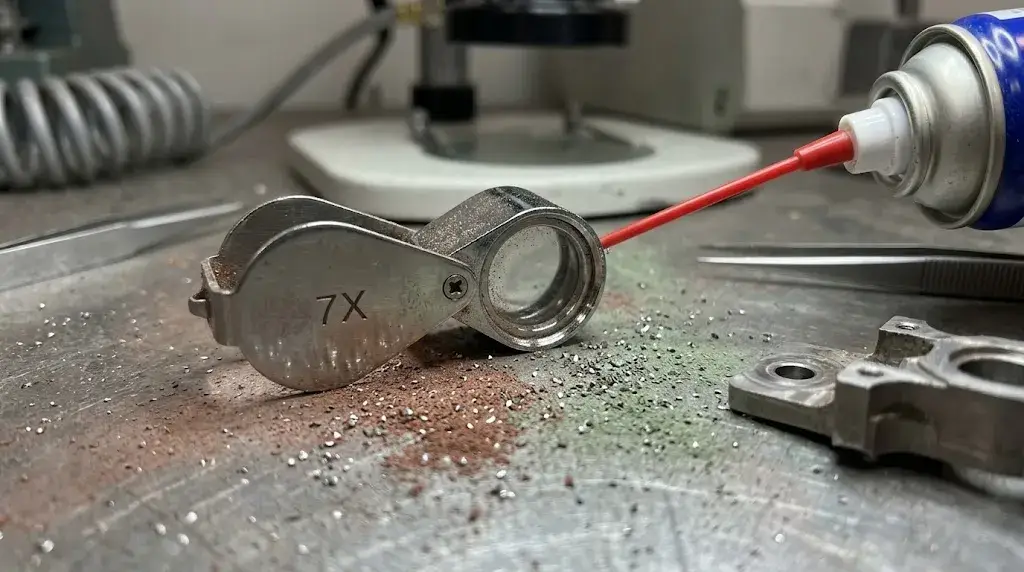
- Dusty Factory Environments: Inspection areas are often filled with abrasive polishing compounds—such as rouge and tripoli—along with airborne metal particulates that can settle on the optics.
- Risk of Physical Scrapes: Because a 20x loupe has a very short focal length (roughly 0.5 inches), it is incredibly easy to accidentally scrape the glass lens against rough jewelry surfaces during a close-up inspection.
- Recessed Lens Protection: Always ensure that the lens is deeply recessed within its metal housing to provide a physical buffer between the glass and the workpiece.
- Preventing Closing Friction: You should blow out the folding housing with compressed air daily. This prevents trapped metal dust from acting as an abrasive and scratching the lens when the loupe is folded closed.
FAQ: Selecting a Loupe for Solder & Hallmark Inspection
- Q: Why is it so hard to focus a 20x loupe?
- A: The laws of optics dictate that as magnification increases, the Depth of Field (DoF) shrinks to fractions of a millimeter. You must physically brace your hands together to keep the jewelry perfectly still within that tiny focal plane.
- Q: Can a loupe tell me if a ring was laser-welded or torch-soldered?
- A: Often, yes. Under 15x or 20x magnification, a laser weld typically shows microscopic, overlapping circular “puddles” of melted metal, whereas traditional solder shows a smooth, continuous capillary flow line
- Q: Do I need color correction (Achromatic) for metal inspection?
- A: It is highly beneficial. Plating issues (like worn rhodium over yellowish white gold) or color mismatches in solder (e.g., using 10K solder on a 14K ring) are much easier to detect with a color-neutral lens.
View all available high-precision magnification tools and microscopes for your production line.
Need to bulk buy for your Factory QC team?
Get a Quick Quote. Our optical specialists will respond within 3 hours.