

Why Jadeite and Jade Evaluators Require a Specialized Loupe
Evaluating Jadeite requires a specific set of optical tools because the process focuses on surface integrity and internal grain structures rather than just clarity.
Here is the breakdown of why jade evaluators require a specialized loupe based on your requirements:
- Surface Analysis over Transparency: Evaluating Jadeite (Type A, B, or C) is less about looking through the stone and more about analyzing its surface texture and internal color distribution.
- Identifying Treated Jade (Type B): To identify “B-Jade” (which has been bleached with acid and impregnated with polymer resin), appraisers must look for the telltale “orange peel” effect or microscopic acid-etched networks on the polished surface.
- Identifying Dyed Jade (Type C): To identify “C-Jade” (dyed jade), they look for unnatural concentrations of color dye pooling within the stone’s micro-fractures.
- Aggregate Mineral Characteristics: Because jadeite is an aggregate mineral (composed of interlocking crystals) rather than a single crystal like a diamond, extreme depth of field is less critical than surface contrast and a wide Field of View (FOV).
- Lens Diameter Requirements: A jade evaluator needs a massive 21mm or larger lens to scan the surface of large cabochons or bangles quickly.
- Aplanatic Correction: A lens with excellent Aplanatic (flat-field) correction is required so that the curvature of the loupe’s lens doesn’t distort the microscopic structural web of the jadeite grains.
Critical Optical Specs for Jade Evaluation Standards
For jade appraisal, identifying surface treatments and dye concentrations relies on area-scan efficiency, optical purity, and multi-illumination screening.
Top 3 Loupe Recommendations for Jadeite and Jade Evaluators
| Key Specification | Recommended Standard | Why It Matters for Jade Evaluators |
| Area Scanning FOV | 21mm or Larger (Wide Field) | Jade pieces, especially bangles and large carvings, require a wide field of view to evaluate the uniformity of the interlocking granular structure and quickly spot general anomalies. |
| Distortion Control | Aplanatic Flat-Field | Acid-etched networks on B-Jade are subtle. Edge distortion blurs area scans, making evaluation difficult and potentially masking treatments on larger pieces. |
| Illumination Integration | Dual-Light (LED/UV) | Standard LED is perfect for illuminating dark internal fractures. UV light is the true secret weapon for instantly revealing polymer resin fills. Note: To view surface ‘orange peel’, use external overhead reflection. |
Engineered to expose hidden polymers, dyes, and structural uniformity, these are essential for the jade market based on our catalog selection:
1. ZEISS D40 & D36 Loupes
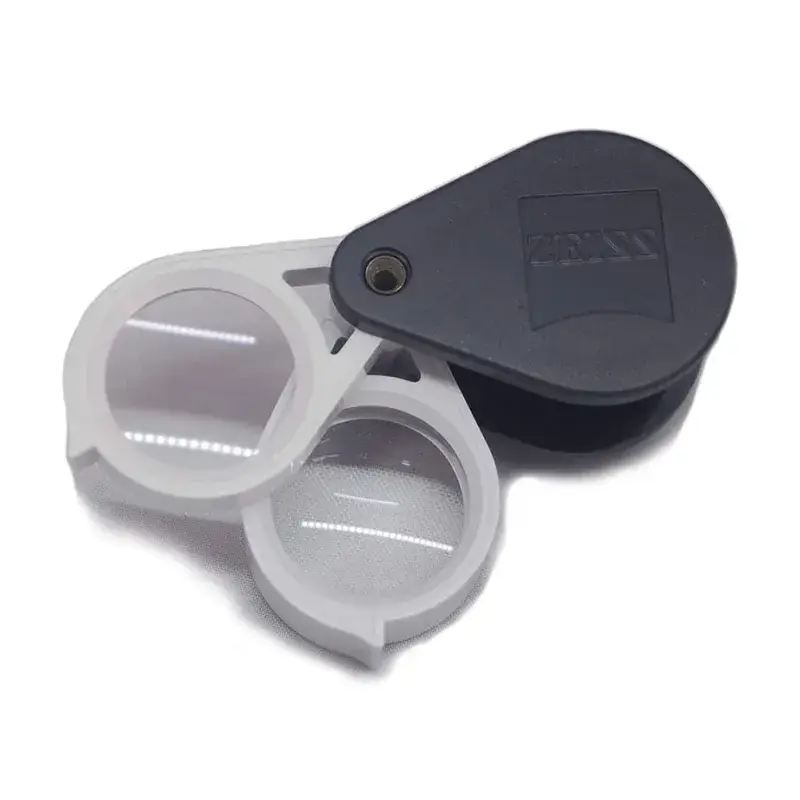
- Specs: Premium German optics with T* Anti-Reflective Coating. The D40 features a small, fixed 10x Triplet lens (13mm), while the D36 features a dual independent lens system (3x/6x=9x) with a wide 22mm diameter.
- Verdict: The ultimate professional toolkit offering both efficient area-scan and unparalleled precision.
- Application: Utilize the D36’s versatile 22mm wide lens for rapid, broad surface scanning of large jade bangles and general color/structural appraisal. Switch to the D40’s pure 10x aplanatic-achromatic triplet lens to dive deep into localized microscopic structural webs, ensuring edge distortion doesn’t mask the subtle acid-etched networks of treated B-Jade.
2. Triplet Loupe With LED/UV Lighted (LUEA0018)
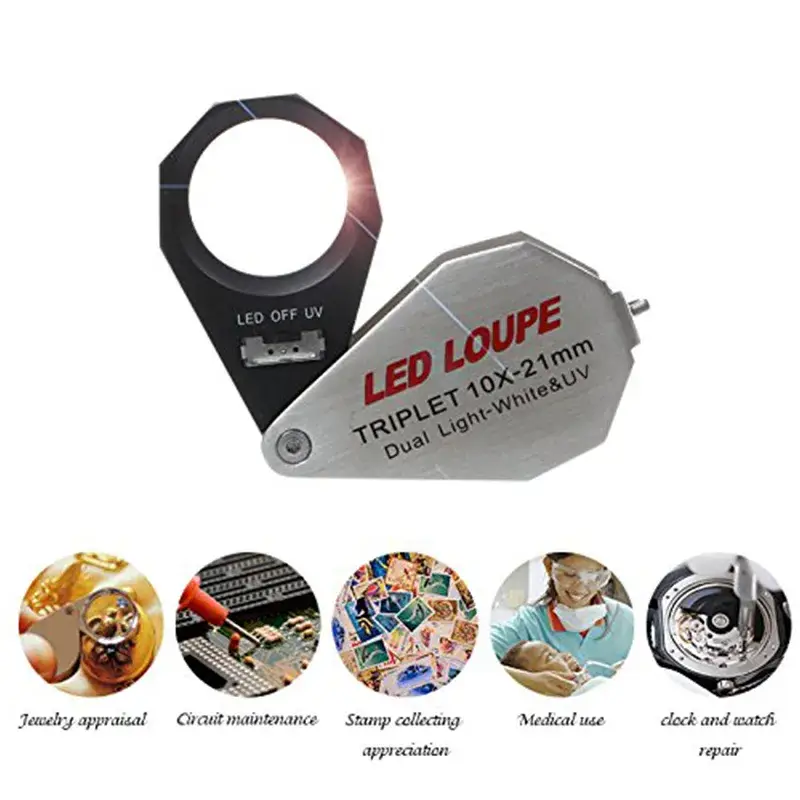
- Specs: 10x Magnification, large 21mm Achromatic & Aplanatic Triplet lens, dual lighting system (6 edge LEDs + 1 base UV light), robust metal case.
- Verdict: The ultimate area-scan tool for rapid structural and fluorescent polymer detection.
- Application: The large 21mm diameter provides excellent area-scan efficiency across the surfaces of cabochons and bangles. While the built-in band of six LEDs is perfect for shadow-free illumination of deep internal fractures, its true diagnostic power lies in the UV mode, which immediately reveals fluorescent polymer resins in Type B jade. To view the dimpled “orange peel” texture, turn off the LEDs and tilt the loupe to reflect a single, external overhead light source off the stone’s surface.
3. Eschenbach 1186-9 Dual-Power Folding Magnifier
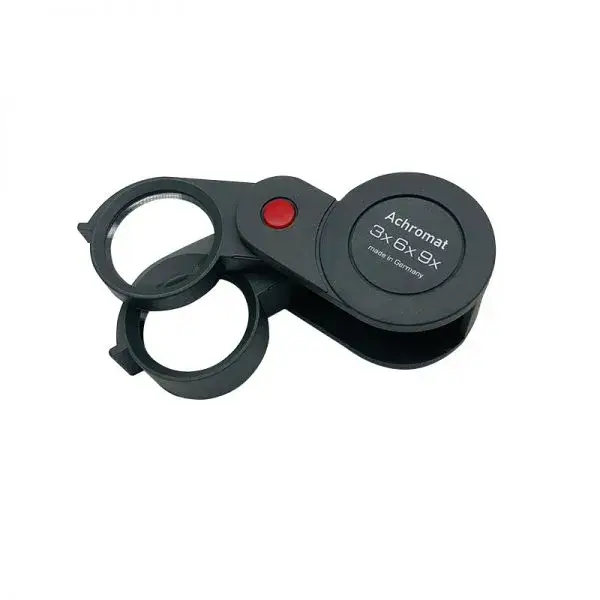
- Specs: 3x + 6x = 9x Magnification, large 23mm Achromatic glass lenses, reinforced glass-fiber durable polyamide airtight case.
- Verdict: Versatile, dust-proof inspection for efficient color analysis across large areas.
- Application: The massive 23mm lens diameter, combined with precision distortion control, is perfect for broad area-scanning of interlocking granular uniformity in jadeite. The pure achromatic design ensures a color-aberration-free image—critical for accurately spotting unnatural green dye concentrations (Type C treatment) pooling in micro-fractures across the whole gem. The airtight case makes it ideal for environmental dust prevalent in jade markets.
How to Clean and Protect Your Jade Evaluation Loupe
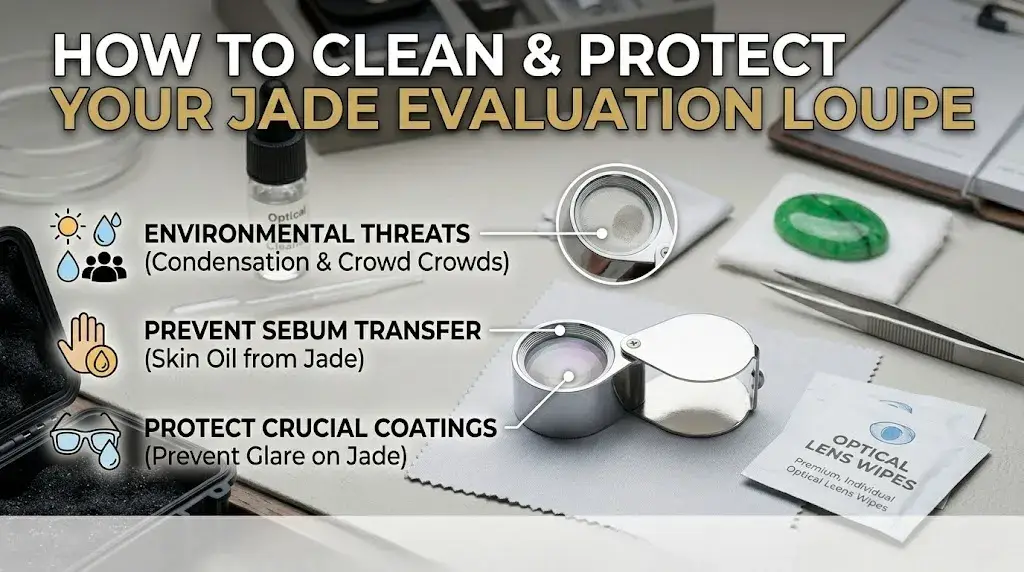
- Understand Environmental Threats: Jade markets are often hot, humid, and crowded. The primary threat to your loupe is condensation and the transfer of handling oils.
- Prevent Sebum Transfer: Jadeite is frequently handled by dozens of people, leaving a layer of sebum (skin oil) on the stone that transfers to your loupe if the lens touches the gem.
- Use Proper Cleaning Supplies: Always carry optical lens wipes for safe and effective cleaning.
- Avoid Harsh Chemicals: Never use harsh chemical cleaners on the lens, as they can strip the anti-reflective coatings.
- Protect Crucial Coatings: Maintaining these coatings is vital, as they are crucial for preventing glare when inspecting highly polished jade cabochons.
FAQ: Selecting a Loupe for Jade Appraisal
- Q: Can a loupe tell me if jade is dyed (Type C)?
- A: Yes. Under a high-quality 10x aplanatic loupe, natural color in jadeite blends smoothly into the surrounding structure. Dyed jade will show the color intensely concentrated “spider-webbing” along the grain boundaries and micro-cracks.
- Q: What is the “orange peel” effect, and how does a loupe show it?
- A: Type B jade is bleached with acid, which erodes the softer minerals, leaving micro-pits that are then filled with resin. Under 10x magnification, reflecting an overhead light source off the jade’s surface reveals these dimples, resembling the skin of an orange.
- Q: Do I need a Triplet lens just to look at opaque jade?
- A: Absolutely. Even though jade is mostly opaque or translucent, a Triplet lens provides the flat-field (Aplanatic) correction necessary to view the geometric structure of the interlocking grains accurately without edge warping.
Need to bulk buy for your Jade Appraisal team?
Get a Quick Quote. Our optical specialists will respond within 3 hours.