

One size does not fit all: the machine that shines a diamond could destroy a delicate circuit board. Choosing the right ultrasonic cleaner machine is about balancing power and precision to match your specific task perfectly. This guide strips away the technical jargon to help you identify exactly which specs meet your unique needs.
Step 1: Define Your Application Scenario
Before looking at specs, look at your workbench. Your application dictates the build quality and tank size you require.
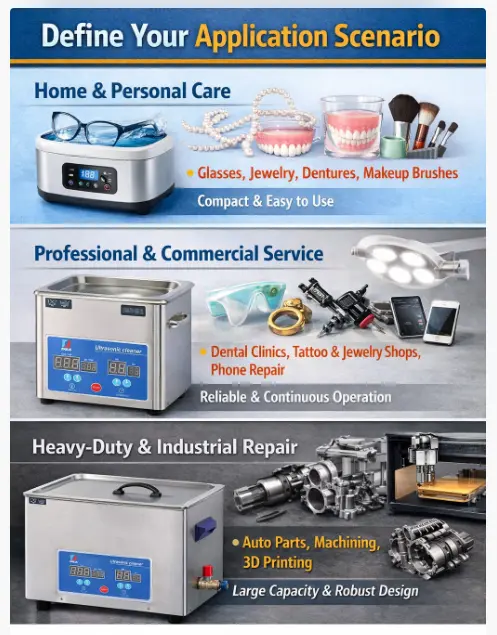
Home and Personal Care
These units prioritize high aesthetic appeal and quiet operation. They are usually compact.
- Typical uses: Glasses, dentures, jewelry, razor heads, and makeup brushes.
- Key need: Simple operation for occasional use.
Professional and Commercial Service
These machines must meet strict hygiene standards. They require high-frequency stability and medium capacity.
- Typical uses: Dental clinics, tattoo parlors, jewelry shops, and mobile phone repair.
- Key need: Supports continuous operation throughout the workday.
Heavy-Duty and Industrial Repair
Here, robustness is king. You need powerful cleaning and extra-large capacity.
- Typical uses: Auto repair shops (carburetors/engine parts), machining, and 3D printing post-processing.
- Key need: Integrated drainage systems and heavy-duty stainless steel construction.
Step 2: Key Purchase Considerations: Frequency, Capacity, and Power
Navigating a spec sheet can be overwhelming. Focus on these three pillars to find your perfect match.

1. Frequency
Frequency determines the size and impact force of the cavitation bubbles.
- Low Frequency (25-28 kHz): This is the “powerful cleaning type.” It creates large bubbles with a strong explosive force. It is perfect for rusty iron parts or heavy carburetors. However, it may damage delicate surfaces.
- Medium Frequency (40-45 kHz): Often called the “all-rounder.” This is the golden frequency for 90% of scenarios. It perfectly balances cleaning power and safety for glasses and jewelry.
- High Frequency (>80 kHz): The “extremely gentle type.” It produces tiny bubbles that penetrate micron-sized gaps. Use this for semiconductor chips or high-precision laboratory glassware.
2. Capacity
Don’t just look at the liters (L), as that represents total volume, not usable space. Follow these three practical rules:
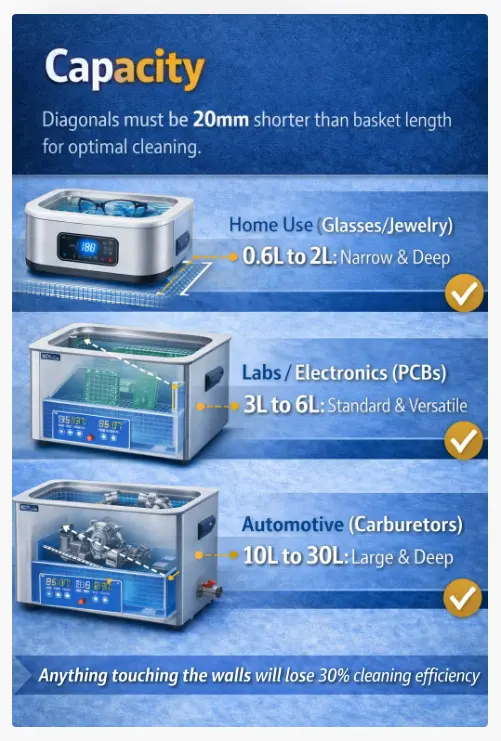
- The Diagonal Rule: The cleaning basket is always smaller than the tank itself. Your item’s longest diagonal measurement must be at least 20mm shorter than the basket’s length. If an item touches the walls, cleaning efficiency drops by 30%.
- The Depth Rule: Your object must be fully submerged with at least 15-20mm of fluid above it. If you are cleaning tall items like lab pipettes or long wrenches, prioritize “Deep Tank” models over wide, shallow ones.
- Scenario Benchmarks:
- Home Use (Glasses/Jewelry): 0.6L to 2L is perfect. These are typically narrow and deep enough for frames.
- Labs/Electronics (PCBs): 3L to 6L is the standard. This fits most 10x15cm circuit boards and surgical tools.
- Automotive (Carburetors): Start at 10L to 30L. Heavy parts require significant depth to ensure the fluid can circulate around the entire component.
3. Power
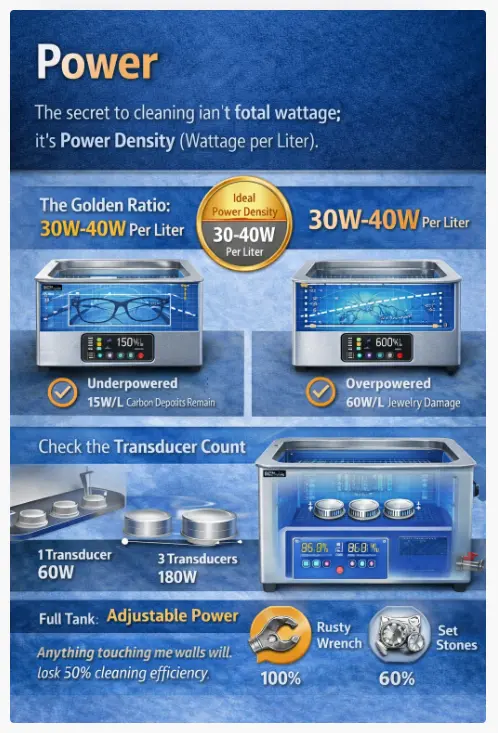
The secret to cleaning isn’t total wattage; it’s Power Density (Wattage per Liter). Use this expert formula to check if a machine is professional-grade:
- The Golden Ratio: 30W to 40W per Liter
- Underpowered: If a 10L machine only offers 150W (15W/L), it will be too weak to remove stubborn carbon deposits.
- Overpowered: Anything above 50W/L can be too aggressive for delicate jewelry, potentially loosening set stones.
- The “Transducer Count” Secret: The real cleaning force comes from the transducers (the silver discs bonded to the bottom). A standard industrial transducer is usually 60W.
- Example: A high-quality 6L machine should ideally have 3 transducers (180W). If a 6L machine only has one, it will have significant “dead spots.”
- Expert Recommendation: If you have a wide variety of needs, look for a model with Adjustable Power. This allows you to use 100% power for a rusty wrench and dial it down to 60% for a sensitive watch strap.
Step 3: Advanced Features to Watch For
The right features turn a basic tank into a professional tool.
- Heating System: Heat is essential for degreasing. A range of 40°C-60°C is the golden zone. Ensure the unit has built-in overheating protection for safety.
- Degas Mode: Fresh water contains air. This air dampens ultrasonic waves. Degas mode quickly removes this air. It solves the common “poor cleaning with new water” problem.
- Sweep Function: Standard waves can create “dead zones” in the tank. The sweep function fluctuates the frequency slightly. This eliminates blind spots and ensures even energy distribution.
Step 4: Cleaning Solution Selection and Safety Maintenance
Ultrasonic cleaning is a team effort. It is a synergy of physics and chemistry.
- Choosing Your Solution: The waves detach dirt physically; the solution breaks chemical bonds. Use enzymatic cleaners for medical tools, de-rusters for metal, and neutral detergents for jewelry.
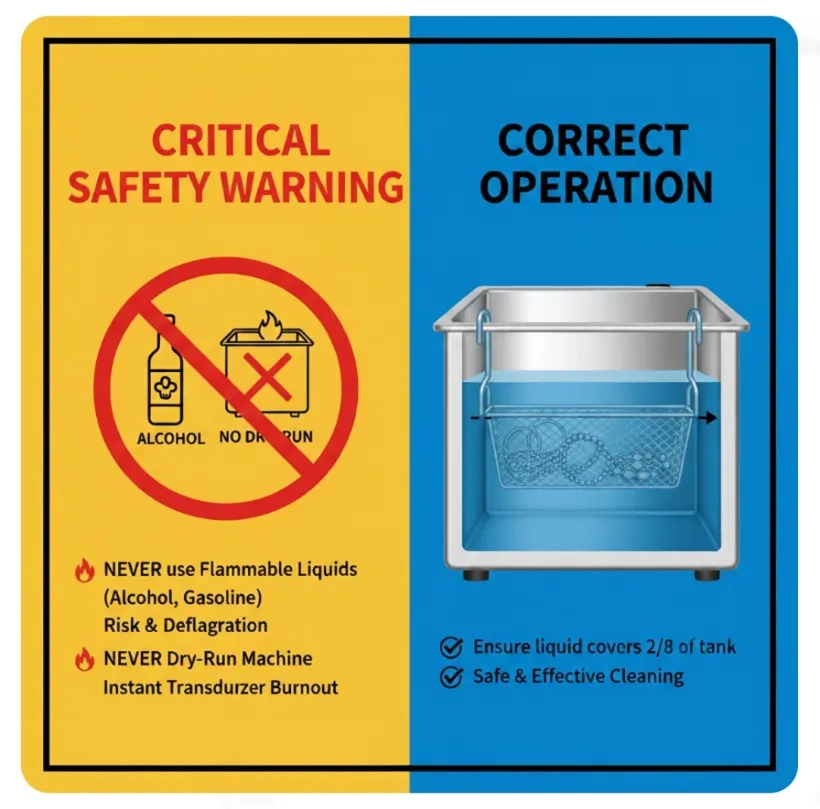
- Prohibited Substances: Never use flammable materials. Alcohol and gasoline are absolutely forbidden due to the risk of deflagration from localized high temperatures. Avoid strong acids/bases unless the tank has a specific anti-corrosion lining.
- Critical Safety Warning: Never dry-run your machine. Turning it on without water will burn out the transducer instantly. Ensure liquid covers at least 2/3 of the tank.
Step 5: Scenario-Based Purchase Guide
| Application Scenario | Recommended Frequency | Suggested Capacity | Essential Features |
| Daily Household | 40 kHz | 0.6L – 2L | Timer, Silent Lid |
| Lab / Medical / Tattoo | 40 kHz | 2L – 6L | Heating, Degas, SUS304 |
| Electronic Repair | 40 kHz | 2L – 3L | Sweep, Degas, Adjustable Power |
| Auto Repair / Heavy Duty | 28 kHz | 10L – 30L | High Power, Drain Valve |
Summary
Choosing an ultrasonic cleaner machine is about precision, not power. First, determine your scenario. Then, match your frequency and capacity needs. Finally, verify the safety features.
The right machine combined with the correct solution creates a perfect cleaning experience. Don’t settle for “good enough” when it comes to your equipment. Explore the full range of professional-grade tools at the JYBS official website.