

Why Laboratory Gemologists Require a Specialized Loupe
- The Foundational Instrument of Gemology: While a laboratory gemologist relies heavily on binocular microscopes, Raman spectrometers, and polariscopes, the hand loupe remains the foundational instrument of gemology.
- First Line of Defense: It is the first line of defense used during intake screening, separating the obvious synthetics or imitations from the stones that require advanced testing.
- Identifying Diagnostic Inclusions: A gemologist uses a loupe to spot the diagnostic “horsetail” inclusions in a demantoid garnet, check for pleochroism in a tanzanite, or locate the flash effect in a fracture-filled diamond.
- The Necessity of an Aplanatic-Achromatic Triplet: For a true gemologist, anything less than a flawless Aplanatic-Achromatic Triplet is unacceptable. While classic designs like the Hastings Triplet set the baseline, the ultimate goal is absolute color and shape correction.
- Achromatic Color Correction: TThe loupe must be perfectly Achromatic; when identifying a sapphire’s origin, the subtle difference between a silky blue and a milky, grayish-blue is highly diagnostic. False color introduced by cheap glass will completely derail the analysis.
- Aplanatic Flat-Field Precision: Furthermore, the loupe must be perfectly Aplanatic (flat-field) to ensure that the three-phase inclusions (solid, liquid, gas) found in Colombian emeralds retain their true geometric shape when viewed near the edge of the lens.
Critical Optical Specs for Gemological Standards
Optical neutrality and total distortion elimination are the hallmarks of a laboratory-grade instrument.
| Key Specification | Recommended Standard | Why It Matters for Gemologists |
| Lens Construction | Aplanatic-Achromatic Triplet | Combines distinct glass elements to mathematically eliminate both chromatic (color) and spherical (shape) aberrations. |
| Magnification | 10x (Grading) / 14x+ (Diagnostic) | 10x is the strict GIA standard for all clarity grading. However, higher magnifications (like 14x) are essential secondary tools for resolving complex diagnostic inclusions, such as laser drill holes or synthetic flux. |
| Housing Design | Matte Black Interior | Prevents ambient laboratory light from reflecting off the inside of the loupe casing and bouncing onto the gemstone, ensuring maximum contrast. |
Top 3 Loupe Recommendations for Laboratory Gemologists
Engineered for flawless diagnostic screening and inclusion plotting:
1. SCHNEIDER Diamond Loupe L1 (Harald Schneider®)
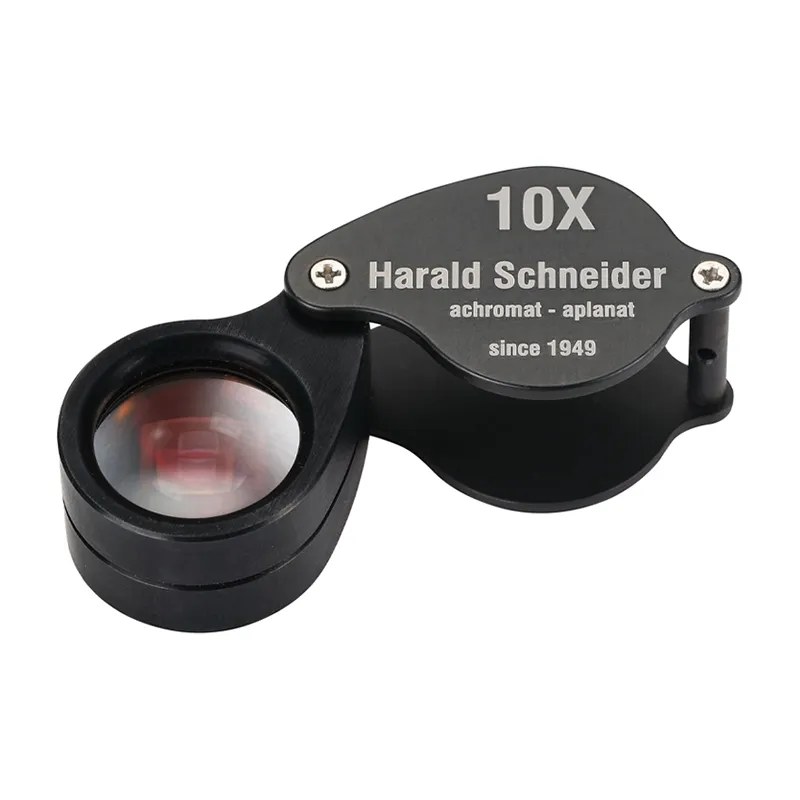
- Specs: 10x Achromatic-Aplanatic Triplet, 20mm Large Viewing Area, Custom German optical glass, Anti-Reflective Coating.
- Verdict: The definitive laboratory standard. Engineered for professionals where precision is a prerequisite, the Schneider L1 features a unique lens system custom-made in-house from premium German glass. Its 20mm wide field of vision and anti-reflective coating deliver a distortion-free, razor-sharp image, providing the supreme clarity needed for accurate grading and authentic identification.
2. SmartPro Triplet Loupe H14
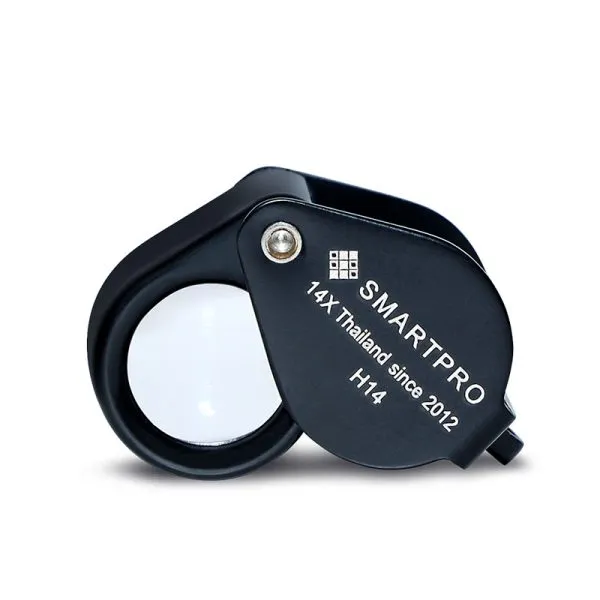
- Specs: 14x Magnification (± 1% error), 10.8mm effective diameter, Strain-free Triplet Optical System, Black non-reflective coating.
- Verdict: For advanced inclusion analysis. While 10x is the strict GIA baseline for grading, this specialized 14x instrument delivers an exceptional resolving power of 63 lines/mm or more for diagnostic identification. The strain-free triplet lens design allows gemologists to rigorously inspect minute details, such as flux-healing in rubies or faint laser drill holes, with negligible color aberration.
3. Triplet Loupe With LED/UV Lighted LED-JYBS
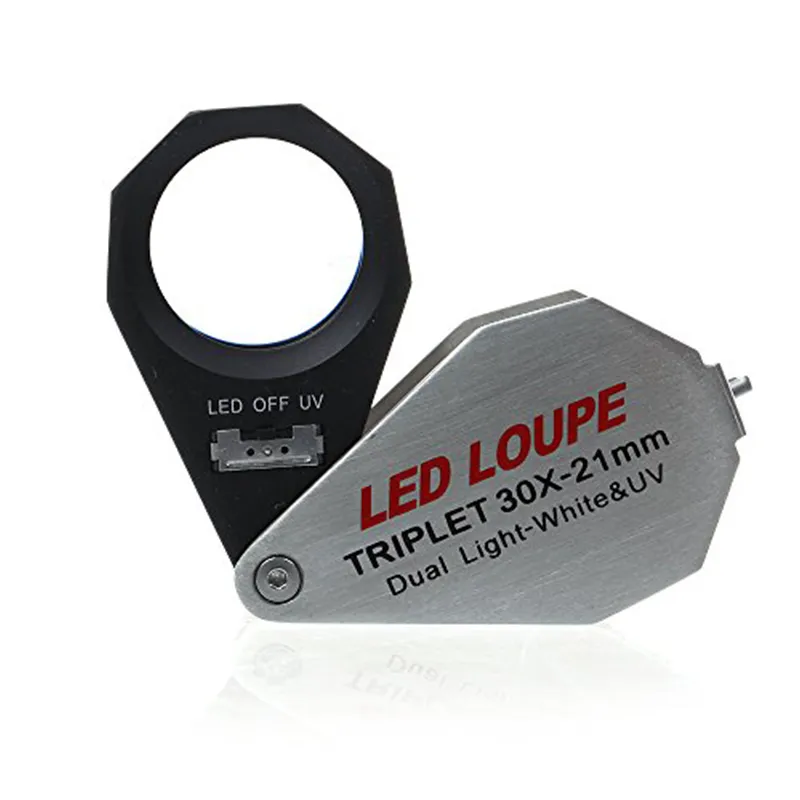
- Specs: 10x Triplet (21mm), Aplanatic & Achromatic, Dual Light Source (6 White LEDs + 1 UV light), Metal housing.
- Verdict: The ultimate intake and screening tool. By integrating a dedicated UV light in the base alongside a band of six white LEDs, this 21mm wide-aperture loupe allows gemologists to instantly check for gemstone fluorescence or properly illuminate stones in poor lighting conditions. The direct illumination eliminates shadows, bringing fine micro-details into sharp focus directly at the intake desk.
How to Clean and Protect Your Gemological Loupe
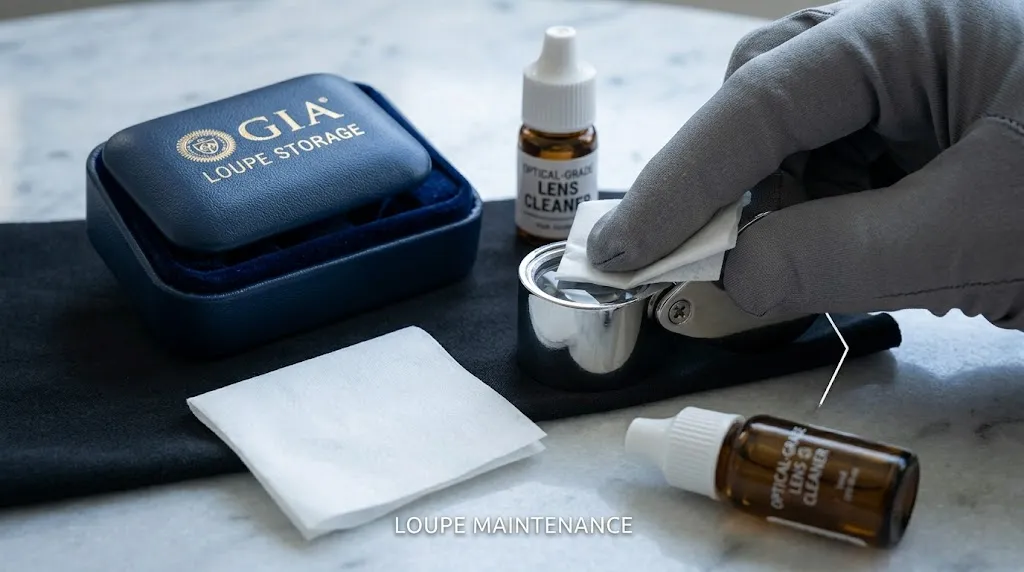
- Microscope-Grade Reverence: A gemologist’s loupe must be treated with the same reverence as a microscope objective.
- Prohibiting Finger Contact: Never touch the glass with your fingers. Oil from your skin drastically alters the refractive index of the lens surface, introducing haze and reducing resolution.
- Professional Cleaning Materials: Clean the lens only with professional, lint-free optical tissue and a specialized lens-cleaning fluid designed for multi-coated optics.
- Secure Storage: Store the loupe in a rigid, dust-proof case when not actively grading.
FAQ: Selecting a Loupe for Laboratory Gemology
- Q: Why does the GIA strictly mandate a 10x loupe for grading?
- A: Standardization. If one gemologist uses a 20x loupe, they will see microscopic flaws that another using a 10x will miss, destroying the consistency of the global grading system. 10x provides the perfect balance of magnification and depth of field.
- Q: What is the difference between a Hastings Triplet and a standard Triplet?
- A: A true Hastings Triplet uses three specific lenses (two meniscus lenses cementing a biconvex lens made of different crown/flint glasses) designed specifically to cancel out each other’s optical errors, resulting in near-perfect optical fidelity.
- Q: How does a darkfield loupe work?
- A: Instead of lighting the stone from above (brightfield), a darkfield loupe projects LED light horizontally through the side of the stone. Inclusions inside the stone catch this light and scatter it upward into the lens, making them glow against a dark background.
Need to bulk buy for your Gemological Laboratory or Research Center? Get a Quick Quote. Our optical specialists will respond within 3 hours.