

In micro-pave setting, a tiny 0.01mm error can shatter high-value gemstones or scrap precious mountings. Professional workshops require industrial-grade bench tools built for continuous, high-frequency impact and microscopic control. This 2026 guide analyzes the essential tool matrix for elite jewelers, focusing on material hardness (HRC), structural precision, and production line efficiency.
I. Core Setting Systems: Pneumatic Engraving and Micro-pave Machines
Modern high-production jewelry workshops have largely transitioned from traditional hand-push gravers to advanced pneumatic setting systems. These machines substitute raw muscle power with precisely regulated air pulses, offering unprecedented control under the bench microscope.
1. Linear Airflow Control
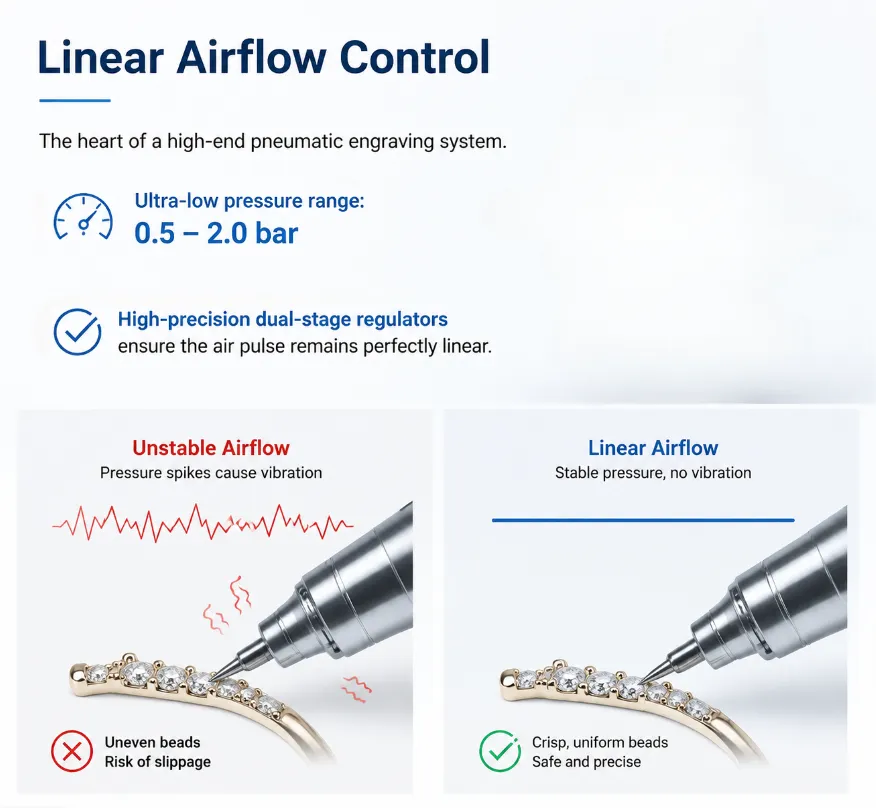
The heart of any high-end pneumatic engraving system lies in its control valve architecture. When executing high-density micro-pave work, the system must operate reliably in the ultra-low-pressure range of 0.5 to 2.0 bar.
- High-precision dual-stage regulators ensure that the air pulse remains perfectly linear.
- This absolute stability prevents sudden pressure spikes that cause handpiece vibration, allowing the setter to raise crisp, uniform beads without risking tool slippage against a delicate diamond girdle.
2. Pneumatic Handpiece Center of Gravity and Materials
A professional handpiece is a direct extension of the gold setter’s hand. Cheap aluminum alloys or plastics shift the tool’s center of gravity backward, causing significant hand strain and carpal tunnel fatigue over an eight-hour shift.
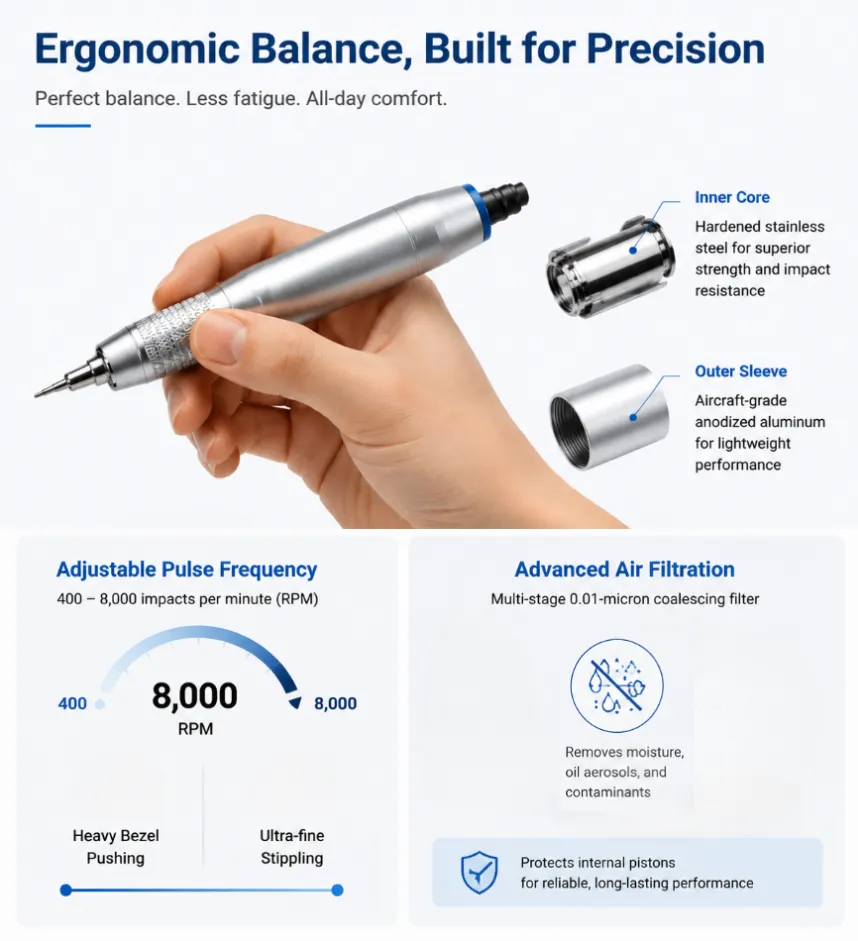
- Premium handpieces utilize a hybrid construction: An inner core machined from hardened stainless steel for impact resistance, paired with an outer sleeve of aircraft-grade anodized aluminum.
- This engineering design places the balance point directly between the thumb and index finger, drastically reducing muscle fatigue during prolonged, continuous work.
Technical Specifications:
- Pulse Frequency: Adjustable from 400 to 8,000 impacts per minute (RPM), allowing seamless transitions from heavy bezel pushing to ultra-fine stippling.
- Air Filtration System: Multi-stage configurations featuring a 0.01-micron coalescing filter to isolate moisture and oil aerosols, perfectly protecting internal striking pistons from sticky residue.
II. Cutting and Finishing Tools: HSS and Tungsten Carbide Setting Gravers
Before a stone can be securely set, the metal seat must be perfectly prepared. The choice of graver material determines how cleanly a jeweler can cut wire, clear a bezel channel, or bright-cut a border.
1. Material Microstructure and Hardness Grades
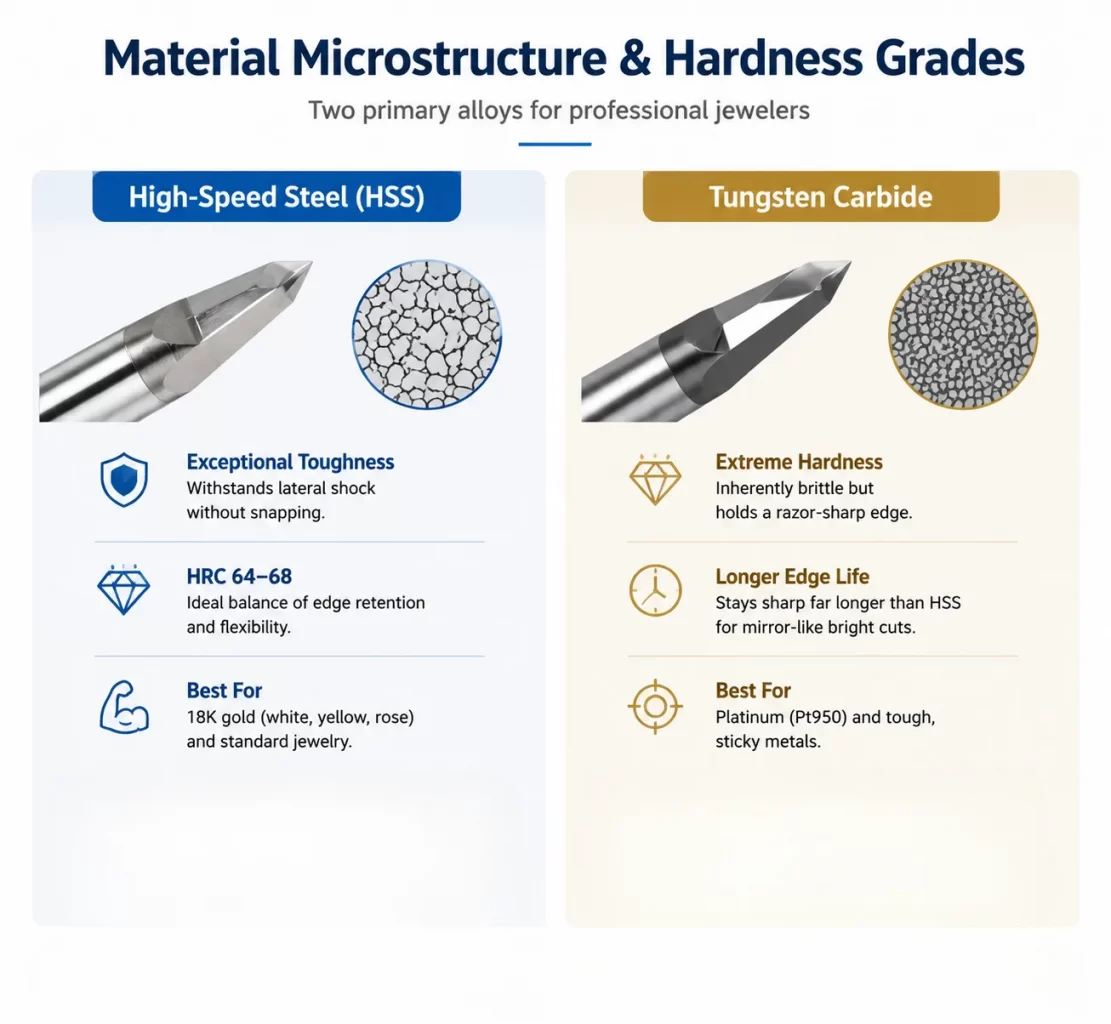
The two primary alloys dominating professional jewelry benches are High-Speed Steel (HSS) and Tungsten Carbide. They exhibit distinctly different mechanical behaviors under stress:
- High-Speed Steel (HSS): Known for its exceptional structural toughness. It withstands lateral shock without snapping. For standard 18K white, yellow, or rose gold mountings, an HSS graver rated at HRC 64–68 provides the ideal balance of edge retention and flexibility.
- Tungsten Carbide (Tungsten Steel): Offers extreme hardness but is inherently brittle. It is indispensable when cutting tough, sticky metals like Platinum (Pt950). Tungsten carbide tips maintain a razor-sharp edge far longer than HSS, allowing for mirror-like bright cuts that make small diamonds look significantly larger.
2. Thermal Fatigue Resistance and Annealing Risks
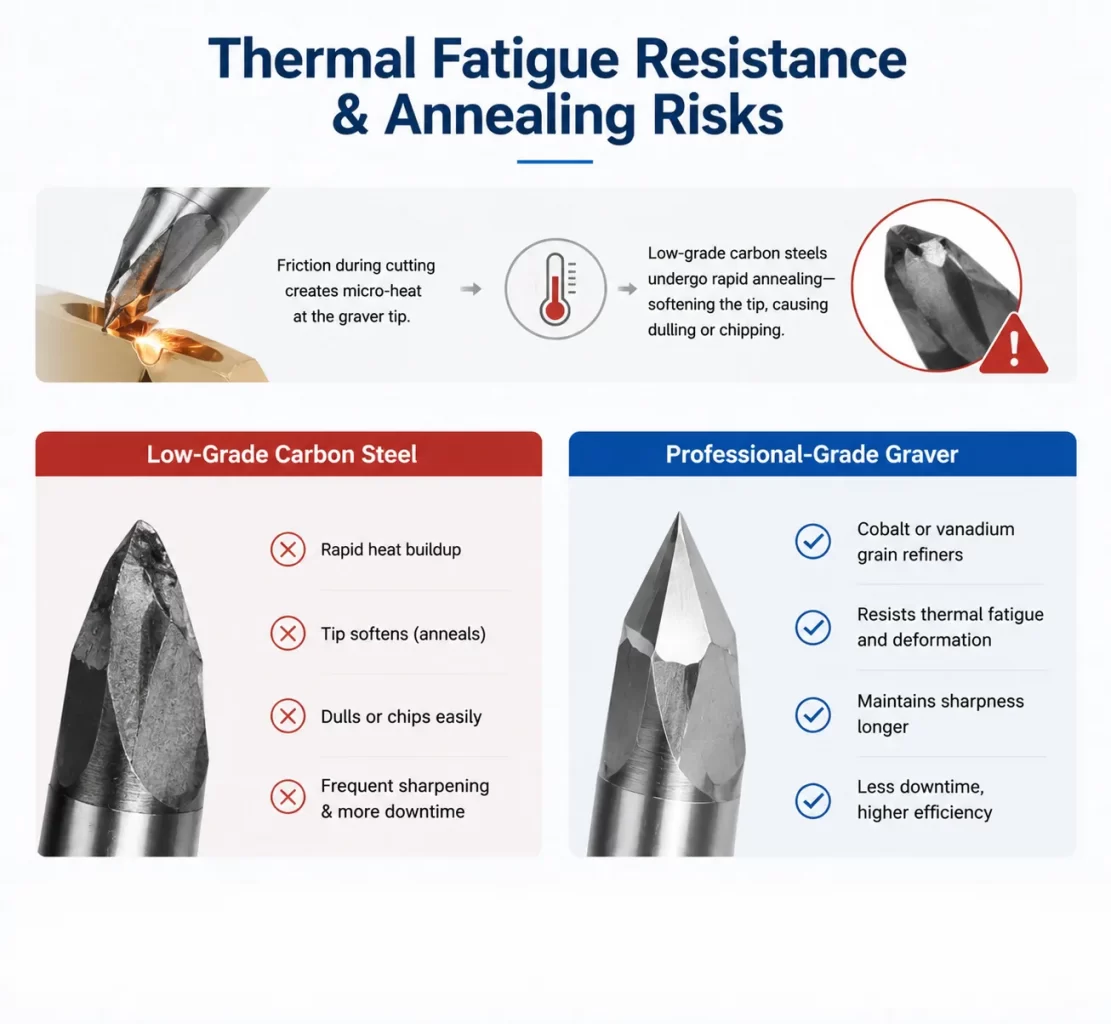
During continuous groove cutting and edge trimming, friction creates localized micro-heat zones at the graver tip. Low-grade carbon steels suffer from rapid thermal annealing—a process where heat softens the metal, causing the tip to dull or chip instantly.
- Professional-grade gravers incorporate cobalt or vanadium grain refiners into their microstructure. This metallurgical formulation ensures the tool retains its structural integrity even under high-frequency friction, reducing costly down-time spent at the sharpening hone.
III. Stabilization and Positioning Assistance: Precision Sealing Wax Fixtures and Pneumatic Ball Vise Mounts
A stone setter cannot work precisely if the jewelry piece is deflecting or vibrating under the impact of the handpiece. Proper workholding solutions are critical to absorbing mechanical shock and eliminating kinetic feedback.
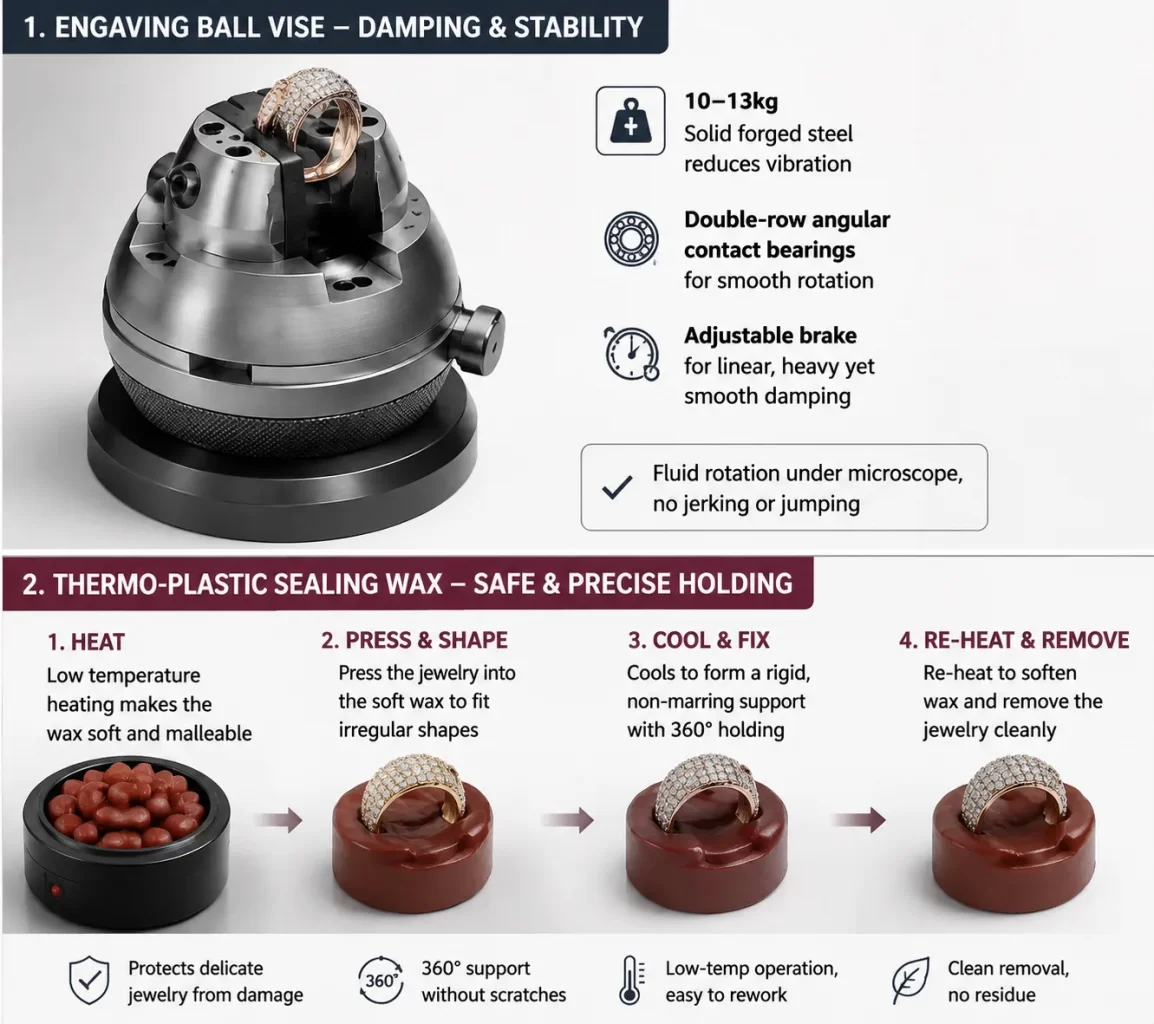
1. Damping Sensitivity of Engraving Ball Vises
A standard positioning block merely holds a ring, but an industrial-grade ball vise actively manages kinetic energy. Professional models weigh between 10kg and 13kg, utilizing massive solid forged steel cores to deaden striking vibrations.
- The critical feature here is the internal double-row angular contact bearing system paired with an adjustable rotational brake.
- The damping sensitivity must be perfectly linear—offering a “heavy yet smooth” resistance. When rotating a ring under a microscope during a continuous pave line, the vise must move fluidly without any jerking or “jumping” sensations that could throw the graver off course.
2. Industrial Applications of Thermo-Plastic Sealing Wax
When dealing with irregularly shaped high-jewelry components, fragile filigree, or ultra-thin earring jackets, traditional mechanical metal jaws fall short. Over-tightening can easily warp, crush, or scratch the precious metal mounting.
- Professional setters rely on advanced thermo-plastic sealing wax compounds.
- Heated at a relatively low temperature, this material becomes completely malleable, allowing the jeweler to press complex assemblies into it.
- Once cooled to room temperature, the plastic hardens into a rigid, non-marring support structure that provides 360-degree seamless wrapping. After the setting is complete, simply re-heating the fixture allows for a clean, residue-free removal of the jewelry piece.
IV. 2026 Professional Stone Setting Tool Panoramic Comparison Matrix
| Tool Category | Core Technical Specifications | Best For | Process Life / Durability |
| Pneumatic Micro-Pave Handpiece | All-stainless steel inner case / Linear pneumatic foot control / Dual-cone piston alignment | High-density micro-pave, fine bead setting, and precision channel detailing | Industrial-Grade Continuous Operation: Built for multi-shift factory floors with minimal maintenance. |
| Tungsten Steel V-Shaped Graver | Hardness rating HRC 68+ / Sub-micron grain structure / Amorphous Carbon (DLC) coating optional | Bright-cutting platinum borders, picking crisp milgrain beads, and precise grooving | High Durability: Exceptional wear resistance against abrasive metals; requires diamond wheels to sharpen. Avoid side impacts. |
| High-Damping Rotary Block | 13kg solid forged steel body / Double-row angular contact bearings / Linked two-way self-centering jaws | Large bezel setting, heavy prong pulling, and high-end deep relief engraving | Permanent Equipment: Heavy-duty structural build with virtually zero wear components over decades of bench use. |
Conclusion
To do something well, you must first have the right tools. Choosing tools with high HRC hardness and extremely high handling stability may seem to increase the initial unit price, but in reality, it significantly reduces labor costs for finishing and eliminates the hidden risk of gemstone breakage for businesses.
For high-volume manufacturing facilities and elite jewelry workshops looking to upgrade their production lines, sourcing from an established manufacturing supplier is paramount. JYBS provides industrial-grade stone setting tools, precision tungsten carbide gravers, and heavy-duty pneumatic workholding solutions engineered specifically to meet the rigorous demands of professional goldsmiths worldwide.