

Limited bench space, toxic metal dust, and runaway compound splatter are daily battles in any active jewelry workshop. A reliable polishing machine isn’t just about achieving mirror-flat reflections—it protects your lungs, recovers lost gold filings, and delivers the continuous torque required for flawless finishing.
1. How to Choose the Right Jewellery Polishing Machine for Your Workshop: 4 Core Factors
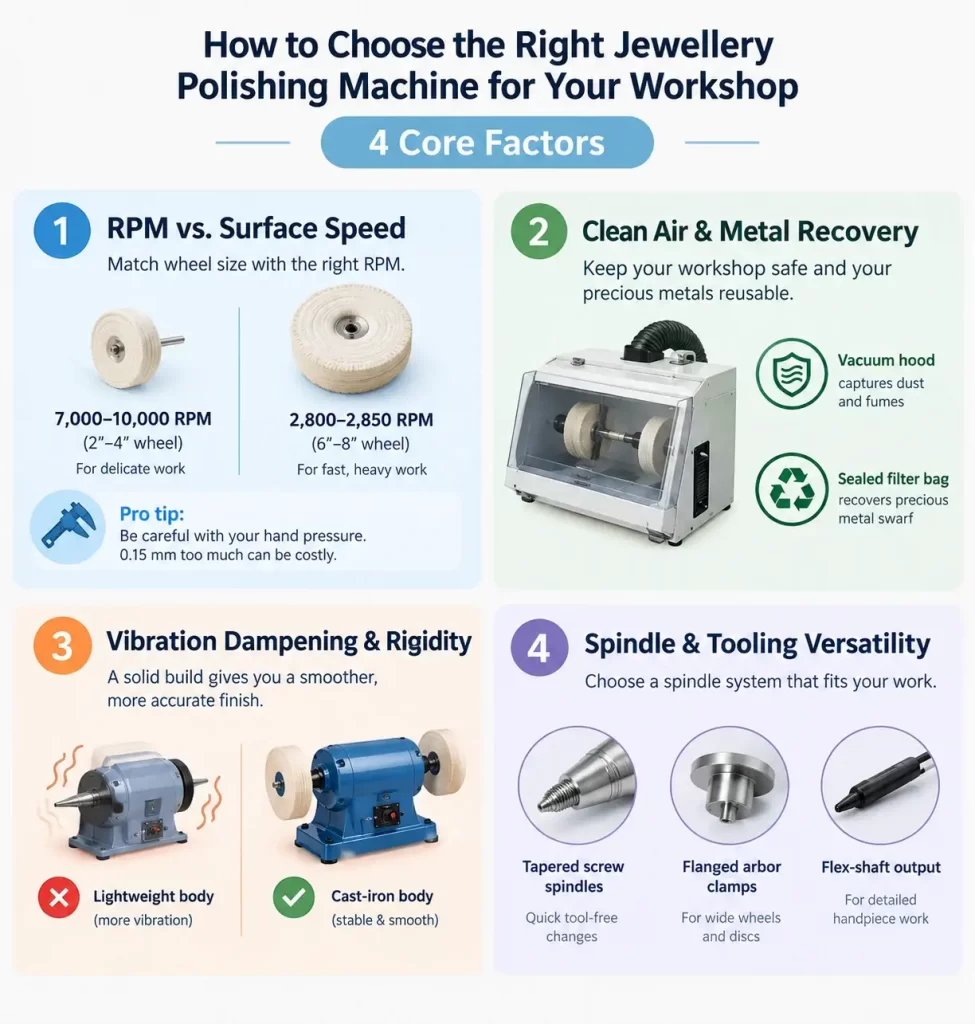
RPM vs. Surface Speed (SFPM)
Motor RPM alone means little without considering wheel diameter.
- High RPM (7,000–10,000) on small 2″–4″ wheels delivers low-heat precision, ideal for delicate prongs and intricate filigree.
- Lower RPM (2,800–2,850) paired with larger 6″–8″ buffs creates fast linear peripheral speeds (up to 35 m/s) to quickly level heavy castings.
- Pro tip: When operating at high speeds, always gauge your hand pressure carefully before aggressive cutting—removing just 0.15 mm too much metal can compromise the structural integrity of a delicate ring band.
Precious Metal Recovery & Clean Air
Airborne silica compounds (such as tripoli) and fine metal dust pose serious workshop health hazards.
- Enclosed vacuum hoods pull toxic aerosols directly from the wheel edge before they reach your breathing zone.
- Sealed filter bags pay for themselves over time by capturing airborne gold, platinum, and silver swarf for scheduled refinery recycling.
Vibration Dampening & Rigidity
Motor chatter instantly transfers to metal workpieces, creating visible ripples across flat signet rings and broad wedding bands.
- Avoid lightweight sheet-metal housings that slide or walk across the bench under pressure.
- Prioritize heavy cast-iron bodies with balanced copper motors to absorb harmonic vibrations and guarantee distortion-free mirror flats.
Spindle & Tooling Versatility
Match the spindle interface of your jewellery polishing machine to your daily workshop output:
- Tapered screw spindles: Essential for rapid, tool-free muslin and felt buff changes.
- Flanged arbor clamps: Required for wide lapping wheels, stone wheels, and rigid abrasive discs.
- Integrated flex-shaft outputs: Allow you to switch seamlessly from macro-buffing to intricate handpiece detailing at the exact same workstation.
2. In-Depth Reviews: The Top 5 Jewellery Polishing Machines for Workshops
1) DM-5 Mini Bench Polisher with Dust Collector: The Clean Desktop Solution
The DM-5 is designed for studios where every square foot counts and clean air is essential. It features an enclosed cabinet that combines a dual-spindle polishing arbor with an integrated internal vacuum system.
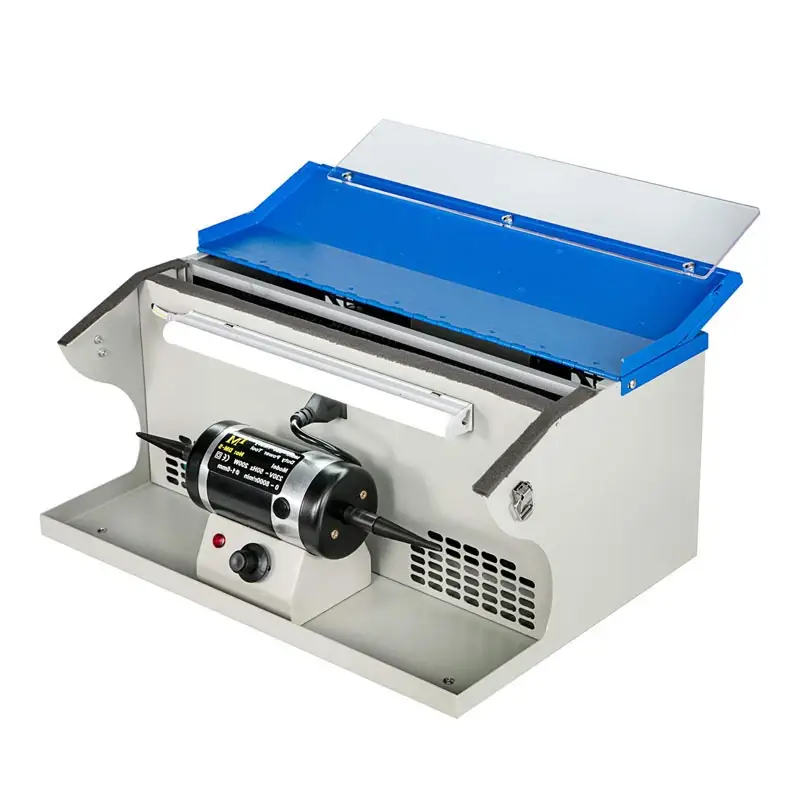
- Core Profile: Self-contained dual-head polishing cabinet designed for clean-room performance without requiring floor-ducted ventilation.
- Key Specifications: 200W polishing drive, 120W internal suction, 500–8,000 RPM range, 10.3 kg net weight, 220V operation.
- Workshop Strengths:
- Dual-motor arrangement isolates suction airflow from the main spindle drive, preventing speed drops when applying heavy hand pressure.
- Fully shrouded enclosure directly captures compounds and filings right at the wheel perimeter.
- Variable speed dial lets you step down the speed when working near heat-sensitive stones or resin fills.
- Practical Limitations: 220V rating requires a dedicated step-up converter if deployed in 110V-only electrical spaces; internal enclosure dimensions restrict the use of wheels larger than standard desktop buffs.
- Verdict: The top choice for boutique goldsmiths and retail repair nooks requiring direct dust containment on a single desk.
2) BL-2 Mini Polishing Bench Lathe: The Essential Budget Workhorse
The BL-2 is one of the most common sights on jewelers’ benches worldwide, serving as an approachable, space-conscious drive unit for daily touch-ups.
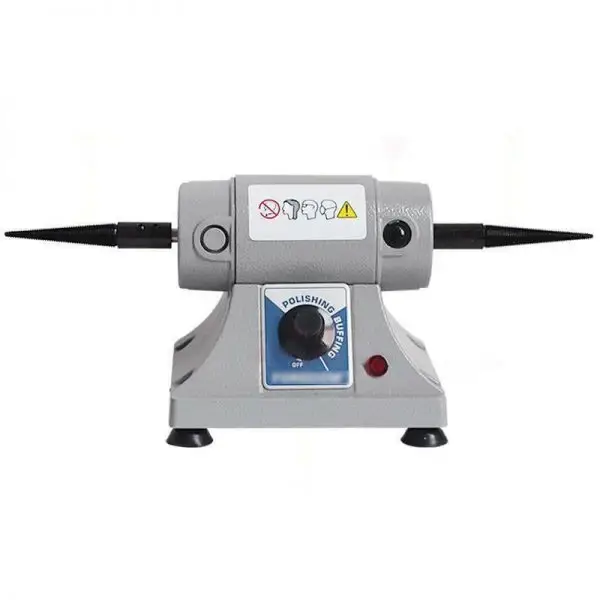
- Core Profile: Ultra-compact variable-speed dual-taper bench motor for entry-to-intermediate gold- and silversmithing.
- Key Specifications: 180W motor, 110/220V dual-voltage compatibility, stepless 500–7,000 RPM dial, standard tapered spindles accommodating up to 4″ (100mm) buffs.
- Workshop Strengths:
- Flexible speed control lets users dial down to prevent burning prongs or overheating acrylics, then ramp up for rapid compound cutting.
- Native 110V/220V compatibility eliminates regional voltage barriers.
- Threaded left- and right-hand spindles make wheel swapping quick and tool-free.
- Practical Limitations: Open-motor design provides zero dust containment; must be placed inside a dedicated splash hood or paired with a standalone extraction unit.
- Verdict: Best entry-level machine for independent designers, hobbyists, and jewelers operating on a modest initial budget.
3) BG-3108 Mini Bench Lathe: The Hybrid Multi-Tool for Micro-Workshops
The BG-3108 combines a traditional benchtop arbor on one side with a flexible shaft drive on the other, freeing up valuable space by eliminating the need for an overhead hanging motor.
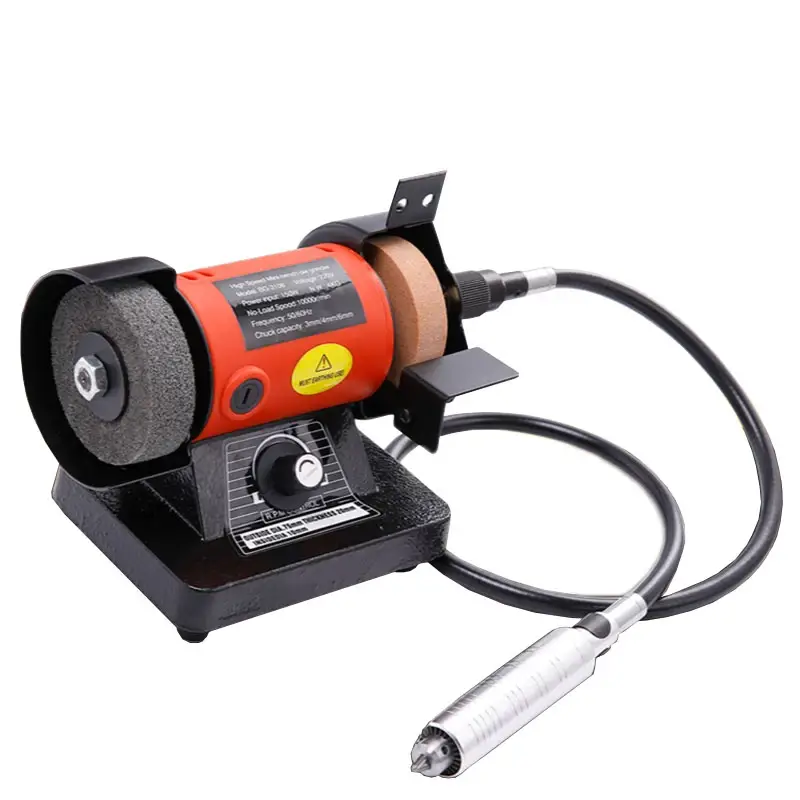
- Core Profile: Compact high-speed bench tool combining stationary wheel rotation with a flexible shaft drive.
- Key Specifications: 150W output, footprint of only 15 × 11 × 14.5 cm, 4 kg weight, continuous speed capability up to 10,000 RPM.
- Workshop Strengths:
- Footprint takes up less space than an open catalog, fitting micro-benches and compact apartment workshops.
- Direct-drive rotary handpiece connection handles inside-ring smoothing, setting cleanups, and engraving without needing a separate hanging flex shaft.
- 10,000 RPM motor runs smaller abrasive points and wire wheels with high cutting efficiency.
- Practical Limitations: Light 4 kg weight requires clamping or bolting down when applying heavy wheel pressure; 150W output can stall under aggressive force.
- Verdict: Ideal for carvers, watch and jewelry modifiers, and micro-workshops demanding dual-station flexibility in minimal space.
4) MD3220 Linli Polishing Bench Lathe (550W): Industrial Heavy-Duty Polishing
When you need to prep dozens of raw castings or smooth wide silver cuff bracelets, low-power desktop units can bog down. The MD3220 provides the industrial torque required for continuous production.
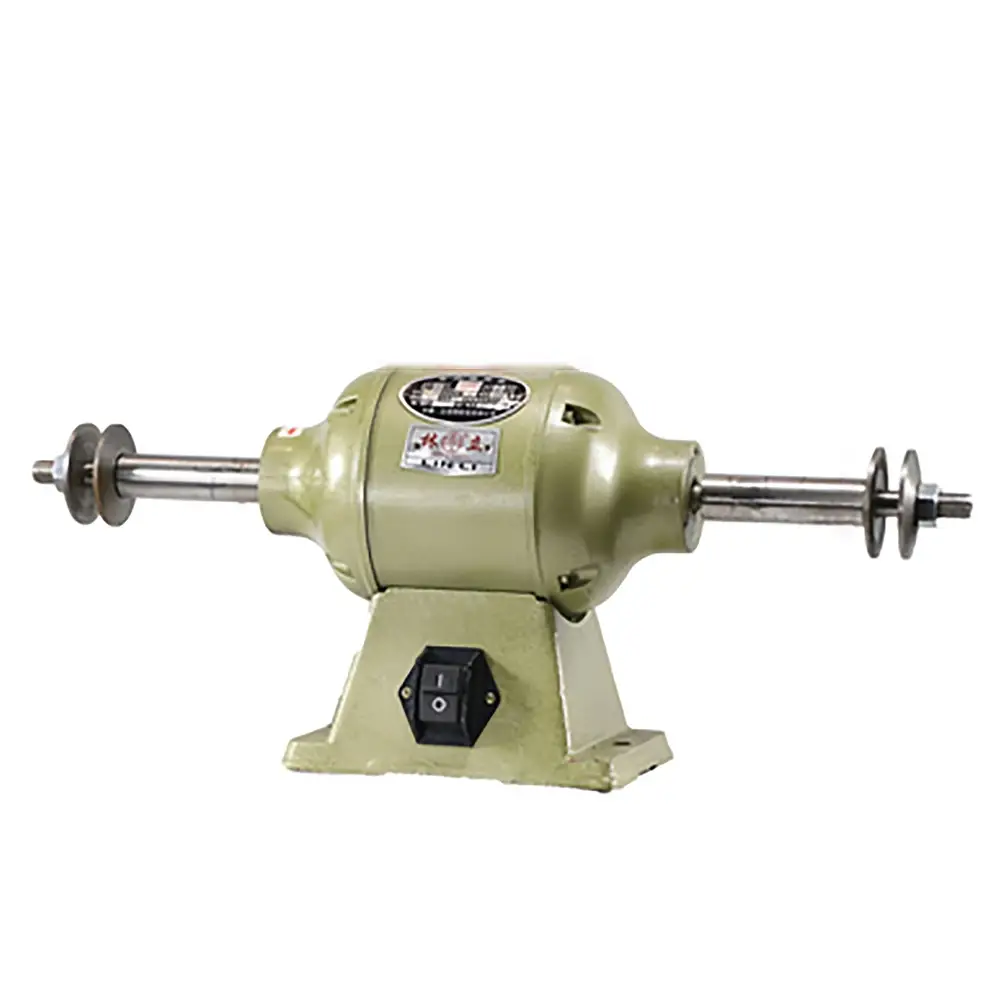
- Core Profile: Rugged industrial-grade double-ended polishing lathe built for continuous high-torque duty cycles.
- Key Specifications: 550W pure copper motor, 2,850 RPM synchronized speed, solid cast-iron chassis, dual threaded and clamp spindles, 200mm max disc size, 10.5 kg weight.
- Workshop Strengths:
- Cast-iron mass and balanced pure-copper rotor suppress harmonic vibrations, ensuring clean, scratch-free mirror flats.
- 35 m/s maximum linear speed drives 8″ stitched mops efficiently through hard platinum, titanium, or heavy brass batches.
- Accommodates both standard tapered threaded screw points and clamped center-hole wheels.
- Practical Limitations: Fixed 2,850 RPM speed removes low-RPM dial-in versatility; requires an external industrial hood setup for dust control.
- Verdict: Built for commercial repair counters, casting houses, and busy production goldsmiths working with wide buffs all day.
5) Single Polishing Bench with Dust Collector (8-Hook Filter): The Ultimate Production Station
For professional manufacturing floors and trade schools, tabletop machines are often swapped out for a dedicated floor workstation with built-in reclamation.
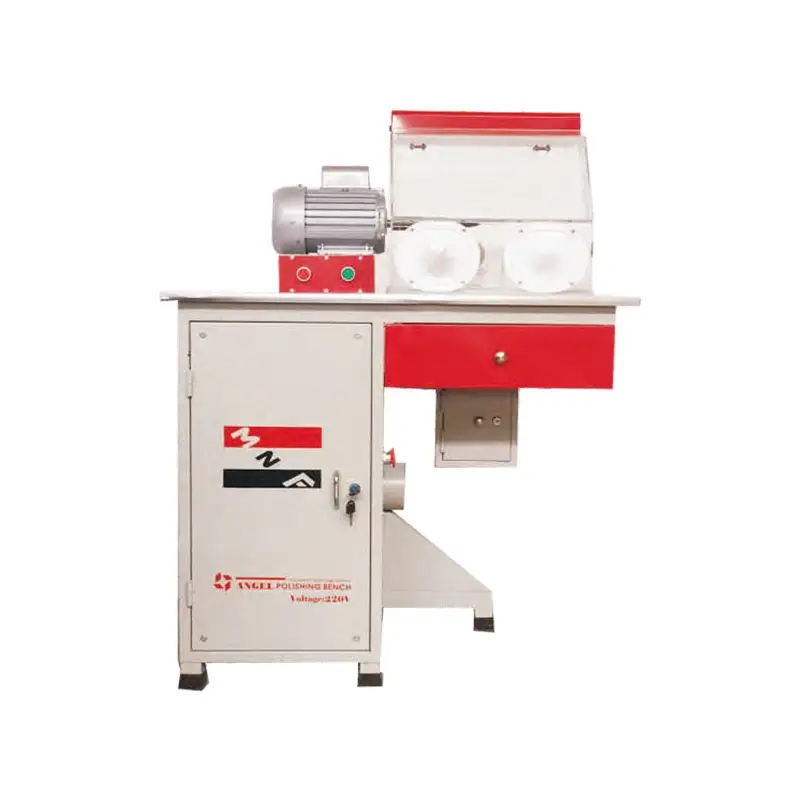
- Core Profile: Self-contained floor-standing workstation designed for continuous precious metal capture.
- Key Specifications: 1/2 HP grinding motor, dedicated 550W suction motor, 2,800 RPM operating speed, heavy-gauge steel cabinet, multi-point 8-hook filter bag.
- Workshop Strengths:
- High-CFM suction draws metal particulates immediately away from the operator’s breathing zone.
- The 8-hook hanging filter bag maximizes interior surface area, preventing airflow clogs and making quarterly precious metal recovery straightforward.
- Clear hood barrier protects against flung components or broken buff fibers while maintaining unobstructed work lighting.
- Practical Limitations: Substantial floor space requirement and higher capital investment; designed for permanent shop positions rather than tabletop moving.
- Verdict: The standard choice for professional manufacturing studios, technical jewelry academies, and high-turnover polishing departments.
2. Getting the Most from Your Jewellery Polishing Machine: Workshop Buffing & Speed Setup
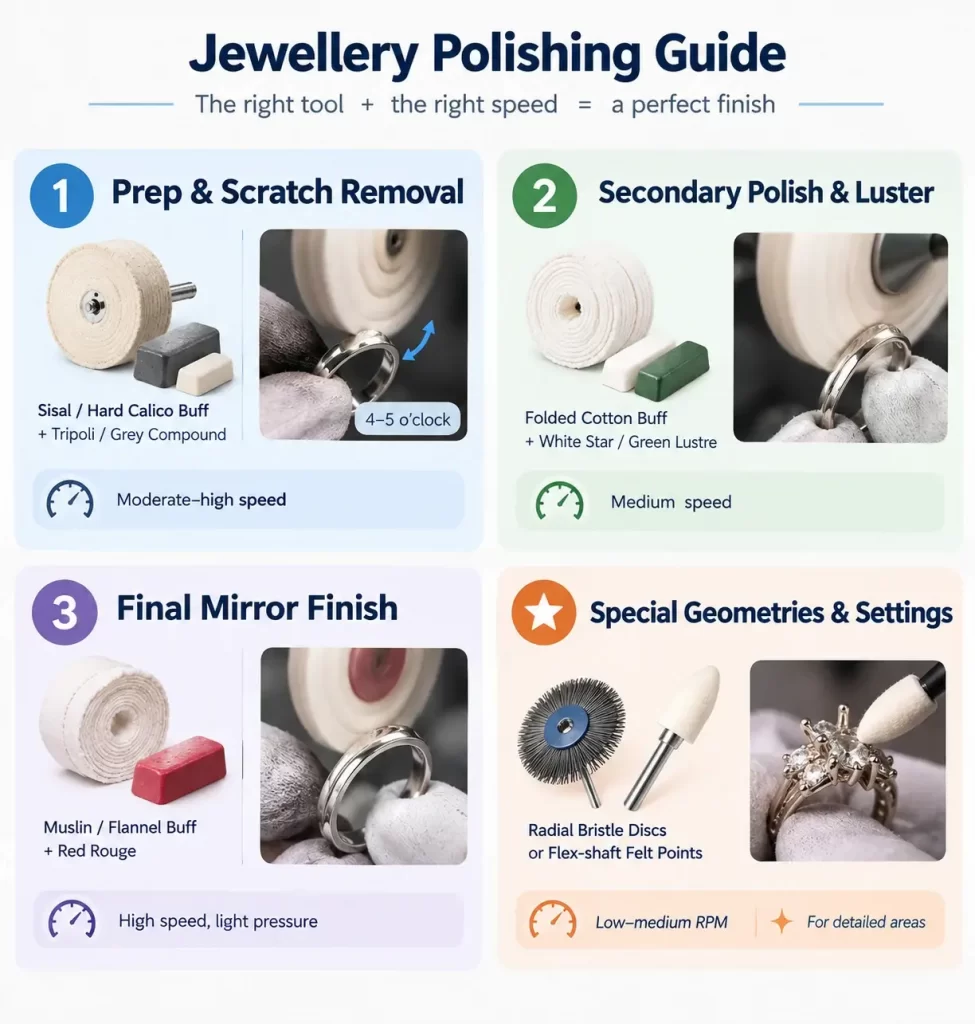
Stage 1: Prep & Scratch Removal
- Tooling: Stitched Sisal or Hard Calico Buff with Tripoli / Grey Compound.
- Application: Run at moderate-to-high linear speed. Cut diagonally across file marks, casting sprues, and firescale. Keep the workpiece moving across the lower quadrant of the wheel (between 4 and 5 o’clock) to prevent edges from catching.
Stage 2: Secondary Polish & Luster
- Tooling: Folded Cotton Buff charged with White Star or Green Lustre Compound.
- Application: Run at medium wheel speed. This stage clarifies transitions, removes the dulling haze left by coarser grits, and brings up color depth on precious alloys without softening crisp design lines.
Stage 3: Final Mirror Finish
- Tooling: Loose Unstitched Muslin or Soft Flannel with Red Jewelers Rouge.
- Application: Use higher speeds with very light contact pressure. The rouge burnishes the outer metal layers at a molecular level, clearing micro-scratches and leaving an undistorted, haze-free mirror reflection.
Special Geometries & Settings
- Tooling: Radial Bristle Discs (80 to 1-micron grades) or flex-shaft felt points.
- Application: Dial down to low-to-medium RPM. These conform to complex shapes, cleaning up prongs, gallery rails, and textured under-bezels without rounding over delicate corners.
4. Buying Summary & Recommendation Rules
- Select the DM-5 if benchtop space is restricted, air quality is a top priority, and a plug-and-play vacuum unit is required.
- Select the BL-2 for a low-cost, multi-voltage variable-speed solution where a separate dust hood already exists.
- Select the BG-3108 if working on intricate carvings, ring shanks, and micro-engraving in very tight quarters.
- Select the MD3220 for high-volume batch grinding, hard metal polishing, and heavy downforce requirements.
- Select the Single Polishing Bench for full commercial operations requiring maximum suction, gold-dust containment, and an all-day floor station.
Conclusion
Setting up an efficient, safe finishing station requires matching machine power, wheel diameter, and dust filtration to your workshop’s daily volume. Whether you run an independent studio bench or a commercial repair line, investing in stable machinery protects your respiratory health and preserves precious metal value over time.
If you are sourcing equipment for your studio or upgrading an entire manufacturing floor, explore the complete range of jewellery polishing machines at JYBS. As an experienced jewelry tools supplier, JYBS works directly with workshops, schools, and factories worldwide, providing robust polishing accessories, heavy-duty production lathes, and advanced filtration units with full support for bulk wholesale orders. Upgrade your workshop setup with dependable equipment engineered for daily production.