

Why Prong & Bezel Setters Require a Specialized Loupe
- A Tool for Structural Engineering: For a bench jeweler specializing in mounting center stones—cutting seats for prongs, hammering bezels, and burnishing flush settings—the loupe is a structural engineering tool.
- Critical Clearances and Contact: The setter must ensure the diamond’s girdle rests perfectly level inside the cut bur-hole, that the pavilion (bottom) of the stone is not touching the metal gallery (which causes chipping), and that a bezel wall is pushed completely flush against the stone without any microscopic puckering.
- Extraordinary Depth of Field (DoF): This precise structural work requires extraordinary Depth of Field (DoF). A setter must be able to focus on the top of the prong and gaze down to the girdle of the diamond in the same visual plane.
- Mandatory Flat-Field Correction: Furthermore, extreme Aplanatic (flat-field) correction is mandatory. When evaluating a bezel setting, the setter must verify that the bezel wire is perfectly round and symmetrical; spherical distortion in a cheap lens will artificially curve the image, making it impossible to judge true symmetry.
- Lower Magnification for Safety: Because setters use sharp pushers and hammers, they often prefer Lower Magnification to gain the focal length (working distance) needed to hold tools near the stone safely.
Critical Optical Specs for Stone Setting Standards
Symmetry, tool clearance, and structural assessment dictate the setter’s optical requirements.
| Key Specification | Recommended Standard | Why It Matters for Setters |
| Depth of Field (DoF) | High (Deep Focal Plane) | Allows the setter to verify that a V-prong is securely folded over the crown while simultaneously checking that the culet isn’t resting on the under-bezel. |
| Spherical Correction | Aplanatic Flat-Field | Essential for judging symmetry. A setter cannot evaluate if a bezel is perfectly round if the lens itself introduces barrel or pincushion distortion. |
| Focal Length | 30mm to 35mm (via 7x/8x power) | Provides “tool clearance.” A longer focal length pushes the loupe further from the ring, allowing the setter to safely maneuver a bezel pusher or burnisher. |
Top 3 Loupe Recommendations for Prong & Bezel Setters
Engineered for structural symmetry and deep focal planes:
1. Zeiss D36 Universal & D40 Professional Pocket Magnifiers
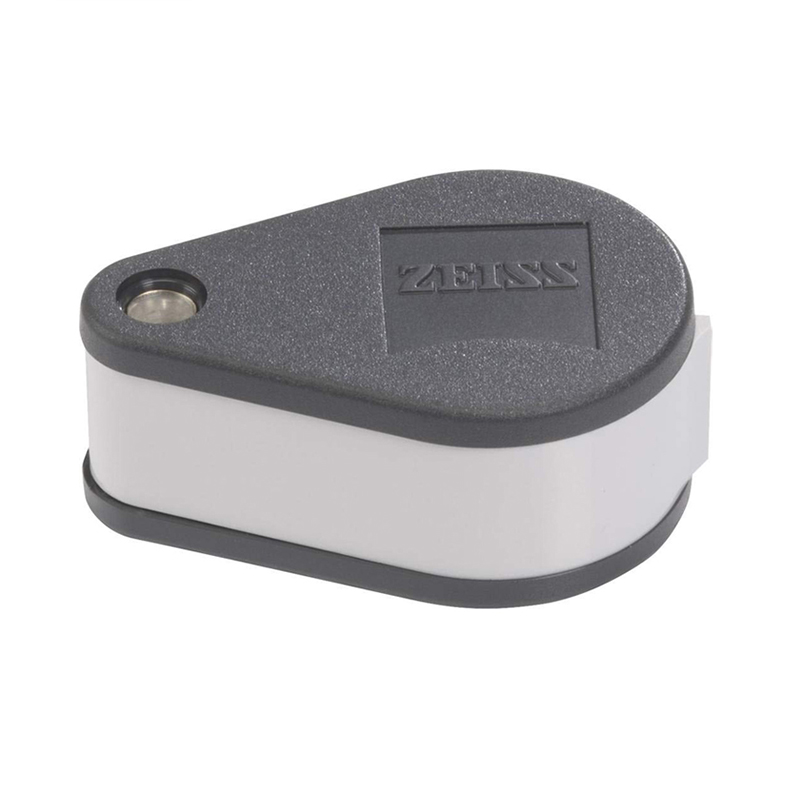
- Specs: D36 (Selectable 3X/6X/9X via dual independent lenses, Wide 22mm aperture) / D40 (Fixed 10X Triplet, 13mm, T* Anti-Reflective Coating). Both feature German-engineered Aplanatic-Achromatic correction.
- Verdict: The ultimate setter’s optical system. Standard 10x loupes force you uncomfortably close to sharp gravers, but the Zeiss D36 solves this. By utilizing its dual independent lens structure (offering flexible 3X or 6X magnification), you significantly increase your working distance, providing the crucial “tool clearance” needed for active bench work. Meanwhile, its wider 22mm lens diameter easily captures the entire geometry of a halo setting to judge perfect symmetry.
- Pro Tip: Once the heavy hammering is done, professional setters switch to the Zeiss D40. Its fixed 10X triplet structure and exclusive T coating provide pure, distortion-free magnification for the ultimate microscopic inspection of the final bezel wall.
2. Hand Grip 5x 7x Magnification Loupes Mini Portable (Alfa Mirage)
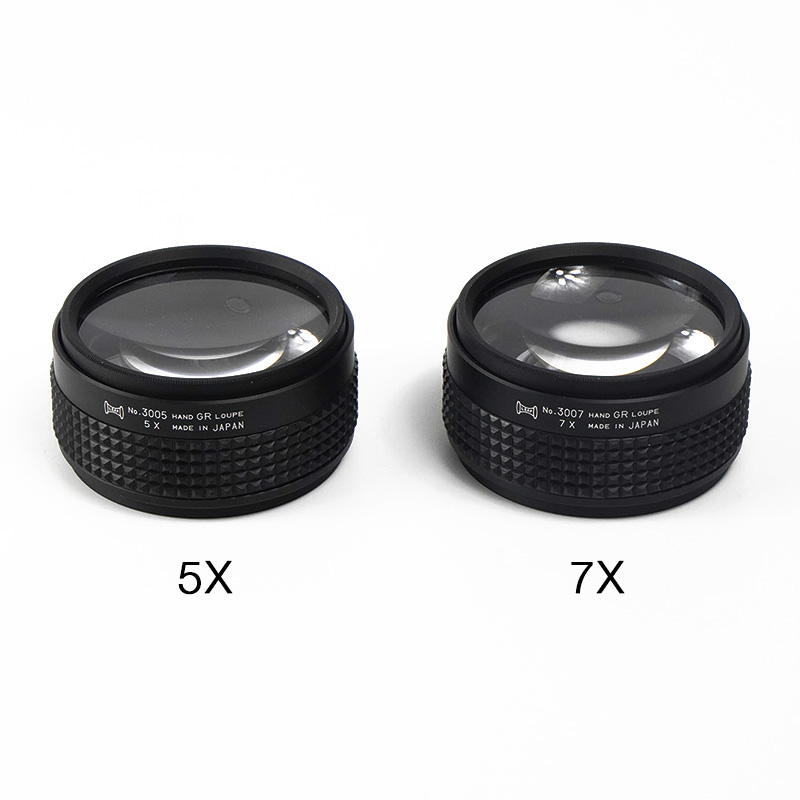
- Specs: 5x or 7x options (Model 3005/3007), Made in Japan, Massive 53.5mm Double Lens, Semi-achromatic (80% flat field), Rubber anti-slip grip.
- Verdict: The workbench hero. By dropping the magnification to 5x or 7x with a massive 53.5mm diameter glass lens, the depth of field and working area expand massively. This high-quality Japanese hand-held design provides the crucial “tool clearance” needed for the setter to safely touch up a prong with a cup bur or graver, while the rubber-wrapped outer ring ensures a secure grip during active bench work.
3. Original OptiVISOR Head Magnifier
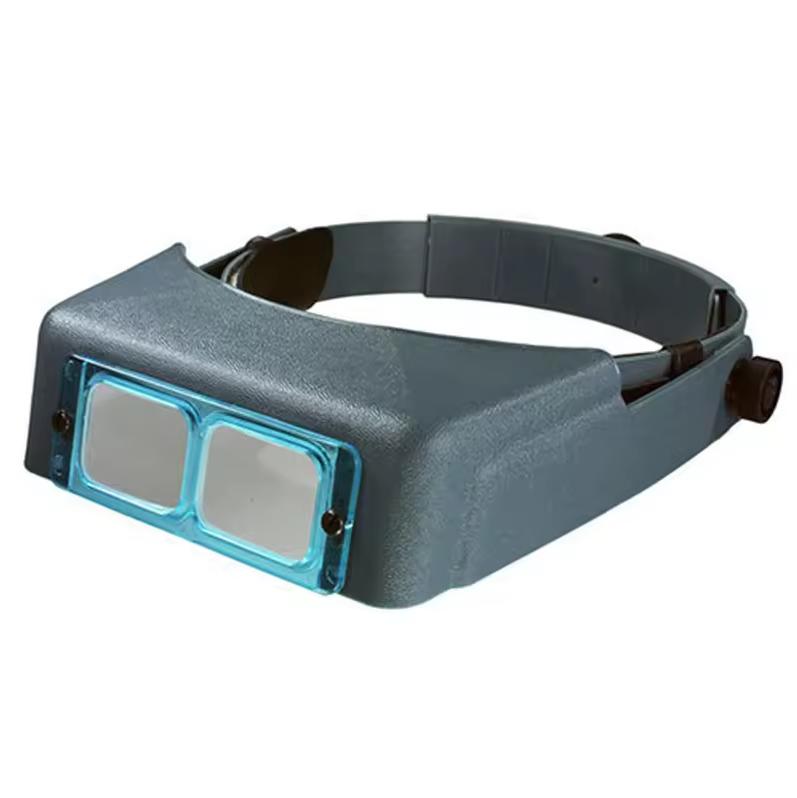
- Specs: Binocular visor (Made in USA), Optical glass prismatic lenses, Multiple focal lengths (e.g., DA5 2.5x at 8″, DA10 3.5x at 4″), Genuine leather comfort band.
- Verdict: Essential for heavy hammering and bezel pushing. It provides hands-free, 3D stereoscopic depth perception for the heavy lifting of stone setting. Worn directly on the head with a padded orthopedic leather band, the visor tilts out of the way instantly and allows the setter to maintain continuous visual contact with varying safe working distances (from 4 to 14 inches depending on the lens plate) to comfortably accommodate any hand tool.
How to Clean and Protect Your Setting Loupe
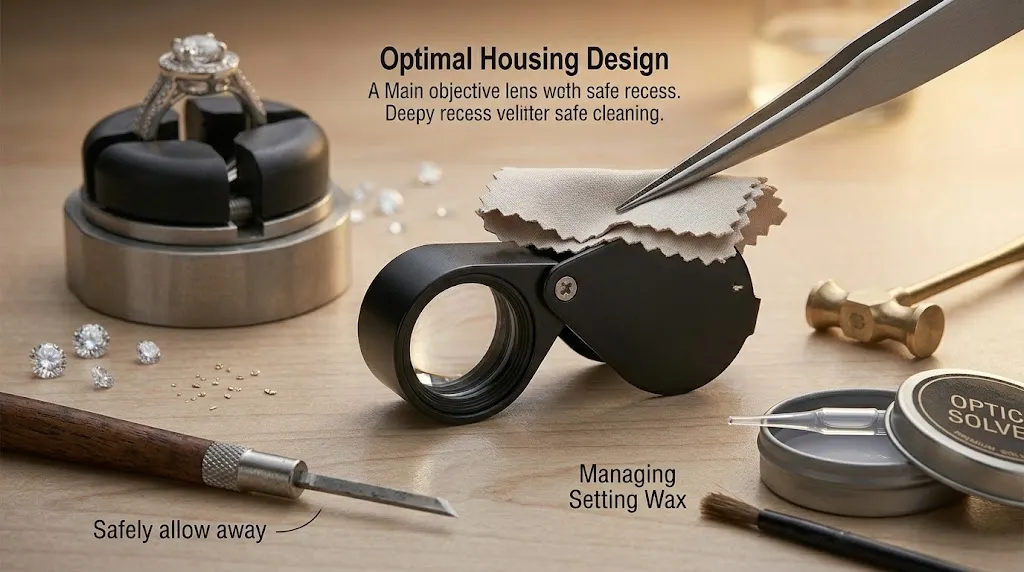
- Guarding Against Impact: Stone setting is a forceful process. Gravers slip, and bezel pushers snap. If your loupe is held too close to the work surface, flying metal chips can easily strike the lens.
- Optimal Housing Design: Always use a loupe with the glass deeply recessed within its metal housing.
- Managing Setting Wax: Keep the loupe free of setting wax (like beeswax or specialized setter’s cement), as wax smears instantly ruin light transmission and are very difficult to wipe off without optical solvents.
FAQ: Selecting a Loupe for Stone Setting
- Q: Why does my loupe hit my tools when I try to check my prong seats?
- A: You are using a standard 10x eye loupe, which has a very short focal length (1 inch). To gain more room for your burs and pushers, switch to a head visor (like the OptiVISOR), a variable magnification loupe (like the Zeiss D36), or a lower magnification hand magnifier (5x/7x), which increases the working distance significantly.
- Q: Is a Triplet lens necessary just for bending metal?
- A: Yes. Flat-field (aplanatic or semi-achromatic) correction ensures straight lines appear straight. If you use a cheap single lens, the edge distortion will make perfectly straight prongs look bent, causing you to constantly over-adjust and weaken the metal.
- Q: How can I tell if the diamond is sitting level in the setting?
- A: Use a wide-aperture magnifier (like a 22mm or 53.5mm lens). Look at the table (the flat top) of the diamond in relation to the halo or the prongs. The wide field of view allows you to see the entire geometry of the ring head at once to judge planar symmetry.
Need to bulk buy for your Bench Jeweler or Setting team? Get a Quick Quote. Our optical specialists will respond within 3 hours.