

Why Goldsmith Apprentices Require a Specialized Loupe
- Retraining the Eye: For a goldsmith apprentice, a loupe is the primary tool for retraining the eye. Apprentices must learn to identify microscopic flaws that ruin a piece of jewelry: pinpoint porosity in a fresh casting, unsoldered gaps in jump rings, or “fire scale” (cupric oxide) hiding beneath the surface of sterling silver.
- Avoiding Poor Optical Habits: If an apprentice uses a cheap, plastic single-lens loupe, they will develop poor optical habits, as the severe spherical distortion will make it impossible for them to differentiate between a curved file-mark and a structural stress fracture.
- The Baseline Professional Triplet: An apprentice needs a baseline optical standard. While traditional 18mm lenses are the classic starting point, upgrading to a 21mm Triplet offers a significantly wider field of view, drastically reducing eye strain during long hours of bench training. Regardless of the size they choose, they absolutely must have a lens with true Aplanatic (flat-field) correction.
- Durability in a Rough Environment: The apprentice environment is notoriously rough on equipment. Loupes will be dropped on concrete floors, subjected to acidic pickle fumes, and covered in polishing rouge.
- Protective Housing Requirements: Therefore, an apprentice’s loupe must feature a highly durable, heavy-duty metal or rubberized housing to protect the fragile optical glass from the daily hazards of learning at the bench.
Critical Optical Specs for Apprentice Standards
Durability and true flat-field optical correction are essential for training a jeweler’s eye correctly.
| Key Specification | Recommended Standard | Why It Matters for Apprentices |
| Lens Construction | Aplanatic & Achromatic Triplet | A single lens creates barrel distortion, training the apprentice’s eye incorrectly. A fully corrected Triplet ensures they see straight file lines and flush joints accurately without color fringing. |
| Housing Durability | Rubberized or Thick Metal | Apprentices frequently drop tools. A shock-absorbing or heavy-gauge metal housing prevents the cemented triplet glass from shattering on impact. |
| Magnification | Strictly 10x | 10x is the global jewelry standard. Training with a 20x loupe will cause the apprentice to over-polish and obsess over flaws that are invisible to the client. |
Top 3 Loupe Recommendations for Goldsmith Apprentices
Engineered for durability and fundamental optical accuracy:
1. Triplet Loupe with Rubber Grip 10X-JYBS
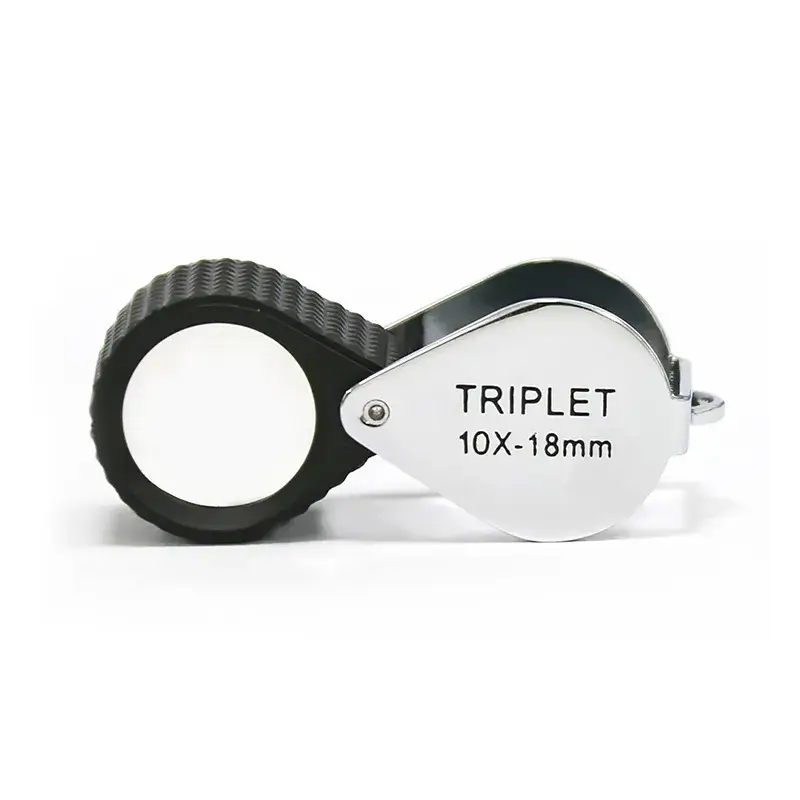
- Specs: 10x Triplet (18mm or 21mm lens options), Shock-absorbing ridged rubber grip, Flat black lens holder.
- Verdict: The ultimate starter tool. The ridged sides ensure a steady grip, and the rubberized housing protects the precision glass from the inevitable drops on the workshop floor. Crucially for apprentices, the flat black color of the lens holder actively controls glare and prevents color distortion, increasing transmission accuracy and reducing eye strain during continuous use.
2. Zeiss D40 Professional Pocket Magnifier
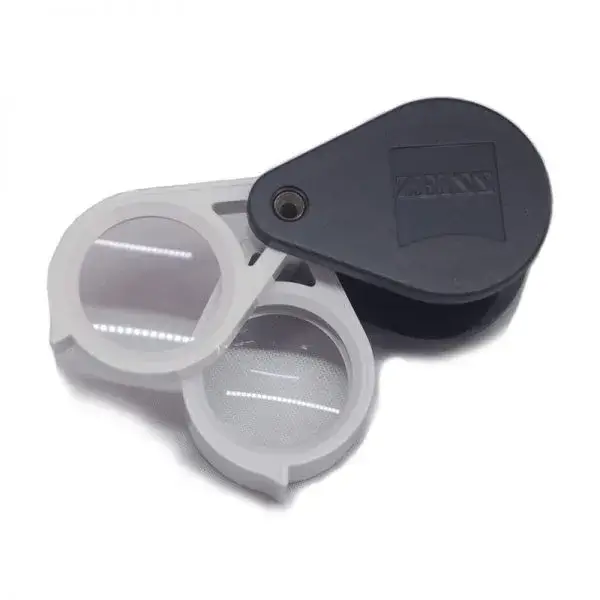
- Specs: Fixed 10x Magnification, 13mm Triplet lens, T* Anti-Reflective Coating, Made in Germany.
- Verdict: The absolute benchmark for professional jewelers and serious apprentices. Unlike the Zeiss D36 which uses dual independent lenses for variable magnification, the D40 is engineered with a precision-cemented fixed triplet structure. This ensures pure, distortion-free maximum achromatic correction. Complying with GIA and CIBJO requirements, its legendary T* coating minimizes glare, providing the ultimate optical clarity for retraining a goldsmith’s eye.
3. Triplet Loupe with LED/UV Lighted LED-JYBS
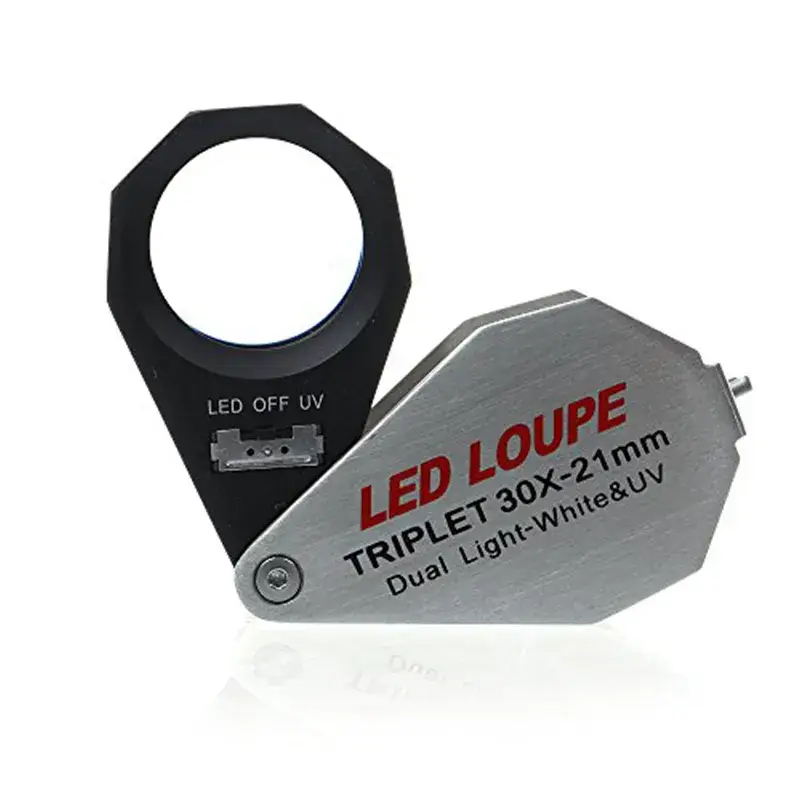
- Specs: 10x Triplet (21mm), Aplanatic & Achromatic, 6 built-in LED lights + 1 UV light.
- Verdict: Ideal for students working in poorly lit university studios or shared makerspaces. Fully corrected for both spherical and color distortions, it offers a large, true-color field of view. The direct illumination from the 6-LED band eliminates shadows in deep bezels, while the integrated UV light allows apprentices to easily practice gemstone fluorescence testing with the flip of a switch.
How to Clean and Protect Your Apprentice Loupe
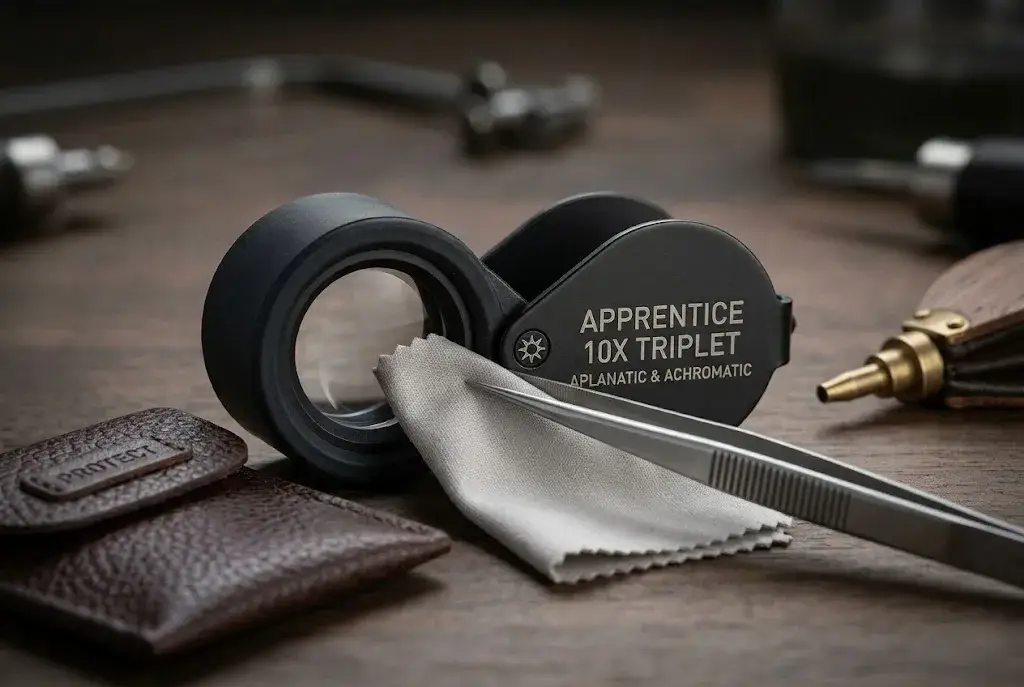
- Avoid Abrasive Contamination: As an apprentice, your hands are constantly covered in abrasive polishing compounds like Tripoli or rouge. Never wipe your loupe lens with the corner of your shop apron; you will instantly grind these abrasives into the optical glass, permanently ruining its light transmission.
- Proper Cleaning Protocol: Always wash your hands before inspecting a stone, and blow the lens off with compressed air before using a dedicated microfiber cloth.
- Storage and Protection: Store the loupe in a sealed leather pouch, far away from your pickling station to avoid acidic vapor corrosion on the housing.
FAQ: Selecting a Loupe for Goldsmith Apprentices
- Q: Why shouldn’t a student start with a cheap $10 loupe?
- A: Cheap loupes use molded plastic lenses with massive spherical and chromatic aberration. They cause severe eye strain, headaches, and prevent the apprentice from accurately assessing the flushness of their solder joints.
- Q: Is a 10x loupe strong enough to see porosity in castings?
- A: Yes. At 10x magnification, microscopic gas bubbles (porosity) in a gold casting appear as distinct, dark craters. If you cannot see the porosity at 10x, it will not be visible to the final customer.
- Q: What does “working distance” mean for an apprentice?
- A: Working distance (or focal length) is how close you must hold the jewelry to the loupe to achieve focus. A 10x loupe has a 1-inch working distance, which apprentices must practice maintaining through muscle memory.
Need to bulk buy for your Jewelry School or Apprentice Program? Get a Quick Quote. Our optical specialists will respond within 3 hours.