
Why Auction House Experts Require a Specialized Loupe
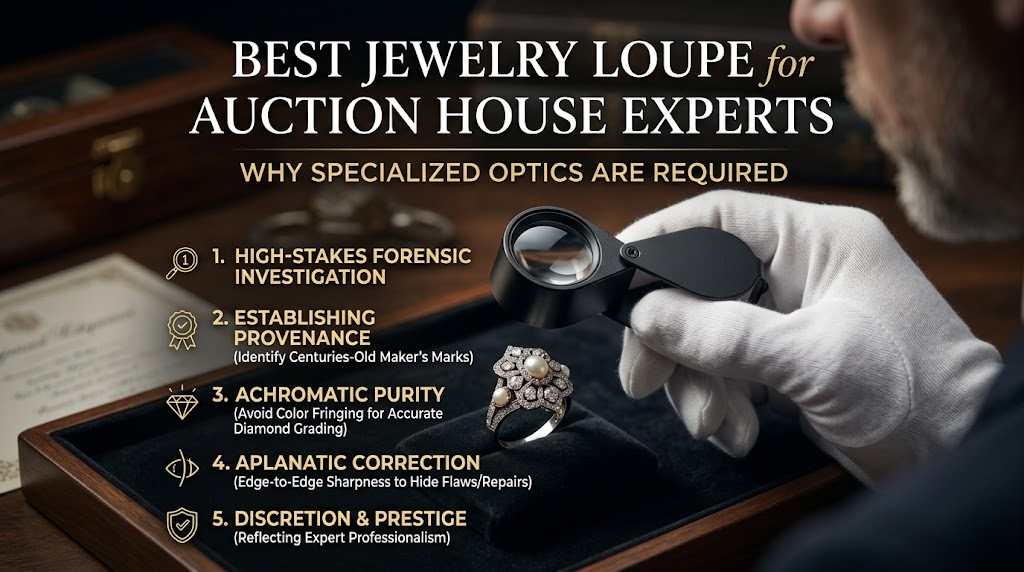
For specialists at elite houses like Christie’s or Sotheby’s, evaluating a masterpiece is a high-stakes forensic investigation. A standard magnifying glass is insufficient when a lot’s reserve price depends on microscopic details.
Here is why auction house experts require top-tier, specialized optics:
- Establishing Provenance: Experts must identify centuries-old maker’s marks or faded Fabergé stamps on curved shanks.
- Achromatic Purity: When evaluating a “D” color diamond, the lens must offer absolute color neutrality. Any “color fringing” (chromatic aberration) could lead to an incorrect color grade and a massive loss in valuation.
- Aplanatic Correction: Essential for “Edge-to-Edge” sharpness. Distortion at the edges of the lens can hide crucial structural flaws or repair marks in estate jewelry.
- Discretion and Prestige: In a high-end vault or private client intake, the equipment must reflect the expert’s professionalism.
Critical Optical Specs for Auction House Standards
| Feature | Professional Requirement | Technical Benefit |
| Optical System | Achromatic & Aplanatic Triplet | Eliminates color dispersion and geometric distortion across the entire field of view. |
| Coating | Multi-layered AR / T* Coating | Minimizes internal reflections and maximizes contrast for dark-field inspections. |
| Resolution | >63 lines / mm | Essential for detecting laser inscriptions and identifying synthetic flux in gemstones. |
| Housing | Non-Reflective Matte Black | Prevents ambient light from bouncing off the housing onto the gemstone. |
Top 3 Loupe Recommendations from Our Inventory
Based on professional laboratory standards and technical performance, these are the primary choices for 2026:
1. Zeiss D40 Aplanatic-Achromatic Loupe (10X)
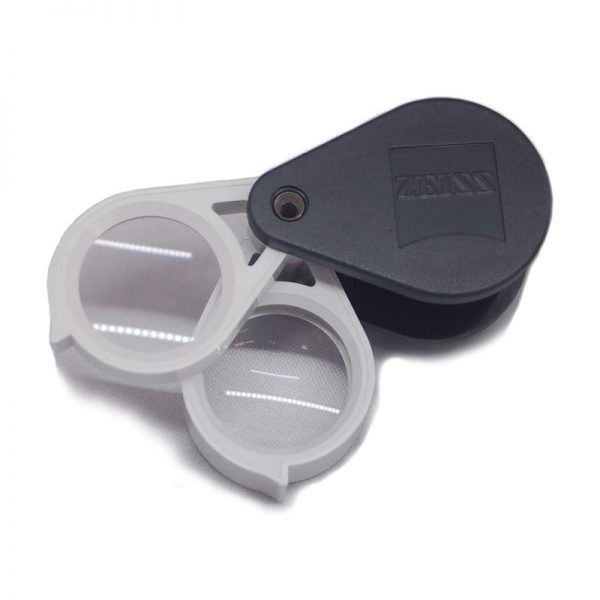
- The Precision Standard: Featuring a 13mm lens with a refractive power of 40 dpt, the D40 is the global benchmark for diamond grading.
- T Anti-Reflective Coating:* This proprietary Zeiss technology minimizes glare and maximizes image contrast, allowing experts to see internal inclusions (GIA standards) with unparalleled clarity.
- Verdict: The “Gold Standard” for laboratory-level gemstone identification.
2. Harald Schneider Triplet Loupe L2 (10X)
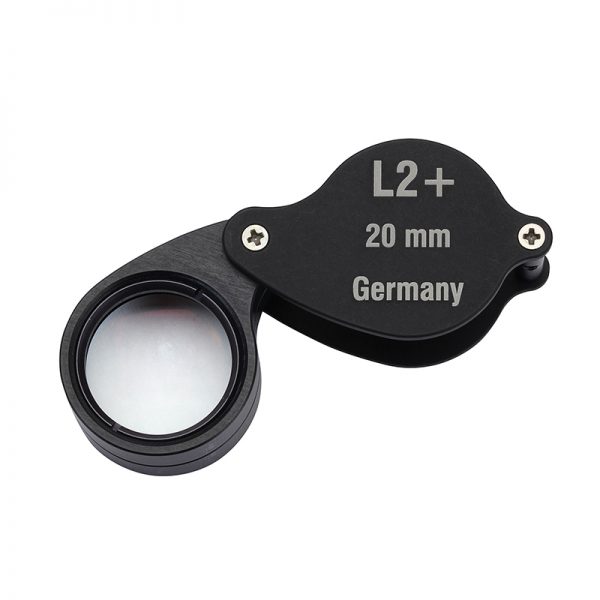
- The Wide-Field Specialist: The L2 features a massive 20mm lens diameter, significantly larger than standard loupes. This offers a generous field of view and superior depth of focus.
- Advanced Lens System: It utilizes a double-lens achromatic-aplanatic system that is thinner and lighter (2.46 oz) without sacrificing resolution.
- Verdict: Best for inspecting large estate brooches or identifying hallmark sequences on antique silverware.
3. Nikon Triplet Loupe (10X)
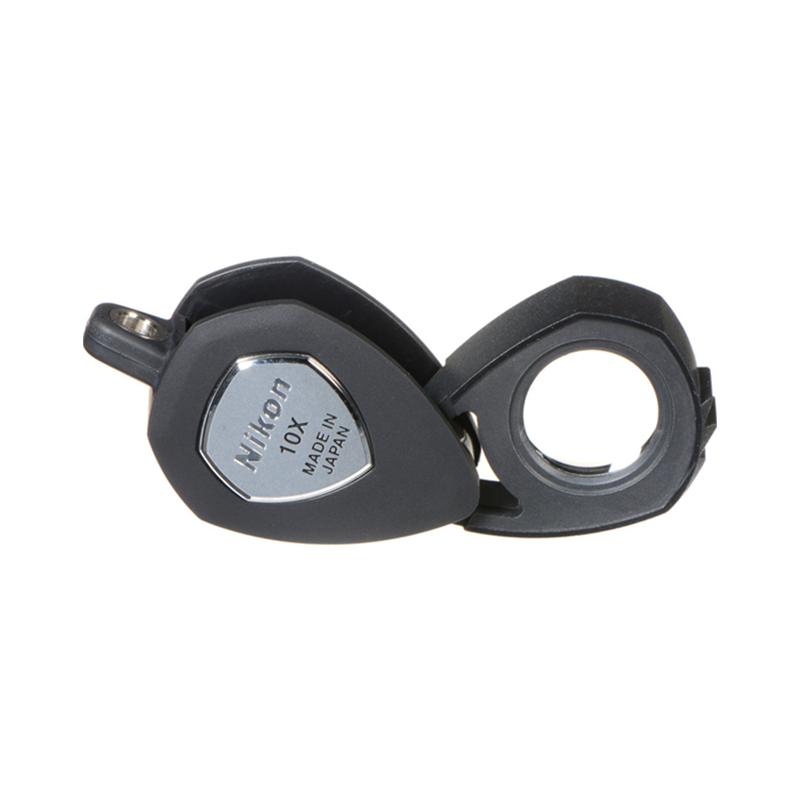
- High-Resolution Orthoscopic Design: Engineered in Japan, this 13mm triplet delivers incredible resolution exceeding 63 lines per millimeter.
- Optical Neutrality: The orthoscopic design ensures that the image is as sharp at the extreme edges as it is in the center, with zero spherical distortion.
- Verdict: The ultimate tool for detecting high-quality counterfeits and micro-printing. Its lightweight frame and 90-degree lanyard eyelet are designed for all-day professional carry.
How to Clean and Protect Your Professional Loupe
Luxury optics require specific maintenance to prevent permanent damage to the lens coatings.
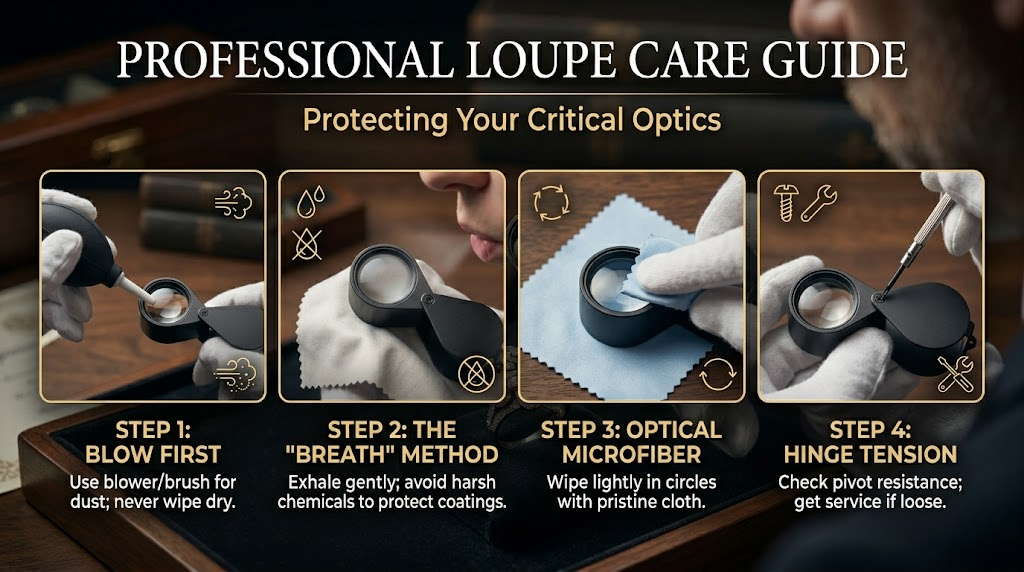
- Blow First: Use a blower or a soft brush to remove dust. Never wipe a dry lens, as vault dust can contain abrasive particles.
- The “Breath” Method: Use a gentle exhale to provide light moisture. Avoid harsh chemical solvents which can strip the T or AR coatings* over time.
- Optical Microfiber: Wipe strictly with a pristine microfiber cloth in a light, circular motion.
- Hinge Tension: A high-quality loupe should have firm resistance. If the pivot becomes loose, have it serviced to prevent the lens from accidentally striking hard surfaces.
FAQ: Expert Insights
- Q: Why choose the Zeiss D40 (10X) over the D36 (9X)?
- A: While the D36 offers flexibility (3X/6X/9X), international grading standards (GIA/CIBJO) specifically require 10X magnification for clarity grading. The D40 provides the fixed 10X triplet structure necessary for formal appraisal reports.
- Q: Is a larger lens diameter (like the Schneider 20mm) always better?
- A: A larger lens offers a wider field of view, which is more comfortable for the eyes during long sessions. However, the center 13mm is where the most critical focus occurs. Experts often use the Schneider L2 for general inspection and the Nikon or Zeiss for high-detail spot-checking.
- Q: Why does the Nikon use a plastic frame?
- A: The high-grade plastic frame reduces total weight for experts who wear the loupe around their necks all day, and more importantly, it is non-reflective, preventing glare from interfering with the stone’s color.
Need a custom quote for your Auction House Specialist team?
We provide bulk procurement for Zeiss, Schneider, and Nikon optics. Contact our for professional pricing and priority shipping.