

Why Watchmakers Require a Specialized Loupe
- Extended Usage Demands: Unlike jewelers who perform intermittent inspections, a horologist (watchmaker) uses their magnification tools for up to 8 hours a day, shifting the optical priority toward ergonomics, weight, and extreme distortion control.
- Prevention of Optical Strain: A watchmaker cannot afford optical strain, as lenses with high spherical aberration lead to severe eye fatigue, headaches, and critical errors during delicate tasks like placing escapement jewels or adjusting hairsprings.
- The Importance of Focal Length: Focal length is the most critical metric, requiring different magnification solutions to match specific tasks within the movement.
- Low-Power Utility: A low-power magnification (2x to 4x) provides a 3-to-4 inch focal length, which is necessary for general movement assembly and working with tweezers.
- High-Power Utility: High-power magnification (10x to 15x) is used exclusively for high-precision tasks such as inspecting pivot wear and jewel oiling.
Critical Optical Specs for Watchmaker Standards
For horology, optical purity must be balanced with ergonomics.
| Key Specification | Recommended Standard | Why It Matters for Watchmakers |
| Focal Length (Working Distance) | Variable (2 inches to 16 inches) | Dictates the watchmaker’s posture. A longer focal length allows the watchmaker to sit upright while using tweezers on the movement, preventing severe back and neck strain. |
| Ergonomics & Weight | Hands-free & Ultralight | Heavy tools or single-eye squinting cause muscle fatigue in the face over long shifts. The solution must support binocular vision or be ultra-lightweight. |
| Distortion Control | Aplanatic / Achromatic | Essential for identifying microscopic wear on steel pivots or assessing the exact color of heat-blued screws. |
The Evolution of Watchmaker Optics: Eye Loupes vs. Modern Ergonomics
The Traditional Eye Loupe
Historically, the iconic image of a watchmaker includes a conical “eye loupe” squeezed into the eye socket. While historically essential, they come with significant ergonomic drawbacks. Holding a loupe in the eye socket requires constant facial muscle tension, leading to severe headaches, eye strain, and a hunched posture over long 8-hour shifts.
The Modern Professional Upgrade
Today, high-volume service centers and master horologists are shifting away from traditional eye-socket loupes toward modern, ergonomic solutions that protect their vision and posture:
- For Continuous Assembly: Instead of a single eye loupe, professionals now prefer Binocular Headsets. These provide true 3D vision, allow the user to sit fully upright, and eliminate facial muscle fatigue completely.
- For Micro-Precise Oiling: For tasks that require extreme magnification, the industry standard has moved to Stereo Binocular Microscopes. A microscope provides the dedicated illumination and rock-solid stability that a handheld or eye-held tool simply cannot match.
Top 3 Magnification Solutions for Watchmakers
Engineered for continuous horological work and absolute optical neutrality, these tools from our catalog meet the strict demands of modern watch movement servicing:
1. ESCHENBACH MaxDetail 2X Headset Magnifier (Model 1624-511)
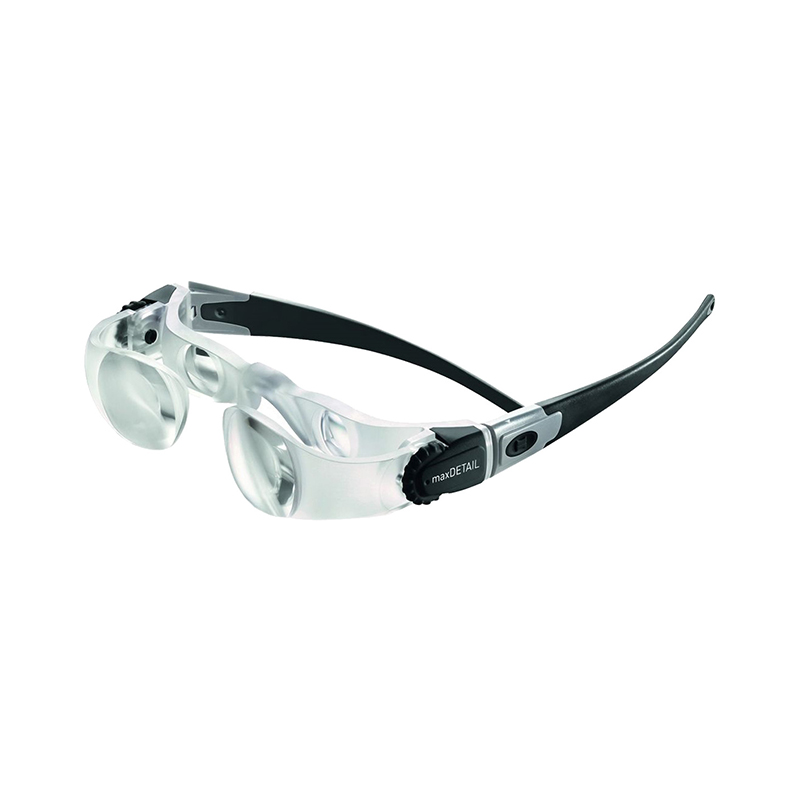
- Specs: Made in Germany. 2x Magnification (Galilean Lens), 16-inch working distance, PXM Plastic optics. Weighs an ultra-light 49g (1.7 oz).
- Verdict: The ultimate ergonomic solution for continuous, hands-free movement assembly.
- Key Advantage: Unlike traditional eye loupes that cause facial fatigue, this headset wears like comfortable prescription glasses. Weighing only 49 grams, it is practically unnoticeable during an 8-hour shift. The extended focal length allows the watchmaker to sit upright with perfect posture while using tweezers to manipulate gears, providing a clear, binocular 20-degree field of view without straining the neck or eye socket.
2. Zeiss D40 & D36 Loupe
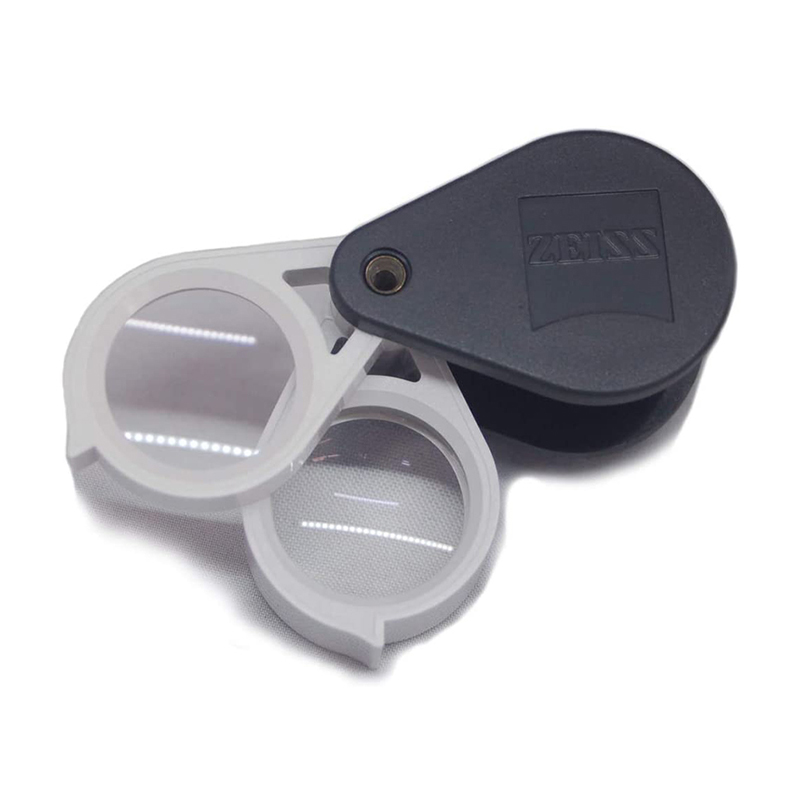
- Specs: Made in Germany. Aplanatic-achromatic triplet optics with T* Anti-Reflective Coating. D40 features fixed 10x magnification (13mm lens). D36 features a dual independent lens structure for selectable 3x, 6x, and 9x magnification (22mm lens).
- Verdict: The gold standard for high-end diagnostics, pivot inspection, and gem identification.
- Key Advantage: A master horologist relies on a flawless pocket loupe for quick, high-power inspections. When checking microscopic wear on a balance staff pivot or verifying the color of a heat-blued screw, the Zeiss triplet design eliminates color dispersion and geometric aberration. The T* coating minimizes glare under harsh bench lights, providing the extreme, edge-to-edge clarity required for top-tier servicing.
3. Tripod Loupe
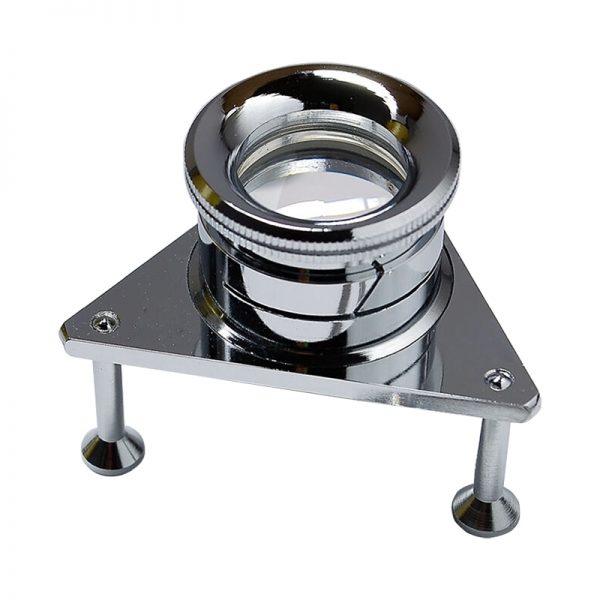
- Specs: 10x Magnification, 18mm Aplanatic & Achromatic Lens, Solid steel tripod base. Features an adjustable height mechanism (37-55mm).
- Verdict: The ideal bench-top companion for hands-free inspection of flat movement components, dials, and jewels.
- Key Advantage: A watchmaker can place this loupe directly over a watch dial, mainplate, or calendar wheel resting on the bench mat. Unlike fixed-focus models, the 37-55mm adjustable height allows you to perfectly dial in the focus depending on the thickness of the watch movement. The open steel base leaves enough room to manipulate microscopic screws with a tweezer, making it an incredibly stable, hands-free optical tool for precise bench work.
How to Clean and Protect Your Horology Optics
Watchmakers work in highly controlled, dust-free environments, but their lenses are subjected to constant skin contact and synthetic watch oils (like Moebius).
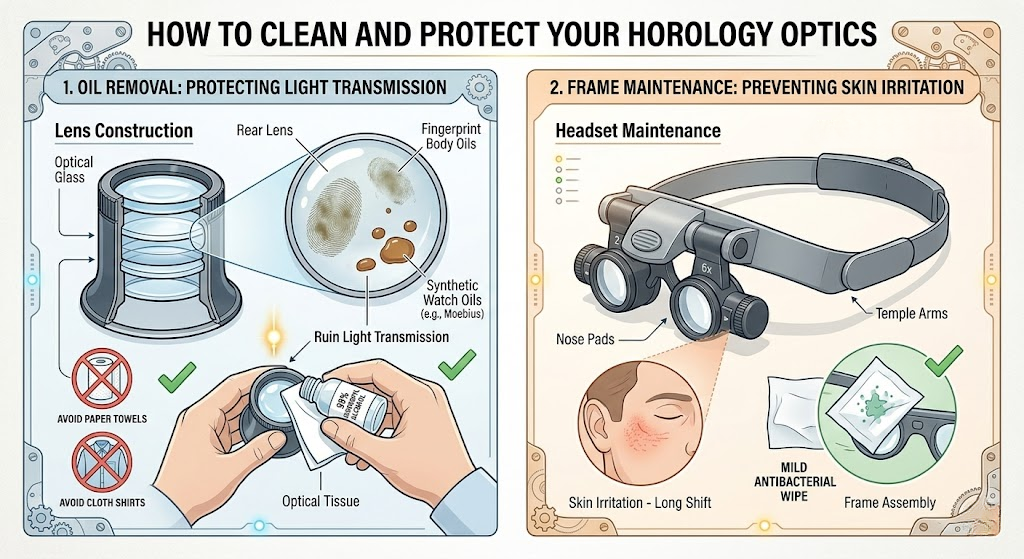
- Oil Removal: Oil transfer from fingers to the lens will ruin light transmission. Clean your lenses exclusively with specialized optical tissue and 99% isopropyl alcohol to strip away synthetic oils without leaving a film.
- Frame Maintenance: For headsets, regularly clean the nose pads and temple arms with a mild antibacterial wipe to prevent skin irritation over long shifts.
FAQ: Selecting Magnification for Watchmaking
Q: Should I use a standard 10x jewelry loupe for assembling a watch movement?
A: No. A 10x loupe has a very short focal length (about 1 inch). If you try to assemble a movement at this distance, your tweezers will hit the lens, and your back will ache from leaning in. Reserve 10x magnification for quick inspections, and use a 2x or 3x headset (like the Eschenbach MaxDetail) for continuous assembly work.
Q: Does a watchmaker really need an Achromatic (color-corrected) lens?
A: Yes, particularly when servicing high-end mechanical watches. Blued steel screws and synthetic ruby jewels have very specific color profiles. Chromatic aberration can mask the subtle discoloration of a heat-blued screw that has been damaged by moisture or improper handling.
Q: What magnification do I need to oil a watch?
A: Oiling anti-shock jewels requires pinpoint precision. While a high-quality 10x aplanatic loupe can work, professional watchmakers universally rely on a Stereo Binocular Microscope. It provides the extreme stability and 3D depth perception needed to see the exact curvature and volume of the oil drop placed on the jewel.
Need to equip your Watch Service Center?
Get a Quick Quote. Our optical specialists will respond within 3 hours.