

Why Diamond Graders Require a Specialized Loupe
- Adherence to GIA Grading Standards
- According to Gemological Institute of America (GIA) standards, all clarity assignments (from Flawless to I3) must be determined under exactly 10x magnification.
- Using a 20x or 30x loupe is considered an immediate violation of standard protocol.
- The Flaws of Standard Single-Lens Loupes
- Spherical Aberration: Causes the edges of the diamond to appear stretched or out of focus.
- Chromatic Aberration: Introduces false color fringing, which can interfere with accurate assessment.
- Mandatory Technical Specifications
- Aplanatic Correction: Required for edge-to-edge sharpness. This is essential when differentiating between minute details, such as a pinpoint inclusion (VVS) and a tiny crystal (VS).
- Achromatic Lens: Ensures the lens does not introduce artificial yellow or blue hues. This is critical when grading a diamond on the D-to-Z color scale.
- Professional Reliability
- In a rigorous grading environment, an uncalibrated loupe is viewed as a liability rather than a tool.
Critical Optical Specs for Diamond Grading Standards
When adhering to GIA or AGS protocols, your optical specifications must be flawless.
| Key Specification | Recommended Standard | Why It Matters for Diamond Graders |
| Lens Construction | Hastings Triplet | Combines three bonded lenses to effectively eliminate both chromatic (color) and spherical (shape) distortion. |
| Magnification | Strictly 10x | GIA clarity grading is explicitly defined by what is visible at 10x magnification. Higher powers narrow the field of view unnecessarily. |
| Focal Length | 25mm (1 inch) | A 25mm focal length allows enough ambient light to illuminate the diamond’s pavilion without the loupe casting a shadow over the stone. |
Top 3 Loupe Recommendations for Diamond Graders
Engineered for laboratory-grade clarity and color fidelity, these triplet loupes meet all international grading standards:
1. Harald Schneider® Diamond Loupe L1
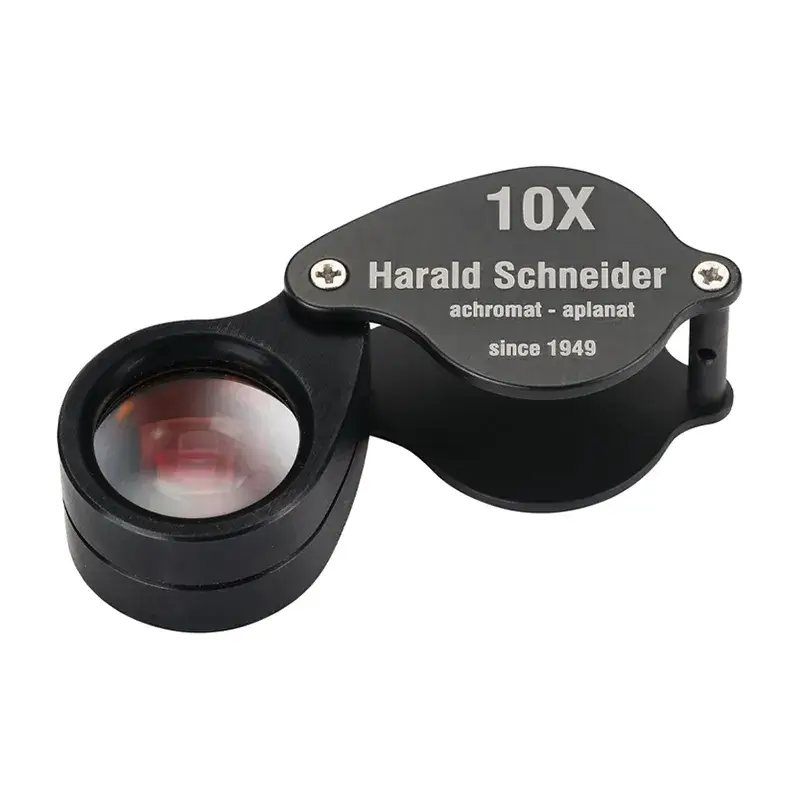
- Specs: 10x Magnification, 20mm Achromatic-Aplanatic Triplet Lens, 1″ Focal Distance, 2.46 oz.
- Verdict: The ultimate precision tool for professional jewelers, gemologists, and graders who demand the absolute highest resolution.
- Key Advantage: Custom-made in-house from premium German optical glass with a specialized anti-reflective coating to maximize light transmission. It delivers a distortion-free, razor-sharp image across the widest field of vision available, while its durable metal housing is built to withstand rigorous daily laboratory use.
2. Professional Triplet Hexagon Loupe with Rubber Grip – JYBS (Model LUEA0013)
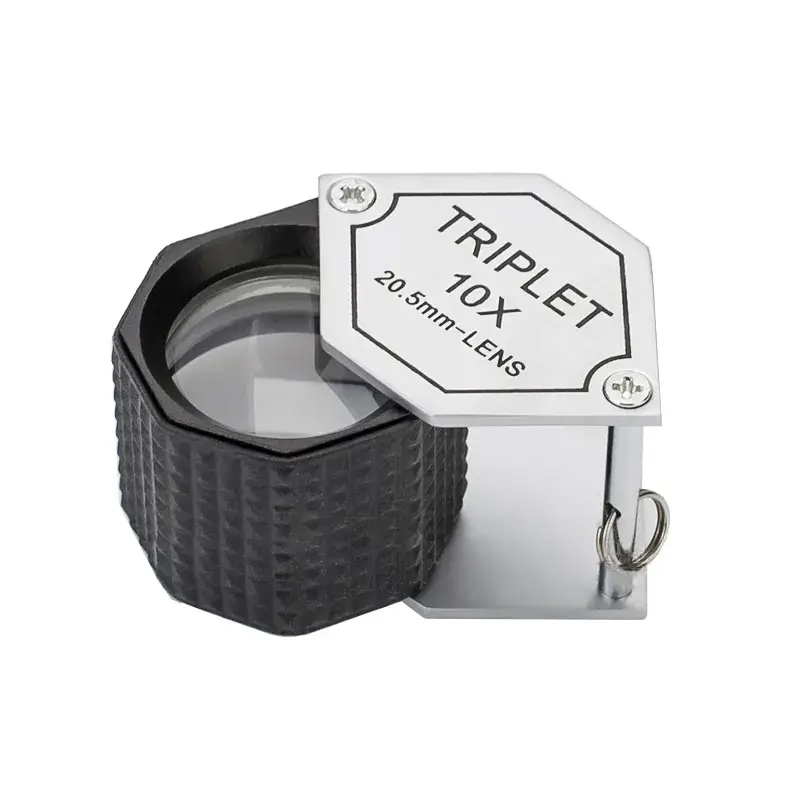
- Specs: 10x Magnification, 20.5mm Triplet Lens, 1″ Focal Distance.
- Verdict: Designed for exceptional stability, accuracy, and reduced eye strain during continuous, high-volume grading sessions.
- Key Advantage: Features ridged sides for a steady grip and a specialized flat black lens holder that actively controls glare and prevents color distortion. It provides excellent depth of field and swivels closed into a protective metal case for easy, pocket-friendly storage.
3. Illuminated 10X Triplet Loupe – JYBS (Model LUEA0017)
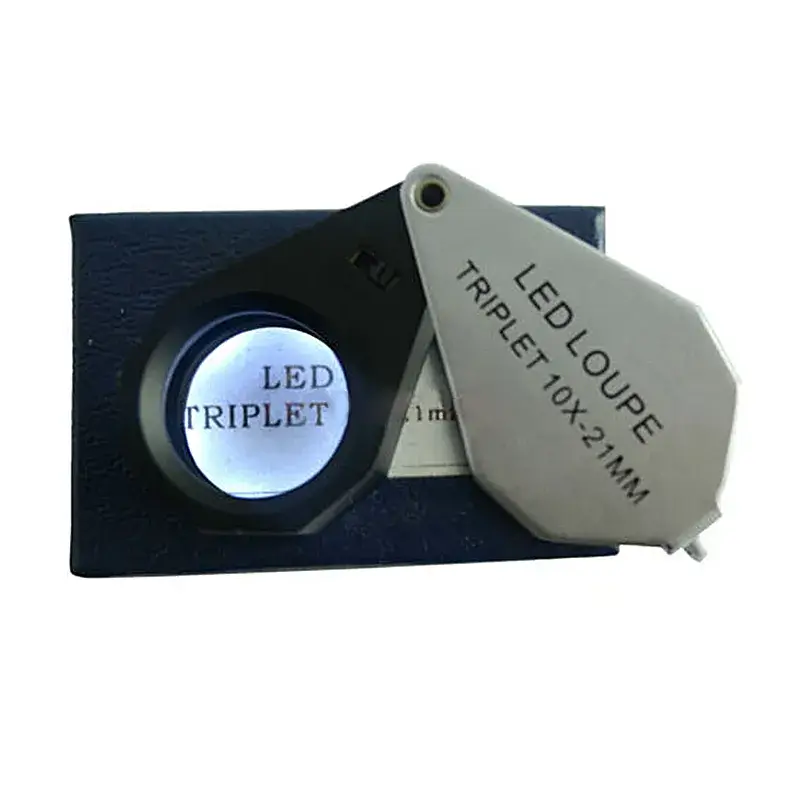
- Specs: 10x Magnification, 21mm Aplanatic & Achromatic Lens, 6 Ultra-Bright White LEDs.
- Verdict: The perfect illuminated solution for field grading, purchasing, or any environment with poor natural lighting conditions.
- Key Advantage: Six built-in LED lamps (covered with a glare-reducing diffuser) provide direct, shadow-free natural white light across all sides of the stone. Paired with a non-reflective black surround, this loupe ensures true color clarity and incredibly sharp focus, even when identifying minute inclusions outside the lab.
- Note: While LED illumination is exceptional for identifying inclusions and clarity grading in the field, official color grading should always be performed under standard ambient daylight lighting.
How to Clean and Protect Your Diamond Loupe
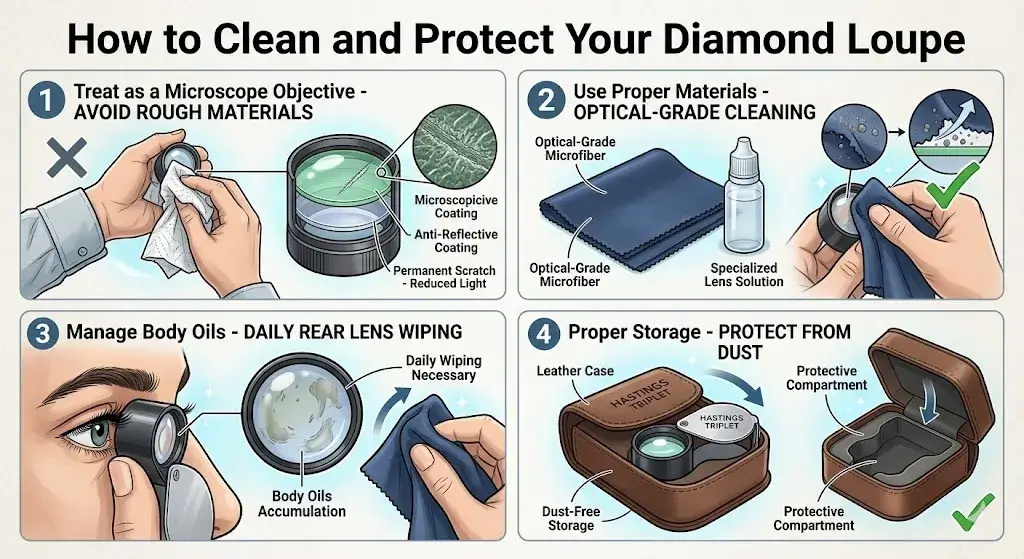
- Treat as a Microscope Objective: Avoid wiping the lens with shirts or rough paper towels, as dust particles can permanently scratch the anti-reflective coating and reduce light transmission.
- Use Proper Materials: Clean exclusively with optical-grade microfiber cloths and specialized lens cleaning solutions.
- Manage Body Oils: Because graders hold the loupe very close to the eye, eyelashes and skin can easily brush against the glass, transferring natural oils to the rear lens element. Daily wiping is necessary to remove this accumulation.
- Proper Storage: Always store the loupe closed in its leather case to prevent dust from settling on the cemented glass layers.
FAQ: Selecting a Loupe for Diamond Grading
- Q: Is a 20x loupe better for seeing small inclusions?
- A: No. While a 20x loupe makes inclusions larger, it violates GIA grading protocols. Furthermore, a 20x loupe reduces your focal length to just 12.5mm (0.5 inches), drastically limiting light entry and creating a dark, highly distorted image.
- Q: What does “Triplet” actually mean?
- A: A triplet lens consists of three separate lenses made of different types of glass (crown and flint) glued together. This specific configuration corrects both color fringing (chromatic) and edge distortion (spherical).
- Q: Why are the edges of my diamond blurry when I look through my loupe?
- A: You are using a cheap doublet or single-lens loupe that suffers from spherical aberration. A professional aplanatic triplet loupe guarantees “edge-to-edge sharpness,” meaning the perimeter is just as focused as the center.
Need to bulk buy for your Diamond Grading team?
Get a Quick Quote. Our optical specialists will respond within 3 hours.